
Medicare Hospice Benefit: Does Medicare Cover Hospice Care?
The Medicare hospice benefit is part of Part A. It covers comfort care for a terminal illness when a hospice doctor and your regular doctor certify a life expectancy of 6 months or less.
The Medicare hospice benefit pays for comfort care when an illness can’t be cured. It is part of Medicare Part A (Hospital Insurance). It covers care for a terminal illness when doctors certify a life expectancy of 6 months or less. The focus is on comfort, not on curing the illness.
Choosing hospice is a hard decision for any family. This article explains the rules as Medicare.gov and Medicare’s hospice booklet give them, with the 2026 and 2027 dollar amounts. It covers who is eligible, what is covered, what you pay and how long care can last. It doesn’t replace your doctor’s guidance. Your doctor and the hospice team are the people to ask about care.
Does Medicare cover hospice? The short answer
Yes. Part A covers hospice care when you’re eligible and you get the care from a Medicare-certified hospice. The table gives the main points.
| Question | What Medicare says |
|---|---|
| Which part pays? | Part A (Hospital Insurance) |
| Who certifies? | Your hospice doctor and your regular doctor, if you have one |
| How long? | Two 90-day benefit periods, then an unlimited number of 60-day benefit periods |
| What do you pay for hospice care? | Nothing for covered hospice services; there’s no deductible |
| Drugs for pain and symptoms | A copayment of up to $5 per prescription |
| Inpatient respite care | You may pay 5% of the amount Medicare allows |
| Room and board | Not covered where you live, including a nursing home |
| In a Medicare Advantage plan | Original Medicare still pays for hospice care |
Who is eligible for the Medicare hospice benefit?
You can get hospice care if you have Part A and meet all of Medicare’s conditions. Medicare.gov lists three:
- A doctor’s certification. Your hospice doctor and your regular doctor (if you have one) certify that you’re terminally ill, with a life expectancy of 6 months or less.
- Comfort care. You accept comfort care, also called palliative care, instead of care to cure your illness.
- A signed statement. You sign a statement choosing hospice care instead of other Medicare-covered treatments for your terminal illness and related conditions.
The statement is called a Hospice Election Statement. It names the hospice, the start date and the doctor you chose as your attending doctor. It must be completed before hospice services begin.
Only those two doctors can certify the illness. Before you decide, Medicare covers a one-time consultation with a hospice medical director or hospice doctor. You can talk about your care options and how to manage pain and symptoms. You can have this visit even if you decide against hospice.
What does Medicare hospice care cover?
Once the benefit starts, Medicare’s booklet says Original Medicare covers everything you need related to your terminal illness and related conditions. You and your family set up a plan of care with the hospice team. Depending on your condition, it can include:
- Doctor services and nursing care
- Medical equipment, like wheelchairs or walkers
- Medical supplies, like bandages and catheters
- Prescription drugs for pain and symptom control
- Hospice aide and homemaker services
- Physical and occupational therapy, and speech-language pathology services
- Social worker services and dietary counseling
- Grief and loss counseling for you and your family
- Short-term inpatient care for pain and symptom management
- Short-term respite care
A hospice nurse and doctor are on call 24 hours a day, 7 days a week. You can keep your regular doctor, a nurse practitioner or a physician assistant as your attending medical professional.
Does Medicare cover home hospice?
Yes. Hospice care is usually given in your home. Medicare & You 2027 says you can usually get it in your home or another facility where you live, like an assisted living facility or a nursing home. If the hospice team decides you need short-term inpatient care, the team arranges it.
What is respite care?
Respite care gives your usual caregiver a rest. You stay in an inpatient facility that the hospice arranges, like a hospice inpatient facility, hospital or nursing home. You can stay up to 5 days each time. You can get respite care more than once, but only on an occasional basis.
What isn’t covered once hospice starts?
Medicare stops paying for care meant to cure the terminal illness. The hospice booklet lists five things the benefit won’t cover:
- Treatment intended to cure your terminal illness or related conditions
- Prescription drugs that aren’t for your terminal illness or related conditions. Medicare drug coverage (Part D) may cover these.
- Care from a provider the hospice team didn’t set up. You can still see the regular doctor you chose as your attending professional.
- Room and board. Medicare covers a short-term inpatient or respite stay that the hospice team arranges.
- Emergency room care, inpatient hospital care or ambulance transportation, unless the hospice team arranges it or it is unrelated to your terminal illness
Contact your hospice team before you get any of these services, or you might have to pay the full cost.
What about other health problems?
Original Medicare still pays for covered services for health problems that aren’t part of your terminal illness. You pay the usual deductible and coinsurance for that care. For hospice care chosen on or after October 1, 2026, federal rules say the hospice must give you a written list of the conditions, items, services and drugs it considers unrelated to your illness, with its reasons, within the first 5 days. If you chose hospice earlier, or haven’t received the list, ask for it.
Does Medicare pay for hospice in full? What you pay in 2026
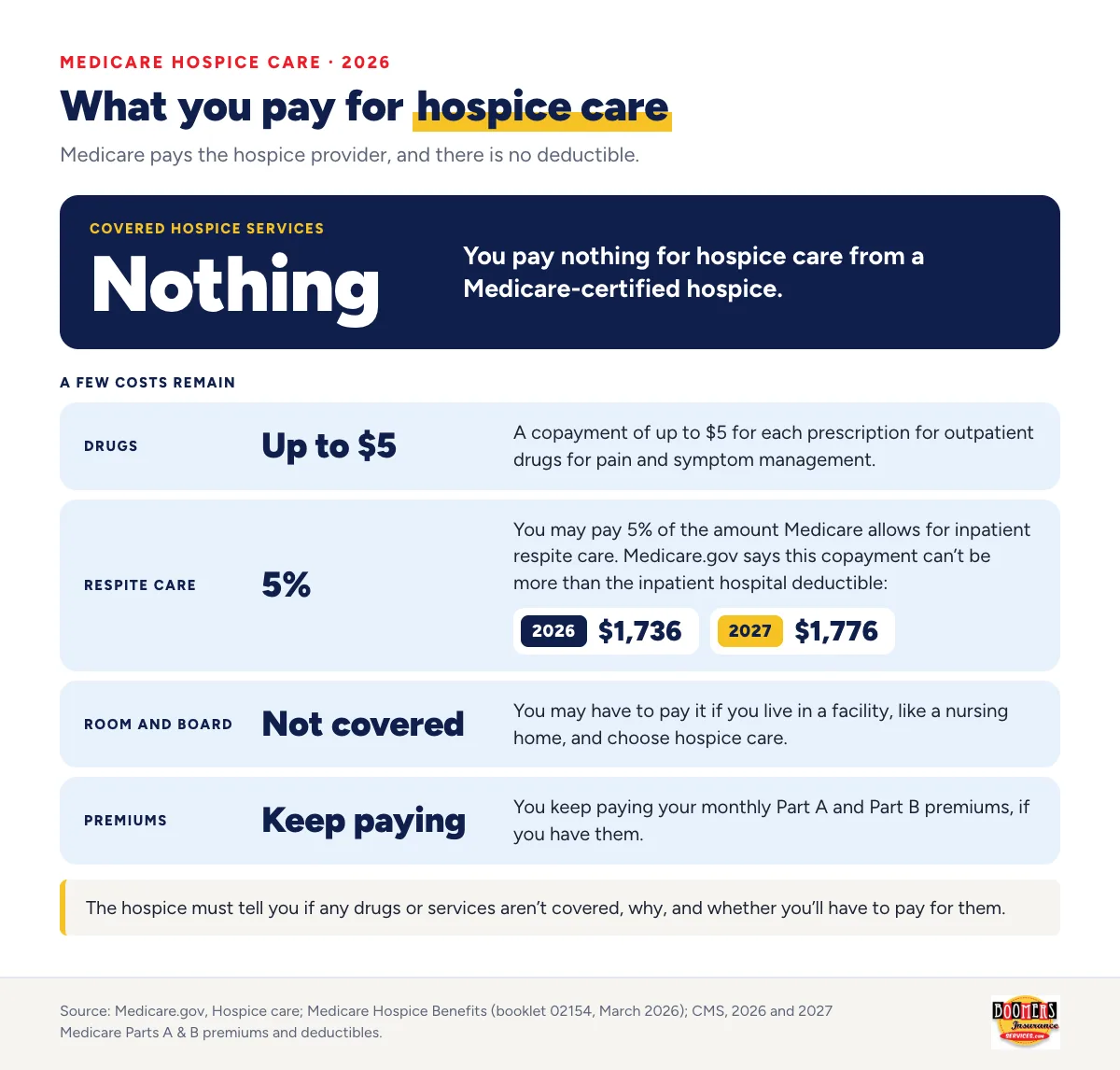
Medicare pays the hospice provider, and there is no deductible. You pay nothing for hospice care from a Medicare-certified hospice. A few costs remain:
- Drugs: a copayment of up to $5 for each prescription for outpatient drugs for pain and symptom management
- Respite care: you may pay 5% of the amount Medicare allows for inpatient respite care. Medicare.gov says this copayment can’t be more than the inpatient hospital deductible, which is $1,736 in 2026 and $1,776 in 2027.
- Room and board: you may have to pay it if you live in a facility, like a nursing home, and choose hospice care
- Premiums: you keep paying your monthly Part A and Part B premiums, if you have them
The hospice must tell you if any drugs or services aren’t covered, why, and whether you’ll have to pay for them.
Most Medigap plans cover hospice costs for drugs and respite care in full. Medigap Plans K and L pay 50% and 75% of that cost sharing. See our guide to Medicare Supplement plans. For the rest of Part A, see what Medicare Part A is.
How long will Medicare pay for hospice?
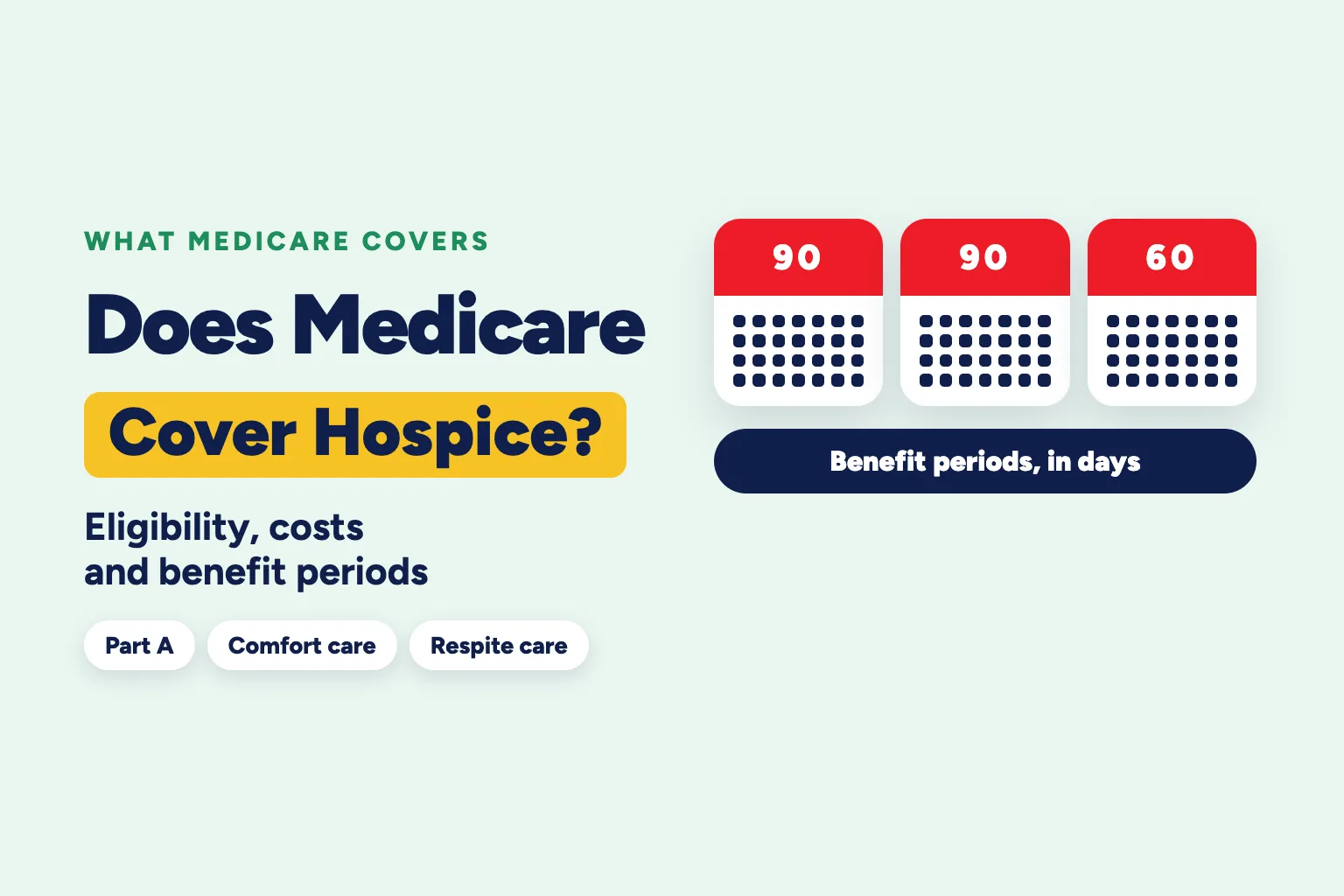
The Medicare hospice benefit has no fixed end date. Medicare covers two 90-day benefit periods, followed by an unlimited number of 60-day benefit periods. Care can continue past 6 months as long as a hospice doctor recertifies that you’re terminally ill.
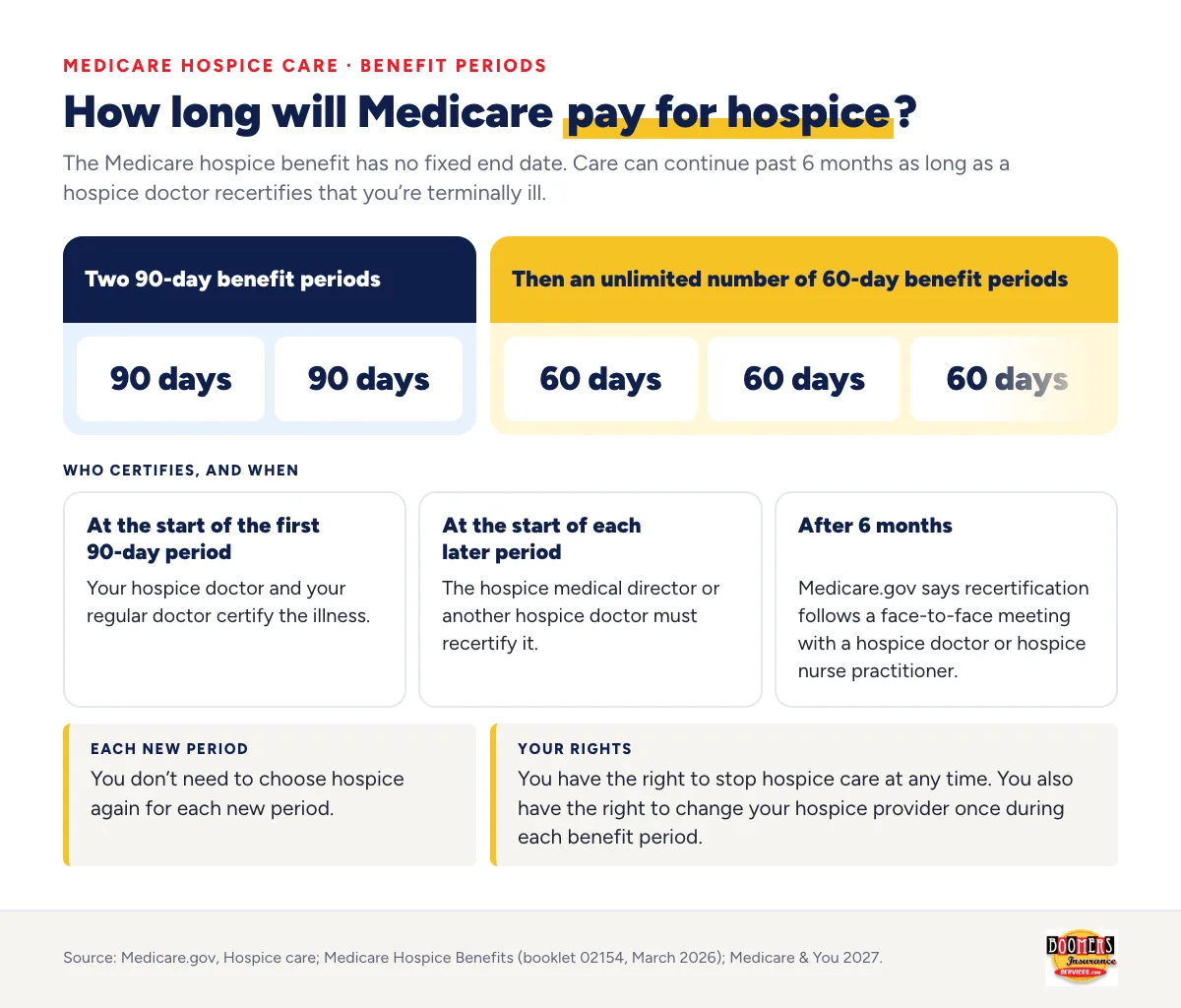
- At the start of the first 90-day period, your hospice doctor and your regular doctor certify the illness.
- At the start of each later period, the hospice medical director or another hospice doctor must recertify it.
- After 6 months, Medicare.gov says recertification follows a face-to-face meeting with a hospice doctor or hospice nurse practitioner.
You don’t need to choose hospice again for each new period.
Medicare and hospice: what if you’re in a Medicare Advantage plan?
Original Medicare pays for hospice care even if you’re in a Medicare Advantage plan. You don’t have to leave your plan. Medicare’s booklet says you can stay in it as long as you pay your plan’s premiums.
- Finding a hospice. Your plan must help you locate a Medicare-certified hospice in your area.
- Other health problems. Your plan can still cover services that aren’t part of your terminal illness. You can get them from the plan’s network or from providers in Original Medicare. What you pay depends on the plan and its rules.
- Extra benefits. The plan still covers any extra services that are medically necessary, like dental and vision benefits, while you pay your premiums.
- Drugs. If your plan includes drug coverage, it covers drugs that aren’t related to your terminal illness.
Medicare’s booklet on Medicare Advantage plans says you may need to show your red, white and blue Medicare card for hospice care. Our guide to what Medicare Advantage is explains how plans work.
Can you stop hospice or change providers?
Yes. You have the right to stop hospice care at any time. You also have the right to change your hospice provider once during each benefit period.
- Stopping. The hospice asks you to sign a form with the date your care will end. Nobody should ask you to sign it unless you asked to stop.
- Going back. If you’re eligible, you can return to hospice care at any time.
- If the hospice says you no longer qualify. You have the right to ask for a fast review by an independent reviewer, called a Beneficiary and Family Centered Care Quality Improvement Organization (BFCC-QIO). The hospice should give you a notice that explains how.
- After hospice in a Medicare Advantage plan. If you’ve kept paying premiums, your plan’s coverage continues. Medicare.gov says it starts again the first day of the following month.
Medicare also warns about hospice fraud. Only a doctor can certify a terminal illness. Medicare’s booklet says never to accept perks or gifts for signing up for hospice services. Report concerns at 1-800-MEDICARE (TTY 1-877-486-2048), 24 hours a day, 7 days a week, except some federal holidays.
Next steps
Start with your doctor, because the Medicare hospice benefit begins with a doctor’s certification. Then choose a provider and ask about costs.
- Talk with your doctor about whether hospice fits your situation.
- Ask for the one-time hospice consultation to hear your options.
- Compare hospice providers at Medicare.gov/care-compare.
- Call your plan if you’re in Medicare Advantage, and ask for help finding a hospice.
- Ask the hospice which items, services and drugs it won’t cover, and what you would pay.
- Plan for daily care. Our articles on Medicare home health care and long-term care explain other help at home and in a facility. Our guide to the Program of All-Inclusive Care for the Elderly (PACE) in California covers another option. In California, HICAP counselors can answer Medicare questions at 1-800-434-0222.
Talk with a licensed Boomers agent
A licensed Boomers agent can go over the Medicare plans we represent in your area and check them against your doctors and prescriptions. We can also explain how your current coverage works alongside hospice care.
Find a licensed agent near you · See upcoming Medicare events
Or call 1-800-815-1943 (TTY 711), Monday – Friday, 9 AM – 5 PM Pacific.
Frequently asked questions
Does Medicare cover hospice in a nursing home?
Medicare covers the hospice care itself wherever you live, including a nursing home. It doesn’t cover room and board there. Ask the facility what you would owe. If you have Medi-Cal, California’s Medicaid program, ask your county office how it treats nursing home costs.
What happens if someone lives longer than 6 months?
Hospice care can continue. A hospice doctor must recertify the terminal illness at the start of each benefit period. There is no limit on the number of 60-day benefit periods.
Do I have to give up my regular doctor?
No. You can choose your regular doctor, a nurse practitioner or a physician assistant as your attending medical professional. That person helps supervise your hospice care alongside the hospice team.
Does Medicare cover comfort care without hospice?
Medicare.gov says Medicare may cover services that are part of palliative care even if you don’t choose hospice. For example, it may cover them through the home health benefit if you’re eligible.
Sources
- Hospice care (Medicare.gov)
- Medicare Hospice Benefits, booklet 02154, March 2026 (Medicare.gov)
- Medicare & You 2027 handbook (Medicare.gov)
- 2026 Medicare Parts A & B premiums and deductibles (CMS.gov, November 14, 2025)
- 2027 Medicare Parts A & B premiums and deductibles (CMS.gov, November 17, 2026)
- Understanding Medicare Advantage Plans, April 2026 (Medicare.gov)
- 42 CFR 418.24, election of hospice care (eCFR)
- Choosing a Medigap Policy, March 2026 (Medicare.gov)
- 42 CFR 418.28 and 418.30, revoking hospice and changing the hospice (eCFR)
- Find and compare hospice providers (Medicare.gov)
- Medicare Counseling (HICAP) (California Department of Aging)
Talk with a licensed Boomers agent
A licensed agent can go over the Medicare plans we represent in your area, check them against your doctors and prescriptions, and answer your questions. There is no cost to you and no obligation to enroll.
Monday – Friday, 9 AM – 5 PM PT