
Medicare Flex Card, Grocery Allowance and Gym Benefits: What Is Real
A Medicare flex card doesn’t come from Medicare itself. Original Medicare doesn’t issue flex cards and doesn’t cover gym memberships or fitness programs. A fitness program, a prepaid card or a grocery allowance is an extra benefit that some Medicare Advantage plans offer.
Is the Medicare flex card real? Not as a card from Medicare. Original Medicare doesn’t issue flex cards, and Medicare.gov says it doesn’t cover gym memberships or fitness programs. A grocery allowance isn’t an Original Medicare benefit either.
These are extra benefits that some Medicare Advantage plans choose to offer. They differ from plan to plan and from one area to the next. Some are only for members who meet the plan’s criteria. This guide uses Medicare.gov, the Medicare & You 2027 handbook and the federal rules for plans from the Centers for Medicare & Medicaid Services (CMS).
Medicare flex card, grocery allowance and gym benefits: the short answer
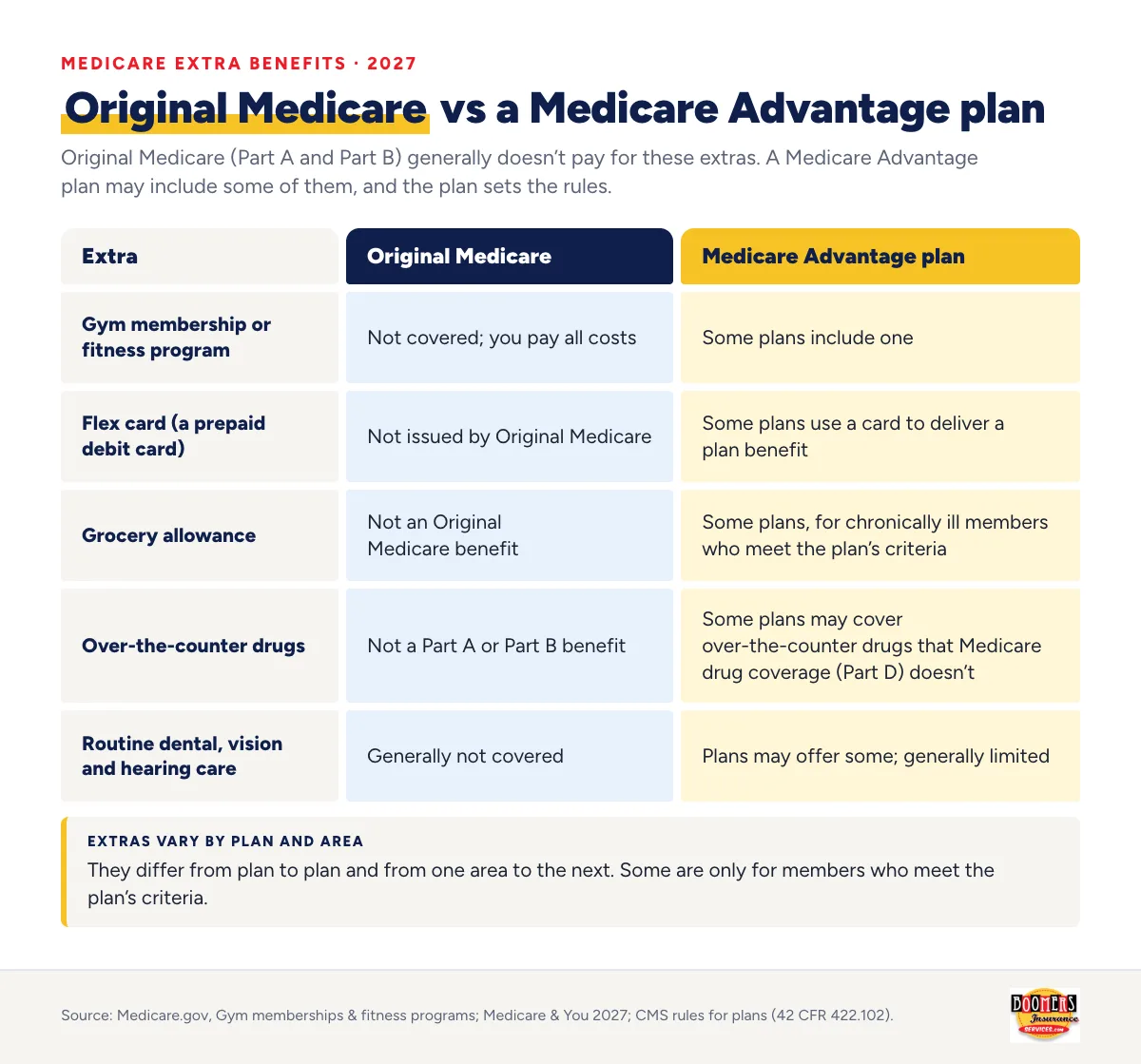
Original Medicare (Part A and Part B) generally doesn’t pay for these extras. A Medicare Advantage plan may include some of them, and the plan sets the rules. The table shows where each one stands.
| Extra | Original Medicare | Medicare Advantage plan |
|---|---|---|
| Gym membership or fitness program | Not covered; you pay all costs | Some plans include one |
| Flex card (a prepaid debit card) | Not issued by Original Medicare | Some plans use a card to deliver a plan benefit |
| Grocery allowance | Not an Original Medicare benefit | Some plans, for chronically ill members who meet the plan’s criteria |
| Over-the-counter drugs | Not a Part A or Part B benefit | Some plans may cover over-the-counter drugs that Medicare drug coverage (Part D) doesn’t |
| Routine dental, vision and hearing care | Generally not covered | Plans may offer some; generally limited |
Medicare Advantage plans are offered by private companies that contract with Medicare. They must cover the medically necessary services that Original Medicare covers, except hospice and a few others. Extras come on top of that. Our guide to what Medicare Advantage is explains how the plans work.
What Original Medicare doesn’t cover, and what you pay
Medicare.gov says you pay all costs for services Medicare doesn’t cover, including gym memberships and fitness programs. Original Medicare also doesn’t cover non-medical long-term care, also called custodial care. Part B does cover many preventive services, like a yearly Wellness visit.
In a Medicare Advantage plan, an extra benefit can have its own limits, and a plan may charge a copayment for it. Some extras are optional and cost an added premium. The plan’s Evidence of Coverage lists the details.
Silver Sneakers and Medicare: how does a fitness benefit work?
People often search for “Silver Sneakers” (SilverSneakers) together with Medicare. Medicare.gov’s page on gym memberships and the Medicare & You 2027 handbook don’t name any fitness brand. They speak only of gym memberships and fitness programs, which Original Medicare doesn’t cover.
Medicare.gov says gym memberships or fitness programs “may be part of the extra coverage” offered by:
- Medicare Advantage plans
- other Medicare health plans
- Medicare Supplement Insurance (Medigap) plans
Medicare.gov’s advice is to call your plan to see if it covers gym memberships or fitness programs. We don’t recommend one fitness program over another.
If a fitness benefit matters to you, ask the plan these questions before you join:
- Does the plan include a fitness benefit in 2027, and which program is it?
- Which gyms or classes near your home take part?
- Is there any cost to you?
- Does the benefit continue if you travel or move?
What is a Medicare flex card?
There is no flex card from Medicare itself. “Flex card” is a marketing name for a prepaid debit card that some Medicare Advantage plans give members to use a plan benefit. The Senior Medicare Patrol (SMP), a program funded by the federal Administration for Community Living, says some plans offer these cards “to eligible members to cover some health-related expenses.”
CMS rules for plans (42 CFR 422.102) set conditions for a debit card that a plan uses to deliver a covered benefit:
- The card must be electronically linked to items and services the plan covers, and checked at the point of sale.
- The card is limited to the plan year.
- The plan must give instructions and customer service support.
- The plan must have another way to reimburse a covered expense when the card can’t be used.
So the card comes from a plan, not from Medicare, and it works only for what that plan covers.
Who qualifies for the flex card?
Only members of a plan that offers one, and only under that plan’s rules. Nobody gets a card just for having Medicare. A plan may give an allowance to each of its members, or it may limit a benefit to members with certain chronic illnesses.
Medicare & You 2027 says you can check with a plan before you join to find out if it offers benefits for people with specific conditions. It adds that “you’ll need to wait until you join the plan to find out if you qualify.”
Medicare grocery allowance: who is it for?
CMS guidance lists food and produce as a benefit a plan may offer as a Special Supplemental Benefit for the Chronically Ill (SSBCI). It is not for every member. Groceries aren’t medical care, and CMS rules let a plan offer a benefit that is “not primarily health related” only as an SSBCI.
Under those rules, a chronically ill member is someone who meets all three of these conditions:
- has one or more comorbid and medically complex chronic conditions that are life threatening or that significantly limit overall health or function
- has a high risk of hospitalization or other adverse health outcomes
- requires intensive care coordination
A chronic condition alone isn’t enough. The plan must also apply its own written, objective criteria for each benefit, and it must post those criteria on its public website. CMS rules say plans may not offer alcohol, tobacco or non-healthy food as an SSBCI.
Plan ads that mention these benefits must carry a disclaimer. It lists the chronic conditions involved (up to five, with a note if there are more). It also tells you that a member with a listed condition won’t necessarily receive the benefit.
If you have both Medicare and Medi-Cal, see our guide to Medi-Medi plans.
Misleading flex card ads and scams: what are the red flags?
Be careful with any ad, call or text that says Medicare is handing out a card with money on it. SMP warns that such ads send people to a website that asks for a Social Security number, credit card number or bank account information. SMP notes that these cards come from some Medicare Advantage plans, not from Original Medicare.
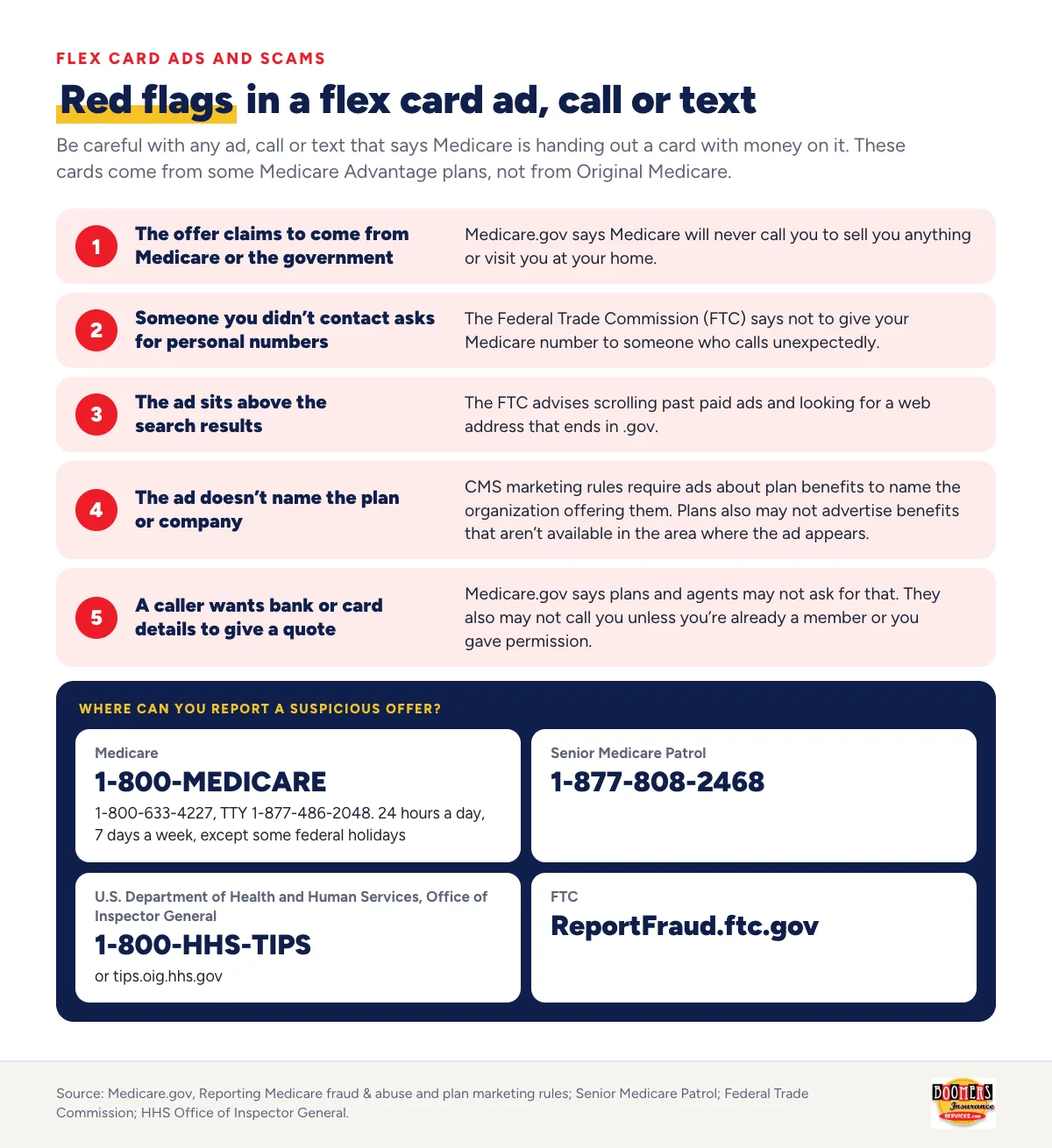
Watch for these warning signs:
- The offer claims to come from Medicare or the government. Medicare.gov says Medicare will never call you to sell you anything or visit you at your home.
- Someone you didn’t contact asks for personal numbers. The Federal Trade Commission (FTC) says not to give your Medicare number to someone who calls unexpectedly.
- The ad sits above the search results. The FTC advises scrolling past paid ads and looking for a web address that ends in .gov.
- The ad doesn’t name the plan or company. CMS marketing rules require ads about plan benefits to name the organization offering them. Plans also may not advertise benefits that aren’t available in the area where the ad appears.
- A caller wants bank or card details to give a quote. Medicare.gov says plans and agents may not ask for that. They also may not call you unless you’re already a member or you gave permission.
Where can you report a suspicious offer?
- Medicare: 1-800-MEDICARE (1-800-633-4227, TTY 1-877-486-2048), 24 hours a day, 7 days a week, except some federal holidays
- Senior Medicare Patrol: 1-877-808-2468
- U.S. Department of Health and Human Services, Office of Inspector General: 1-800-HHS-TIPS, or tips.oig.hhs.gov
- FTC: ReportFraud.ftc.gov
If you gave out your Medicare card details, see how to replace a Medicare card.
What should you check before choosing a Medicare Advantage plan for its extras?
Extras are one part of a plan, and they can change each year. Medicare & You 2027 says these benefits “are generally limited.” It suggests checking with the plan before you join to learn what exactly is covered and whether the benefits are available to you.
- Start with your care. Check your doctors, hospitals and prescriptions against the plan first.
- Read the limits. The plan’s Evidence of Coverage lists what each extra covers and where you can use it.
- Ask who can get it. Find out whether an extra is for each member or only for members with certain conditions.
- Expect yearly changes. Plans send an Annual Notice of Change by September 30. An extra offered in 2026 may differ in 2027.
- Weigh the whole plan. Our article on the pros and cons of Medicare Advantage plans covers networks, costs and prior approval.
You can change plans during Medicare Open Enrollment, October 15 to December 7. Our Annual Enrollment guide explains the dates. For dental, vision and hearing extras, see what Medicare covers for dental, vision and hearing.
Next steps
Medicare flex card, grocery and gym questions come down to one thing: what your own plan, or a plan you’re considering, includes for 2027. These steps help you find out.
- Look at your plan’s materials. If you’re in a Medicare Advantage plan, read its Evidence of Coverage or call the number on your plan card.
- Compare plans at Medicare.gov, where each plan’s benefits are listed.
- Ignore offers that claim to come from Medicare. Report them using the numbers above.
- Get neutral help. In California, call HICAP, the Health Insurance Counseling & Advocacy Program, at 1-800-434-0222 for one-on-one counseling.
Talk with a licensed Boomers agent
A licensed Boomers agent can go over the Medicare plans we represent in your area and check them against your doctors and prescriptions. We can also show you which extra benefits those plans list for 2027 and who can use them.
Find a licensed agent near you · See upcoming Medicare events
Or call 1-800-815-1943 (TTY 711), Monday – Friday, 9 AM – 5 PM Pacific.
Frequently asked questions
Does Medicare cover Silver Sneakers?
Original Medicare doesn’t. Medicare.gov says it doesn’t cover gym memberships or fitness programs, and you pay all costs. Some Medicare Advantage plans, other Medicare health plans and Medigap plans include a fitness program as extra coverage. Call your plan to ask.
Is the Medicare flex card real?
Original Medicare doesn’t issue flex cards. Some Medicare Advantage plans give members a prepaid card to use a plan benefit, under that plan’s rules. An offer of a card “from Medicare” is a warning sign of a scam.
Can I get a Medicare grocery allowance with Original Medicare?
No. A grocery allowance isn’t an Original Medicare benefit. Some Medicare Advantage plans offer a grocery benefit to chronically ill members who meet the plan’s criteria. Having a listed condition doesn’t mean you’ll receive it.
Do extra benefits stay the same every year?
Not always. A plan can change its benefits, costs and rules each January. Read the Annual Notice of Change your plan sends by September 30.
Sources
- Gym memberships & fitness programs (Medicare.gov)
- Medicare & You 2027 handbook (Medicare.gov)
- Understanding Medicare Advantage Plans, April 2026 (Medicare.gov)
- 42 CFR 422.100, general requirements for benefits (eCFR)
- 42 CFR 422.102, supplemental benefits, SSBCI and debit cards (eCFR)
- Long-term care (Medicare.gov)
- 42 CFR 422.2263 and 422.2267, plan marketing rules and the SSBCI disclaimer (eCFR)
- Marketing rules for Medicare health & drug plans (Medicare.gov)
- Reporting Medicare fraud & abuse (Medicare.gov)
- Supplemental benefits for the chronically ill, guidance to plans, April 24, 2019 (CMS.gov)
- Flex Card Scam Circulates (Senior Medicare Patrol)
- Medicare fraud affects everyone, May 2026 (FTC)
- What to know ahead of Open Enrollment to avoid health insurance scams, September 2026 (FTC)
- Report fraud (HHS Office of Inspector General)
- Medicare Counseling (HICAP) (California Department of Aging)
Talk with a licensed Boomers agent
A licensed agent can go over the Medicare plans we represent in your area, check them against your doctors and prescriptions, and answer your questions. There is no cost to you and no obligation to enroll.
Monday – Friday, 9 AM – 5 PM PT