
What Is Medicare Advantage? Medicare Part C in Plain English
What is Medicare Advantage? It is another way to get your Medicare Part A and Part B coverage, through a plan from a private company that contracts with Medicare. Most plans include drug coverage, and plans must set a yearly limit on what you pay for covered Part A and Part B services.
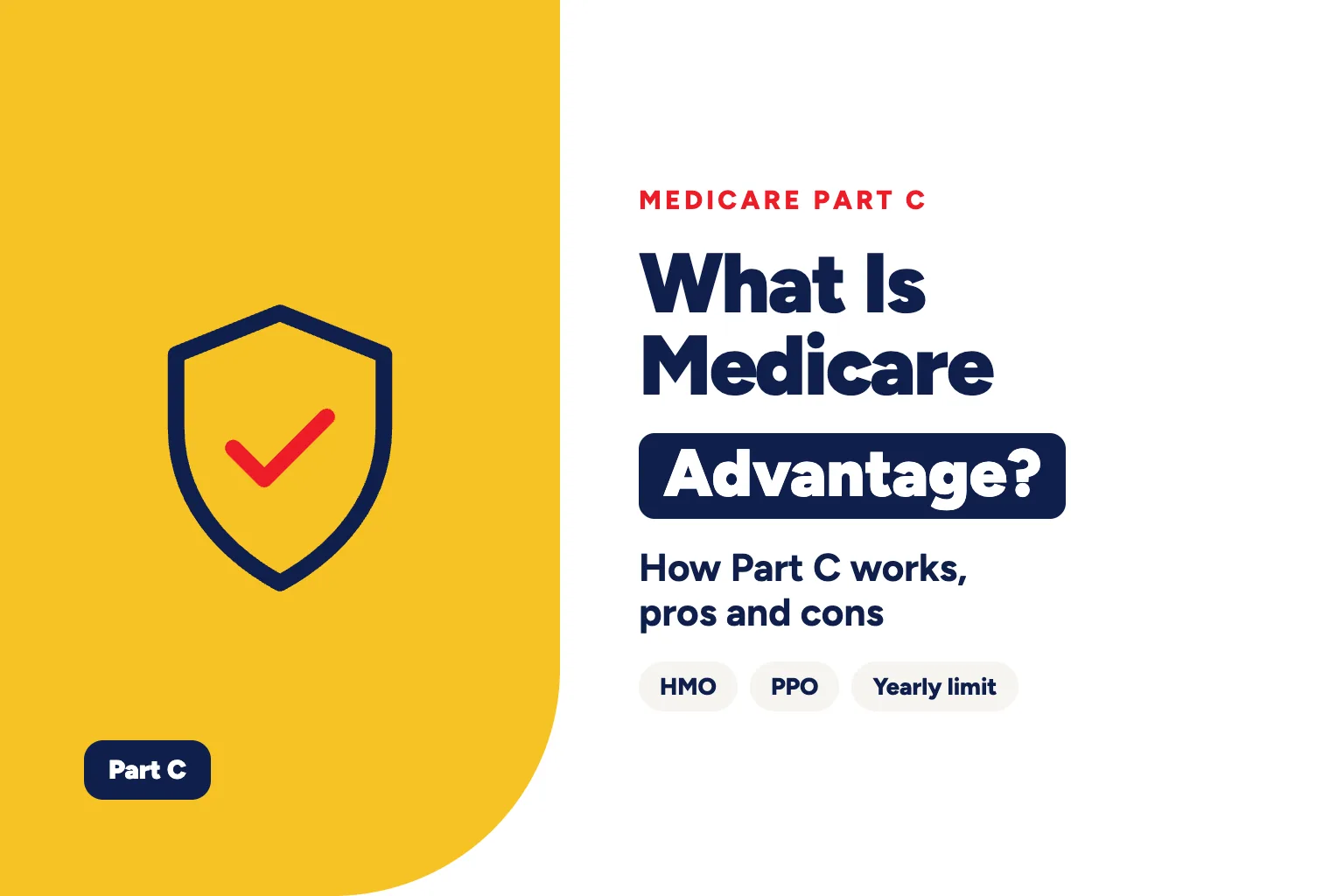
What is Medicare Advantage? It is another way to get your Medicare Part A (hospital) and Part B (medical) coverage. Instead of Original Medicare paying your bills, a private company that contracts with Medicare runs your plan. Medicare Advantage is also called Medicare Part C, or an "MA plan."
You still have Medicare when you join. You keep the same rights and protections. But your plan sets its own costs and rules, and those can change each year. This guide explains how it works in 2026 and 2027, in plain English.
What is Medicare Advantage, also called Medicare Part C?
So what is Medicare Part C? It is another name for Medicare Advantage. Medicare pays a fixed amount each month to the company that offers your plan. In return, the plan must follow rules set by Medicare.
Most plans bundle three things into one card:
- Part A: hospital stays, skilled nursing facility care and some home health care
- Part B: doctor visits, outpatient care, medical equipment and preventive care
- Part D: prescription drugs (most plans include it)
You use the plan's card for covered care. Keep your red, white and blue Medicare card in a safe place. You may need it for some services, and you will need it if you go back to Original Medicare.
What does Medicare Part C cover?
Medicare & You 2027 says plans cover almost all medically necessary services that Original Medicare covers. A few things stay with Original Medicare even when you are in a plan: hospice care, kidney transplant costs and some costs of clinical research studies.
Drug coverage
Most Medicare Advantage plans include Part D drug coverage. If you join an HMO or PPO plan without drug coverage, you generally can't add a separate drug plan. Medical Savings Account plans and some Private Fee-for-Service plans don't include drug coverage. With those, you can join a separate drug plan.
Extra benefits
Many plans add benefits Original Medicare doesn't cover, such as some dental, vision and hearing care, or gym programs. Medicare & You 2027 says these extras "are generally limited," so check what a plan covers before you join. Our article on dental, vision and hearing coverage explains what Original Medicare leaves out.
How does Medicare Advantage work day to day?
Each plan sets its own rules for how you get care. The main ones to check are:
- Networks. Many plans ask you to use doctors, hospitals and other providers in the plan's network for care that isn't an emergency or urgent.
- Referrals. Some plans ask you to get a referral from your primary care doctor before you see a specialist.
- Prior authorization. For certain services, supplies or drugs, you may need the plan's approval before it covers them.
- Service area. You must live in the plan's service area to join.
- Travel. Plans generally don't cover care outside the U.S., though some offer emergency and urgent care abroad as an extra.
Plans must tell you about changes for next year in the Annual Notice of Change. Your plan must send it to you, printed or electronic, by September 30.
You still pay the Part B premium
Joining a plan doesn't replace your Part B premium. You keep paying it ($202.90 a month for most people in 2026, per CMS) unless Medi-Cal or a Medicare Savings Program pays it for you. Some plans help pay all or part of your Part B premium, and some charge their own monthly premium. Our Medicare cost guide explains these costs in more detail.
The Medicare Advantage out-of-pocket maximum
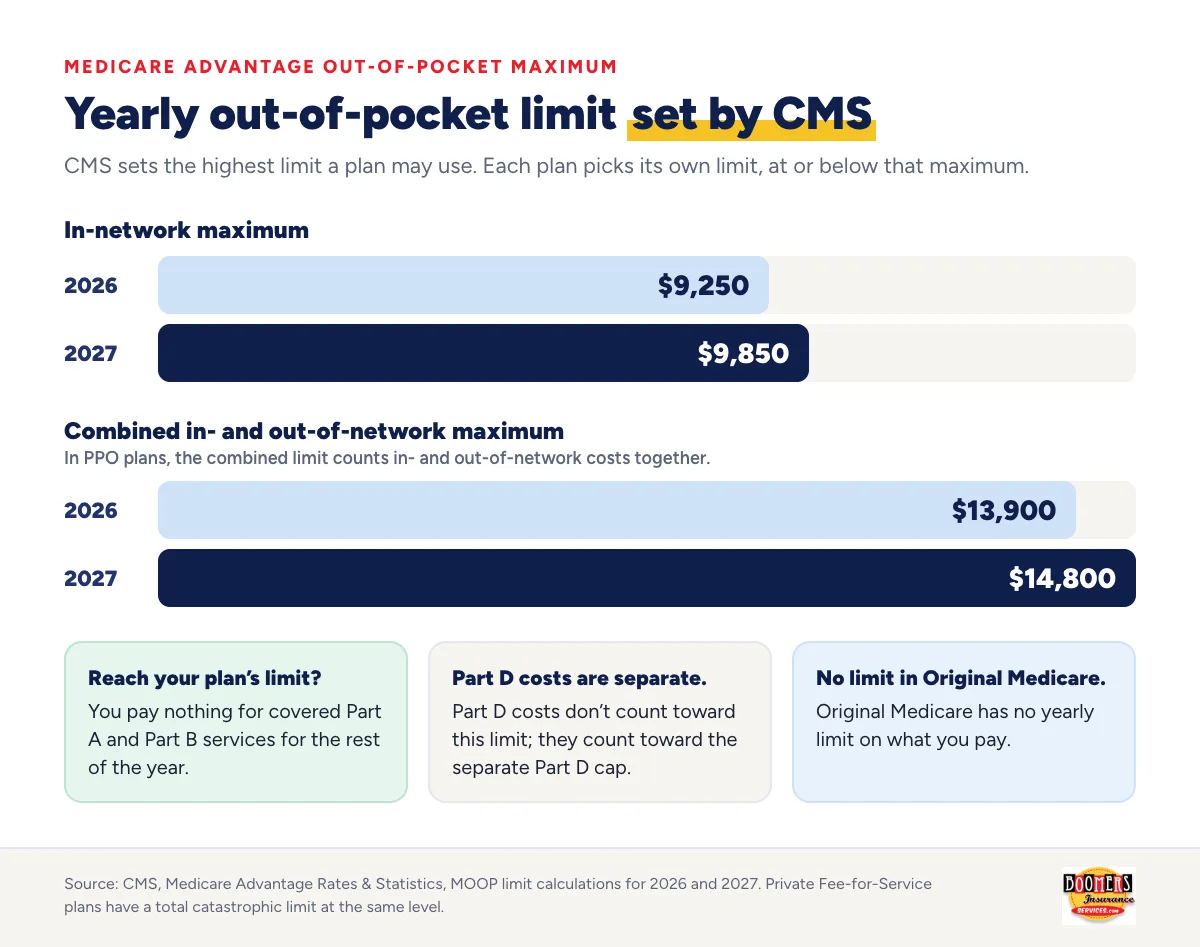
Original Medicare has no yearly limit on what you pay. Medicare Advantage plans do. Once you reach your plan's limit, you pay nothing for covered Part A and Part B services for the rest of the year.
CMS sets the highest limit a plan may use. Each plan picks its own limit, at or below that maximum.
| Year | In-network maximum | Combined in- and out-of-network maximum |
|---|---|---|
| 2026 | $9,250 | $13,900 |
| 2027 | $9,850 | $14,800 |
Source: CMS, Medicare Advantage Rates & Statistics, MOOP limit calculations for 2026 and 2027. In PPO plans, the combined limit counts in- and out-of-network costs together. Private Fee-for-Service plans have a total catastrophic limit at the same level. Part D drug costs don't count toward this limit; they count toward the separate Part D cap.
What types of Medicare Advantage plans are there?
| Plan type | In short |
|---|---|
| HMO (Health Maintenance Organization) | Generally in-network care only, except emergencies, out-of-area urgent care and temporary out-of-area dialysis; many need referrals |
| PPO (Preferred Provider Organization) | In-network care costs less; you can generally go out of network for covered services, but usually pay more |
| PFFS (Private Fee-for-Service) | The plan sets what it pays providers and what you pay; a provider must accept the plan's terms |
| SNP (Special Needs Plan) | For people with certain chronic conditions, people who live in, or need the level of care of, a facility like a nursing home, or people with Medicare and Medicaid |
| MSA (Medical Savings Account) | A high-deductible plan paired with an account the plan puts money into; no drug coverage in the plan |
Our guide to Medicare Advantage HMO vs PPO compares those two types side by side. If you have Medicare and full Medi-Cal, see Medi-Medi plans.
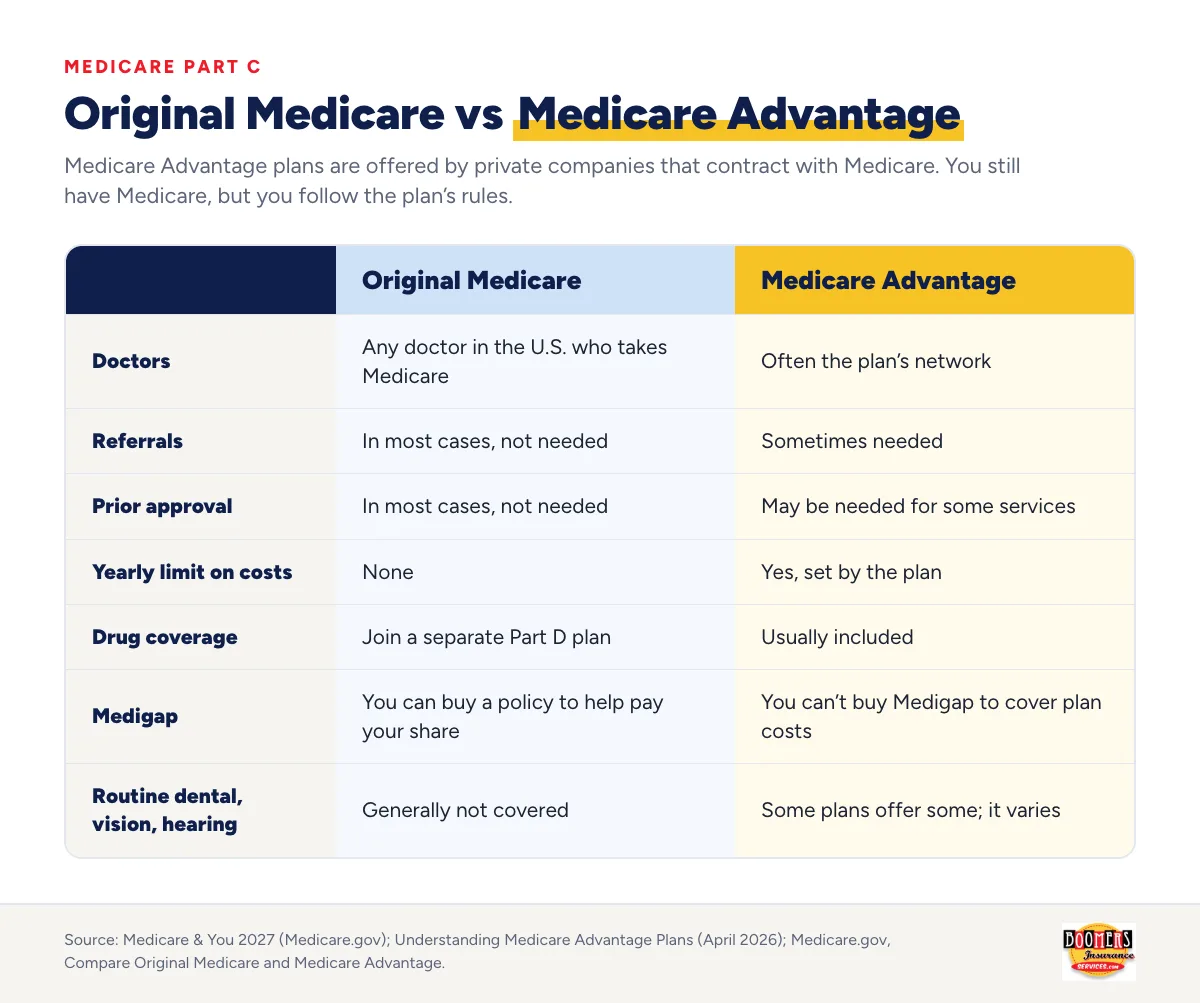
Original Medicare vs Medicare Advantage
| Original Medicare | Medicare Advantage | |
|---|---|---|
| Doctors | Any doctor in the U.S. who takes Medicare | Often the plan's network |
| Referrals | In most cases, not needed | Sometimes needed |
| Prior approval | In most cases, not needed | May be needed for some services |
| Yearly limit on costs | None | Yes, set by the plan |
| Drug coverage | Join a separate Part D plan | Usually included |
| Medigap | You can buy a policy to help pay your share | You can't buy Medigap to cover plan costs |
| Routine dental, vision, hearing | Generally not covered | Some plans offer some; it varies |
What are the pros and cons?
Asking "what is Medicare Advantage?" is the first step. Deciding whether it fits you is the next. There is no right answer for everyone, and these are the trade-offs most people weigh. For each trade-off in more detail, read the pros and cons of Medicare Advantage plans.
| Possible pros | Possible cons |
|---|---|
| One plan for hospital, medical and usually drug coverage | You may need to use the plan's network |
| A yearly out-of-pocket limit | You may need prior approval or referrals |
| Some plans include extras | Extras are generally limited and vary |
| Drug coverage is usually built in | Copays for each service can add up |
| Rules, costs and networks can change each year |
One more point matters if you might switch back later. Outside certain protected times, a Medigap insurer may use health questions and can turn you down. Our Medicare Advantage vs Medigap guide explains California's rules.
When can you join or switch a Medicare Advantage plan?
To join, you need Part A and Part B, must live in the plan's service area, and must be a U.S. citizen or U.S. national, a lawful permanent resident (green card holder), a Cuban-Haitian entrant, or lawfully living in the U.S. as a COFA migrant. People with End-Stage Renal Disease (ESRD) may join too. You can join or switch during these windows:
- Initial Enrollment Period: seven months around your 65th birthday month
- Open Enrollment: October 15 to December 7 each year; changes start January 1 (see our Annual Enrollment guide)
- Medicare Advantage Open Enrollment Period: January 1 to March 31, one change if you are already in a plan (see our MA Open Enrollment Period guide)
- Special Enrollment Periods: after events like a move or losing other coverage (see Special Enrollment Periods)
Next steps
- List your doctors, hospitals and prescriptions.
- Check whether your doctors are in a plan's network before you join.
- Read a plan's Evidence of Coverage for prior approval rules and extras.
- If you are turning 65, start with the Turning 65 checklist.
Talk with a licensed Boomers agent
A licensed Boomers agent can go over the Medicare plans we represent in your area and check them against your doctors and prescriptions.
Find a licensed agent near you · See upcoming Medicare events
Or call 1-800-815-1943 (TTY 711), Monday – Friday, 9 AM – 5 PM Pacific.
Frequently asked questions
What is Medicare Advantage in simple terms?
It is a Medicare health plan run by a private company that contracts with Medicare. It covers your Part A and Part B services, and most plans also cover drugs. You still have Medicare, but you follow the plan's rules for costs and providers.
Is Medicare Advantage the same as Medigap?
No. Medicare Advantage is a different way to get your Part A and Part B coverage. Medigap is a separate policy that helps pay your share of costs in Original Medicare. You can't buy a Medigap policy to cover your costs in a Medicare Advantage plan.
Do I still pay my Part B premium with Medicare Advantage?
Yes, in most cases. You keep paying the Part B premium unless Medi-Cal or a Medicare Savings Program pays it. Some plans help pay all or part of it, and a plan may also charge its own premium.
Can I leave a Medicare Advantage plan?
Yes, but only at certain times. You can switch during Open Enrollment (October 15 to December 7) or the Medicare Advantage Open Enrollment Period (January 1 to March 31). A Special Enrollment Period may also let you change.
Sources
- Medicare & You 2027, Section 4 (Medicare.gov)
- Understanding Medicare Advantage Plans, April 2026 (Medicare.gov)
- Compare Original Medicare and Medicare Advantage (Medicare.gov)
- Medicare Advantage Rates & Statistics: MOOP limit calculations (CMS.gov)
- 2026 Medicare Parts A & B premiums and deductibles (CMS.gov, November 14, 2025)
- Choosing a Medigap Policy, March 2026 (Medicare.gov)
Talk with a licensed Boomers agent
A licensed agent can go over the Medicare plans we represent in your area, check them against your doctors and prescriptions, and answer your questions. There is no cost to you and no obligation to enroll.
Monday – Friday, 9 AM – 5 PM PT