
Medicare Broker vs Agent: What Each Does and How They're Paid
A Medicare broker and a Medicare agent follow the same federal rules. Both must be licensed by the state, pass yearly training and testing, and record a Scope of Appointment before a sales meeting. The plan pays them, and they can't charge you an enrollment fee. Here is what the terms mean.
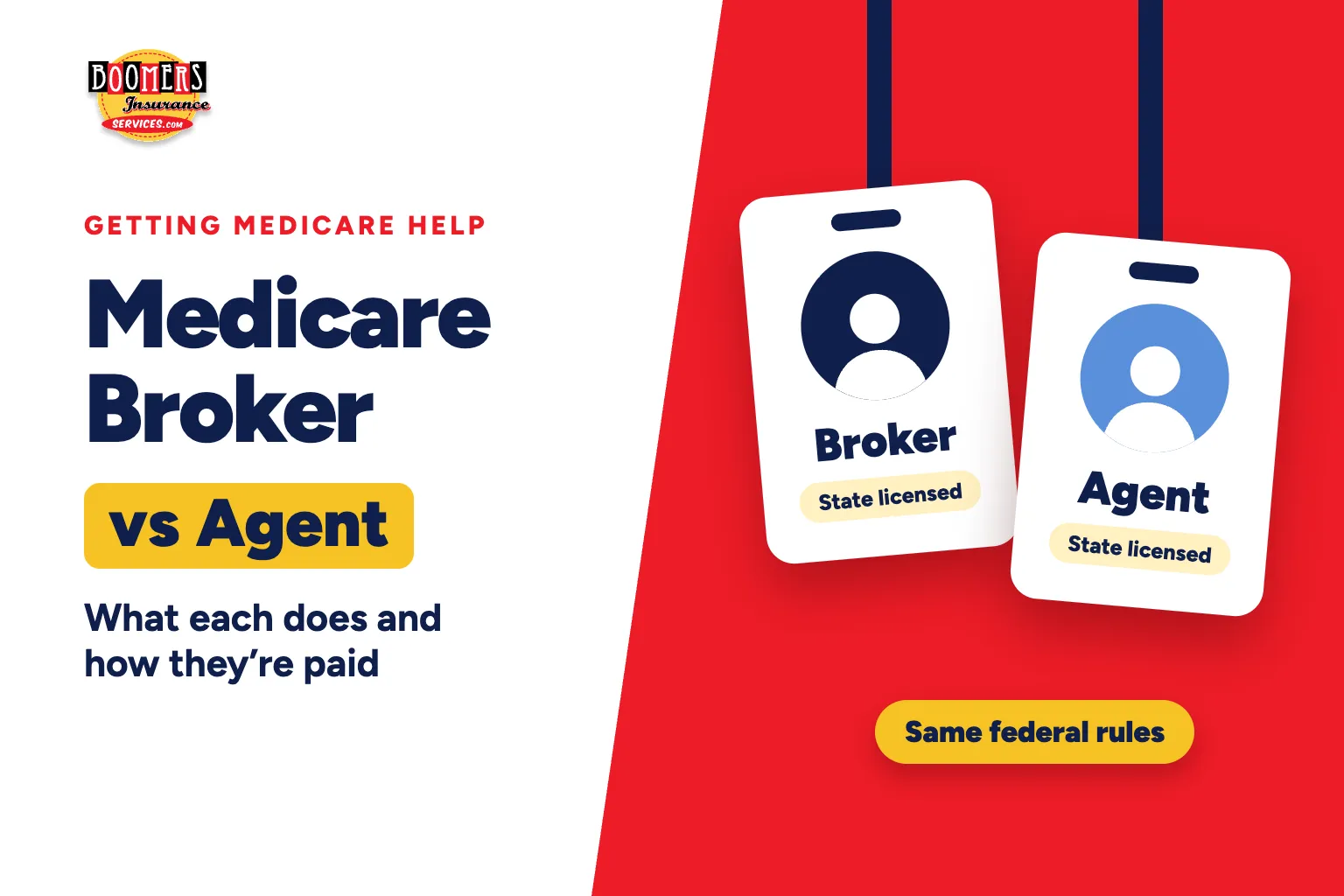
A Medicare broker and a Medicare agent do much the same job. Each is a state-licensed person who can explain Medicare plans from private companies and help you enroll. Medicare's own rules don't treat them differently. They speak of "agents and brokers" together and hold both to the same standards.
Boomers Insurance Services is an agency of this kind, so we have a stake in the answer. This guide sticks to what the federal rules and Medicare.gov say for the 2027 plan year. It also covers help that has no tie to any insurance company.
What is the difference between a Medicare broker and an agent?
In everyday use, the difference is how many companies the person represents. Medicare's rules apply to both in the same way. The federal regulation names three kinds of agents and brokers: employed, captive and independent. It doesn't define the words, so the descriptions below are the common meanings.
| Who | Common meaning | What to know |
|---|---|---|
| Employed or captive agent | Generally sells plans for one insurance company | Can show you that company's plans |
| Independent Medicare agent or broker | Generally has contracts with more than one company | Can show you the plans of the companies they represent, which may not be all of them |
| SHIP counselor | Counsels through a state program | Isn't connected to any insurance company or health plan |
People often use "Medicare insurance agent" for employed, captive and independent agents and brokers alike. A SHIP counselor is not an agent and doesn't sell plans. For a Medicare plan, the federal rules that protect you are the same either way.
Federal rules also use a wider term: Third-Party Marketing Organization (TPMO). It covers organizations and people, including independent agents and brokers, who are paid for lead generation, marketing, sales or enrollment work for Medicare plans. Boomers is a TPMO.
Who licenses and tests Medicare agents and brokers?
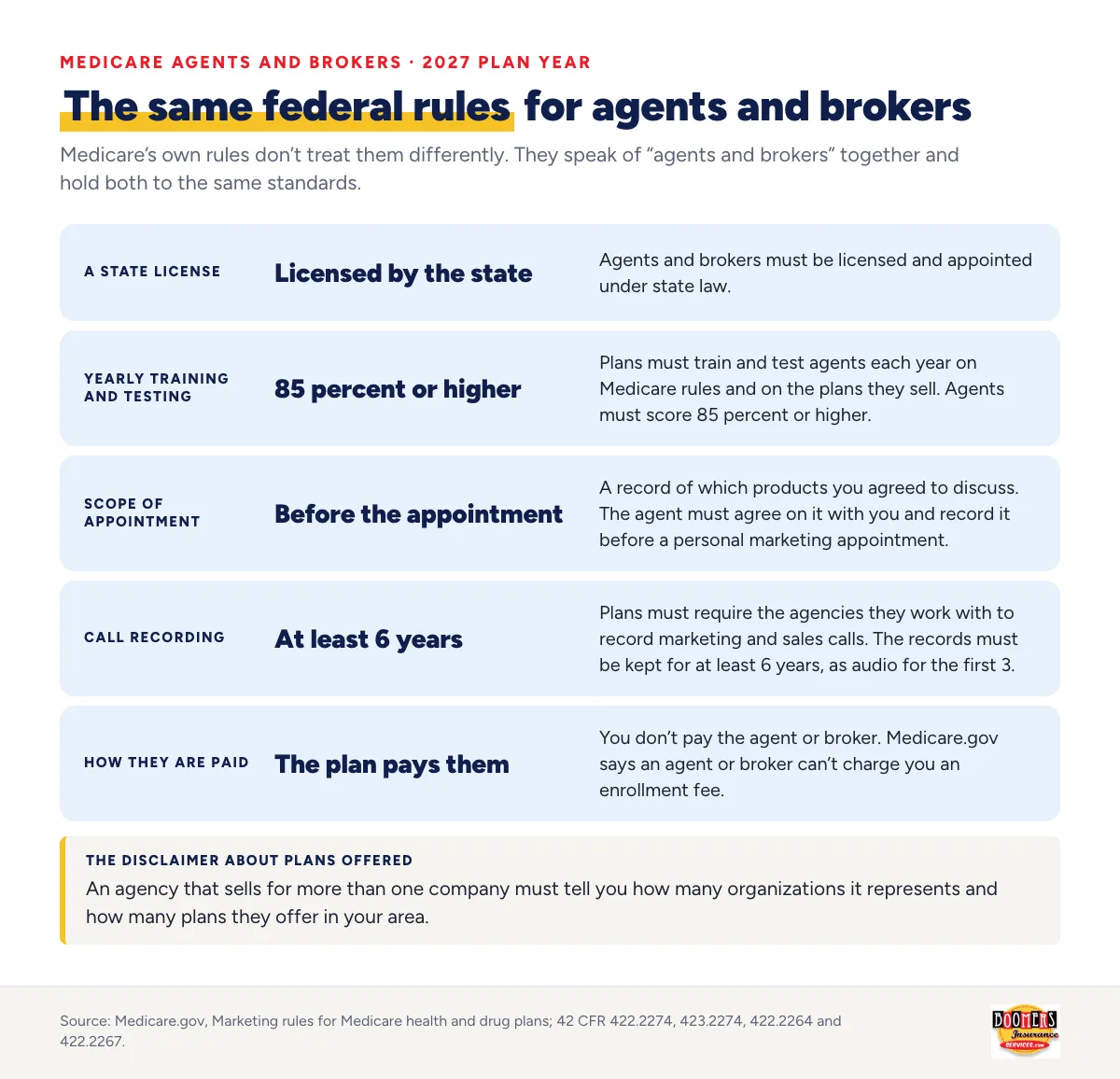
Your state licenses them, and the plans they sell for must train and test them every year. Federal rules set three basic requirements for anyone who represents a Medicare Advantage or Part D plan:
- A state license. Agents and brokers must be licensed and appointed under state law. Medicare.gov adds that plans must tell your state which agents are selling their plans.
- Yearly training and testing. Plans must train and test agents each year on Medicare rules and on the plans they sell. Agents must score 85 percent or higher.
- A Scope of Appointment before a personal marketing appointment, explained below.
In California, you can look up a license by name or license number on the California Department of Insurance website. Its consumer line is 1-800-927-4357.
What rules must a Medicare insurance agent follow?
The rules come from the Centers for Medicare & Medicaid Services (CMS), mainly 42 CFR 422.2274 for Medicare Advantage and 42 CFR 423.2274 for Part D. They cover how a meeting is set up, what is said and what is kept on record.
Scope of Appointment
A Scope of Appointment is a record of which products you agreed to discuss. The agent must agree on it with you and record it before a personal marketing appointment. It must be in writing when you meet in person. During the meeting, the agent can discuss only the products you agreed to hear about.
Many people have heard of a "48-hour rule." From 2023, the form had to be completed at least 48 hours before most appointments. CMS removed that waiting period in its Contract Year 2027 rule. The rule took effect June 1, 2026, and its marketing changes apply to marketing for 2027 plans, which began October 1, 2026. The agreement is still required before the appointment. It just no longer has to come two days ahead.
Call recording
Plans must require the agencies they work with to record marketing and sales calls. That includes the audio of calls held through web-based technology. The records must be kept for at least 6 years, as audio for the first 3. That is why an agency like ours records a phone call about plans.
The disclaimer about plans offered
An agency that sells for more than one company must tell you how many organizations it represents and how many plans they offer in your area. On a sales call, it must say so before any benefits are discussed. The same statement goes on its website and in its marketing materials. Unless the agency sells for all the Medicare Advantage organizations in the area, it must also say that the plans it offers are not the full list of plans available there.
That applies to us. The plans we offer are not the full list of plans available in your area. Ask your agent how many organizations and plans we represent where you live. For information on all of your options, contact Medicare.gov or 1-800-MEDICARE (1-800-633-4227, TTY 1-877-486-2048), 24 hours a day, 7 days a week, except some federal holidays.
Topics an agent must cover before you enroll
Before an enrollment in a Medicare Advantage plan, the rules require plans to make sure certain topics are fully discussed. They include whether your doctors and specialists are in the plan's network, whether your pharmacy is in the network, and whether your prescriptions are covered. They also include costs, premiums, benefits and your specific health care needs.
How do Medicare brokers get paid?
For a Medicare Advantage or Part D plan, the plan pays them. You don't pay the agent or broker. Medicare.gov says an agent or broker can't charge you an enrollment fee, and federal rules bar marketing consulting fees for people who are considering a plan.
Here is how the pay rules work for Medicare Advantage and Part D plans:
- CMS sets the yardstick. It determines an amount called fair market value for an enrollment, updated each year. The rules cap the compensation a plan may pay an independent agent or broker for an enrollment at that amount. Payments for other services, like training or customer service, are separate and may not be more than the market value of those services.
- Renewal years pay less. For years after the first, pay is capped at half of fair market value.
- Pay follows your enrollment. A plan may pay only for the months you are enrolled.
- Quick departures are clawed back. If you change plans within the first three months, the plan generally must take back the agent's pay. There are exceptions, like a move out of the service area.
Under these rules, an agent's compensation is paid for enrollments in plans. The rules describe no payment for choosing Original Medicare alone. That is worth knowing when you weigh any advice, including ours.
What can't an agent or broker do?
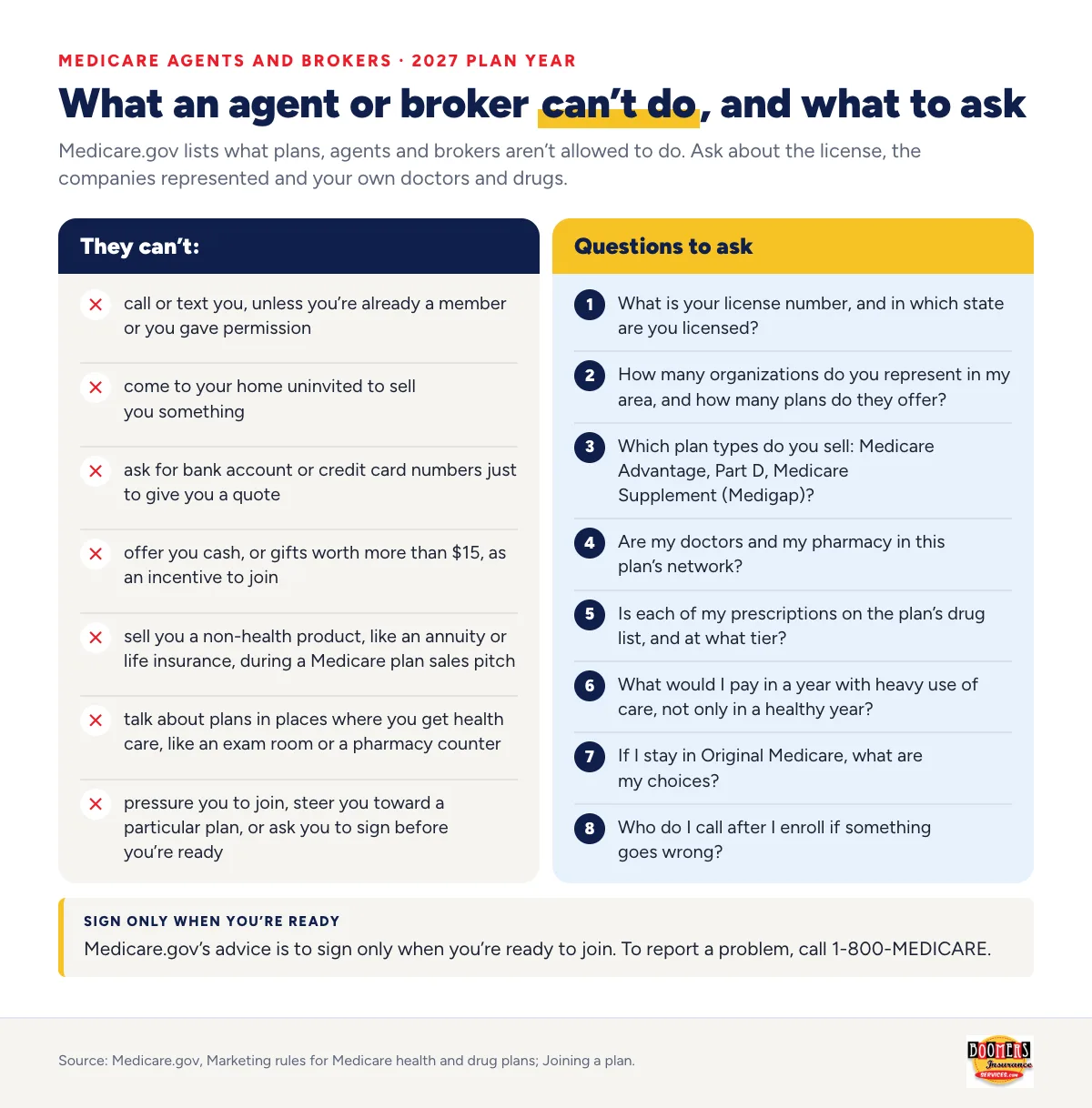
Medicare.gov lists what plans, agents and brokers aren't allowed to do. They can't:
- call or text you, unless you're already a member or you gave permission
- come to your home uninvited to sell you something
- ask for bank account or credit card numbers just to give you a quote
- offer you cash, or gifts worth more than $15, as an incentive to join
- sell you a non-health product, like an annuity or life insurance, during a Medicare plan sales pitch
- talk about plans in places where you get health care, like an exam room or a pharmacy counter
- pressure you to join, steer you toward a particular plan, or ask you to sign before you're ready
During a meeting, an agent can give you plan materials, explain plan options, and give you an enrollment form and collect it when you complete it. Medicare.gov's advice is to sign only when you're ready to join. To report a problem, call 1-800-MEDICARE.
What should you ask a Medicare broker or agent?
Ask about the license, the companies represented and your own doctors and drugs. You can expect plain answers to these. Bring your drug list and your doctors' names.
- What is your license number, and in which state are you licensed?
- How many organizations do you represent in my area, and how many plans do they offer?
- Which plan types do you sell: Medicare Advantage, Part D, Medicare Supplement (Medigap)?
- Are my doctors and my pharmacy in this plan's network?
- Is each of my prescriptions on the plan's drug list, and at what tier?
- What would I pay in a year with heavy use of care, not only in a healthy year?
- If I stay in Original Medicare, what are my choices?
- Who do I call after I enroll if something goes wrong?
Our guides on what Medicare Advantage is and Medicare Supplement plans explain the two main paths. How to sign up for Medicare covers Part A and Part B, which you sign up for through Social Security, not through an agent.
Where can you get help that isn't tied to a company?
You have two sources that aren't connected to an insurance company: your State Health Insurance Assistance Program (SHIP) and Medicare itself. You can use them instead of an agent, or along with one.
- SHIP. The Medicare & You 2027 handbook says SHIPs are state programs that get money from the federal government to give local health insurance counseling. They aren't connected to any insurance company or health plan.
- HICAP. California's SHIP is the Health Insurance Counseling & Advocacy Program (HICAP). It gives confidential one-on-one counseling on Medicare. Counselors don't charge a fee. Call 1-800-434-0222.
- Medicare. Call 1-800-MEDICARE or use the plan comparison tool on Medicare.gov, which lists the plans in your area.
No rule says you must use an agent or a broker. Some people prefer a counselor. Others want one person to call each year. Either choice is yours to make.
Next steps
Decide what kind of help you want, then check whoever you choose. These steps keep it simple.
- Write down your doctors, your pharmacy and your prescriptions.
- Check the agent's license with your state insurance department.
- Ask the questions above before any benefits are discussed.
- Compare what you hear with Medicare.gov or a SHIP counselor.
- Turning 65 soon? Our Turning 65 checklist lists each step.
Talk with a licensed Boomers agent
A licensed Boomers agent can go over the Medicare plans we represent in your area and check them against your doctors and prescriptions. You don't pay us a fee, and you don't have to enroll.
Find a licensed agent near you · See upcoming Medicare events
Or call 1-800-815-1943 (TTY 711), Monday – Friday, 9 AM – 5 PM Pacific.
Frequently asked questions
Is a Medicare broker vs agent comparison even needed?
For your protection, not really. Medicare's marketing rules apply to agents and brokers alike. What matters more is how many companies the person represents, and whether they answer your questions about doctors, drugs and costs.
Does it cost anything to use a Medicare broker?
An agent or broker can't charge you an enrollment fee, and the plan pays their compensation. Federal rules also bar marketing consulting fees. These rules cover Medicare Advantage and Part D plans, so ask how fees work for any other product.
Does an independent Medicare agent offer all the plans in my area?
Not necessarily. An independent agent offers the plans of the companies they have contracts with. Federal rules require an agency that doesn't sell for all the Medicare Advantage organizations in an area to tell you so. For the full list, use Medicare.gov or call 1-800-MEDICARE.
Does signing a Scope of Appointment enroll me in a plan?
No. It records which products you agreed to discuss. You can decide not to enroll after the meeting.
Can an agent call me without my permission?
No. Medicare.gov says plans and their representatives can't call or text you unless you're already a member or you gave them permission. They also can't come to your home uninvited.
Sources
- Marketing rules for Medicare health and drug plans (Medicare.gov)
- Joining a plan (Medicare.gov)
- Talk to someone (Medicare.gov)
- Medicare & You 2027 handbook (Medicare.gov)
- 42 CFR 422.2274, agent, broker and other third-party requirements (eCFR)
- 42 CFR 423.2274, agent, broker and other third-party requirements for Part D (eCFR)
- 42 CFR 422.2264, beneficiary contact and Scope of Appointment (eCFR)
- 42 CFR 422.2267, required materials and content, including the TPMO disclaimer (eCFR)
- 42 CFR 422.2260, definitions (eCFR)
- Contract Year 2027 Medicare Advantage and Part D final rule, April 6, 2026 (Federal Register)
- Check a license (California Department of Insurance)
- Medicare counseling: HICAP (California Department of Aging)
Talk with a licensed Boomers agent
A licensed agent can go over the Medicare plans we represent in your area, check them against your doctors and prescriptions, and answer your questions. There is no cost to you and no obligation to enroll.
Monday – Friday, 9 AM – 5 PM PT