
What Is Medicare Part D? How Medicare Drug Coverage Works
What is Medicare Part D? It is Medicare's optional prescription drug coverage, offered through private companies that contract with Medicare. You get it from a stand-alone drug plan or a Medicare Advantage plan with drug coverage.
What is Medicare Part D? It is the part of Medicare that helps pay for prescription drugs. It is optional and offered to everyone with Medicare. Private companies that contract with Medicare run the plans, so costs and covered drugs differ from plan to plan.
Even if you take few drugs today, the timing of when you join matters. Joining late without other creditable drug coverage can mean a penalty you generally pay for as long as you have Medicare drug coverage. This guide explains how Part D works, what it covers, and what it costs in 2026 and 2027.
What is Medicare Part D, and how do you get it?
Original Medicare (Parts A and B) doesn't cover most drugs. Part B covers a limited number, such as some drugs given by injection or infusion in a doctor's office. Part D covers most drugs you fill at a pharmacy. There are two ways to get it:
- A stand-alone Medicare drug plan. You add it to Original Medicare, with or without a Medigap policy. You need Part A and/or Part B to join.
- A Medicare Advantage plan with drug coverage. Your hospital, medical and drug coverage come in one plan. You need both Part A and Part B to join.
Either way, you must live in the plan's service area and be a U.S. citizen or U.S. national, a lawful permanent resident (green card holder), a Cuban-Haitian entrant, or lawfully living in the U.S. as a COFA migrant. If you are in a Medicare Advantage HMO or PPO and join a stand-alone drug plan, you are generally removed from the Medicare Advantage plan and returned to Original Medicare. Our HMO vs PPO guide explains how those plans handle drugs.
If you have job or union drug coverage, call your benefits administrator before you sign up for anything; joining a Medicare drug plan could make you lose it. If you have VA coverage, you can also join a Medicare drug plan, but you can't use both for the same drug at the same time.
What does Medicare Part D cover?
Each plan has a list of covered drugs, called a Part D formulary. Plans must cover a wide range of drugs, including most drugs in certain "protected classes," such as drugs to treat cancer, HIV/AIDS, depression and seizures. Before you join, check that your drugs are on the plan's list.
Drug tiers
Plans usually sort drugs into levels called tiers. A drug in a lower tier generally costs you less than one in a higher tier. If your doctor thinks you need a higher-tier drug instead of a similar lower-tier one, you or your doctor can ask the plan for an exception to get a lower copayment or coinsurance.
Coverage rules
Plans may use rules for some drugs:
- Prior authorization: your doctor may need the plan's approval first
- Quantity limits: a cap on how much you can get at a time
- Step therapy: you may need to try a similar, lower-cost drug first
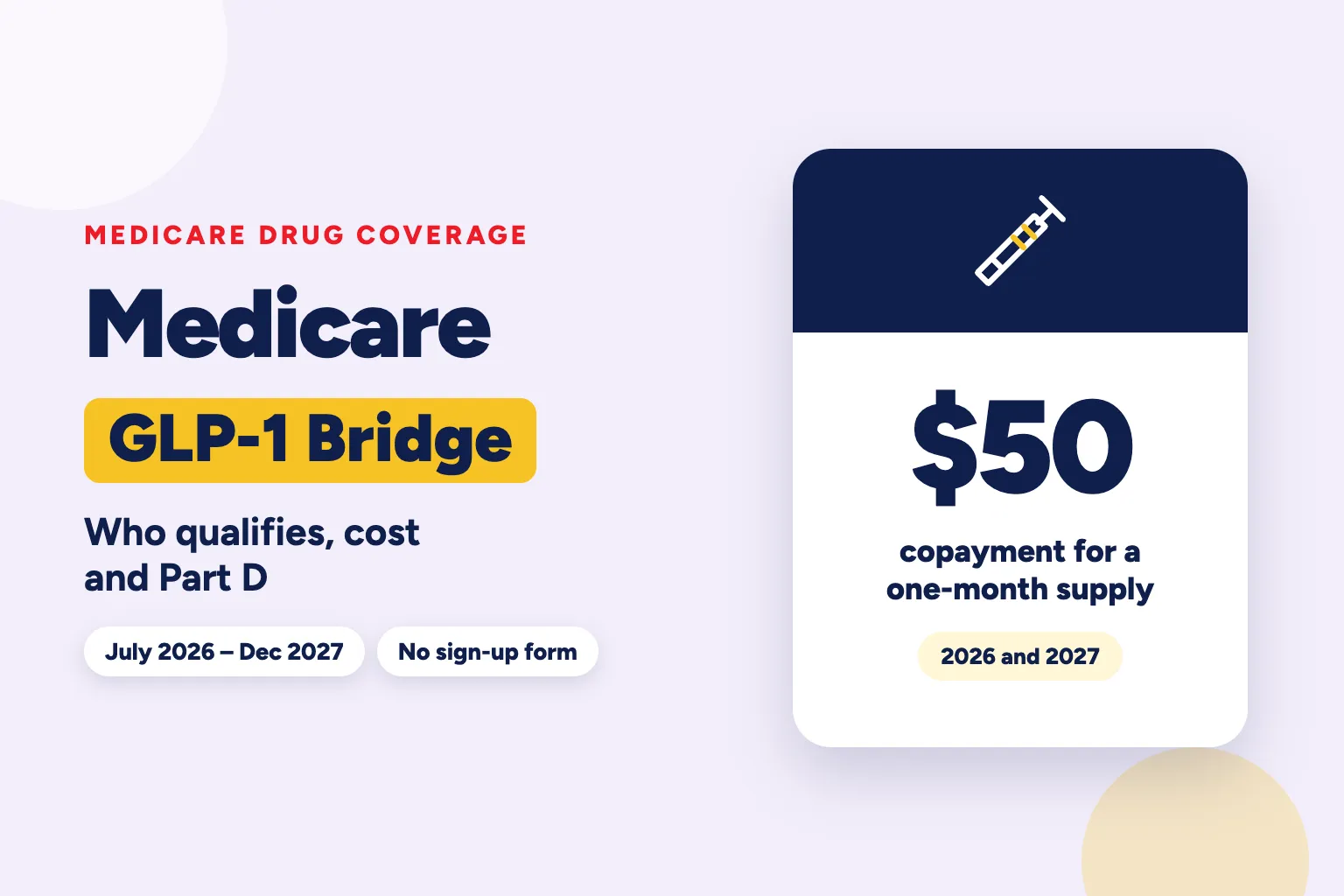
You or your doctor can ask the plan to waive a rule. In your first 90 days in a plan, you may get a one-time 30-day transition fill of a drug you've been taking that the plan doesn't normally cover, or that usually needs prior authorization or step therapy. For GLP-1 drugs prescribed for weight loss, read about the Medicare GLP-1 bridge program, which works outside Part D.
Insulin and vaccines
Part D plans can't charge you more than $35 for a one-month supply of each covered insulin, and there is no deductible for it. Part D also generally covers adult vaccines recommended by the Advisory Committee on Immunization Practices, such as shingles and RSV, and you pay nothing for them.
How much does Medicare Part D cost?
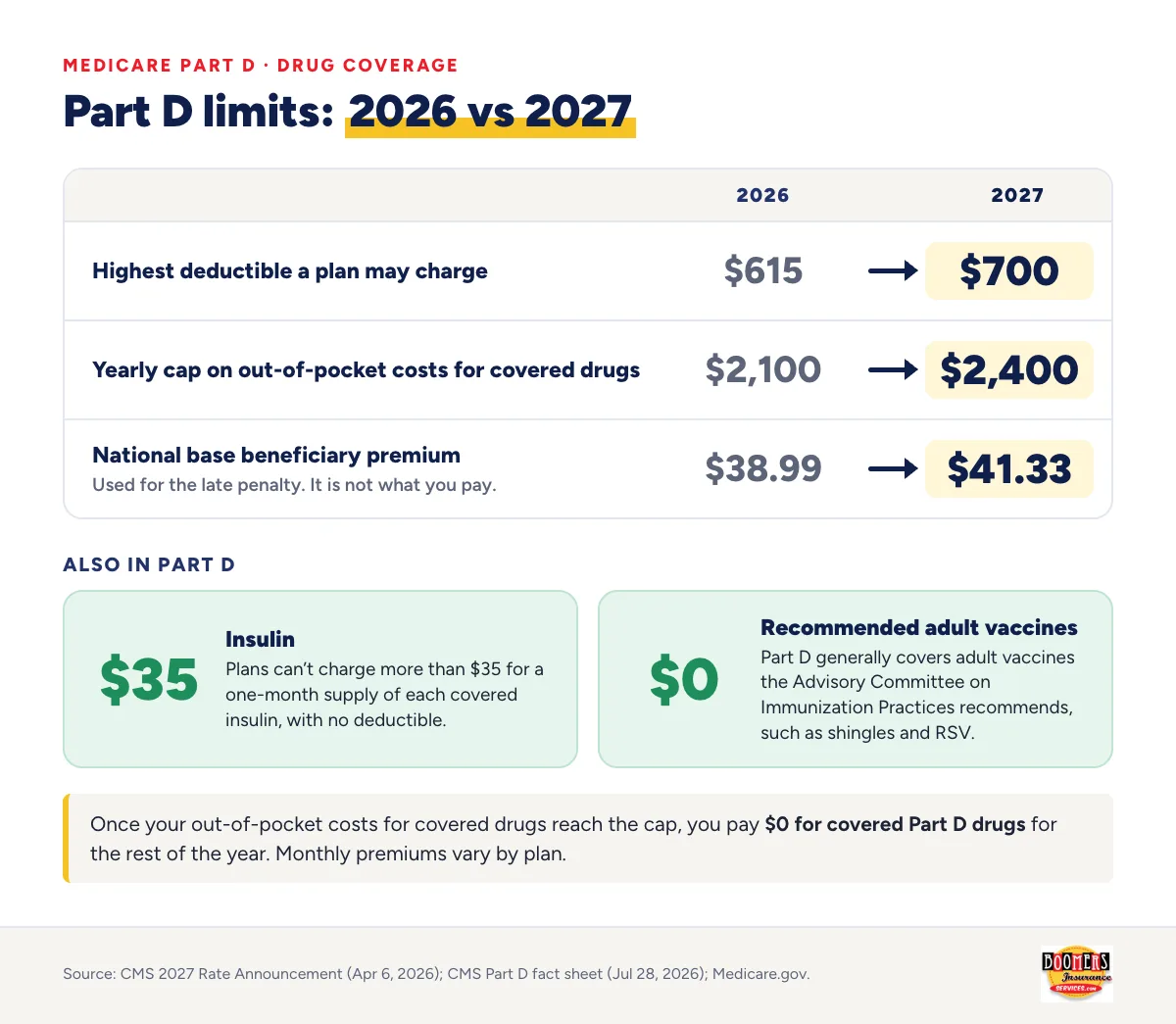
You may pay a monthly premium, a yearly deductible, and a copayment or coinsurance for each drug. These are the amounts CMS set for 2026 and 2027:
| Cost | 2026 | 2027 |
|---|---|---|
| Highest deductible a plan may charge | $615 | $700 |
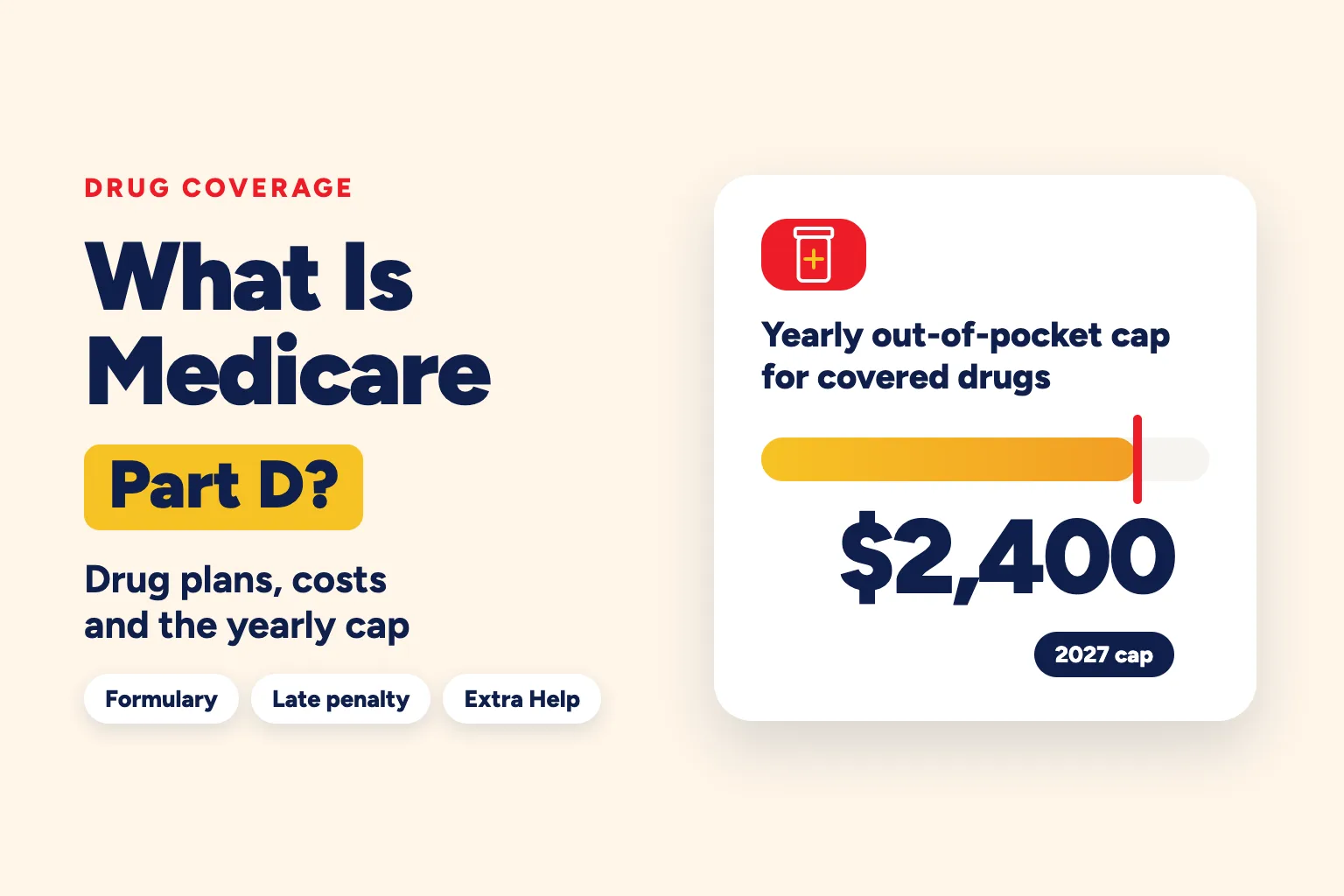
| Yearly cap on out-of-pocket costs for covered drugs | $2,100 | $2,400 |
| National base beneficiary premium (used for the penalty) | $38.99 | $41.33 |
Source: CMS 2027 Rate Announcement (April 6, 2026), CMS Part D fact sheet (July 28, 2026) and Medicare.gov.
Some plans have no deductible, and some cover drugs on certain tiers before the deductible. Monthly premiums vary by plan. The base beneficiary premium is not what you pay. Medicare uses it to work out the late enrollment penalty.
How the yearly cap works
Once your out-of-pocket costs for covered drugs reach the cap, you pay $0 for covered Part D drugs for the rest of the year. If paying large amounts early in the year is hard, the Medicare Prescription Payment Plan can spread those costs into monthly bills. It doesn't lower your total costs. Our guide to the Part D out-of-pocket cap and payment plan explains both.
Higher incomes pay an extra amount
If your income is above a set level, you pay an extra amount on top of your plan premium. It is called the Part D income-related monthly adjustment amount (IRMAA). In 2026 it starts above $109,000 for a single filer and $218,000 for a joint return, and ranges from $14.50 to $91.00 a month (CMS). It applies to Medicare Advantage plans with drug coverage too. Our Medicare cost guide has the full table.
What is the Part D late enrollment penalty?
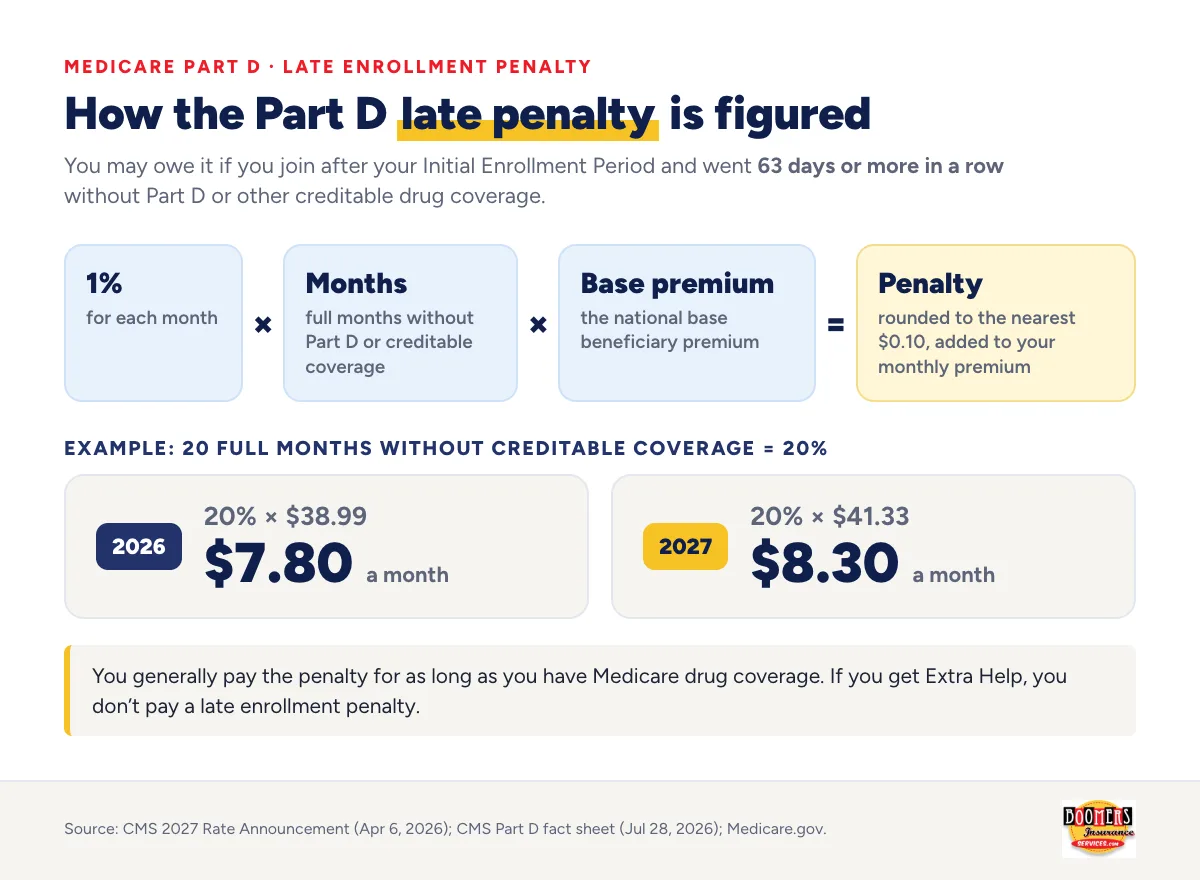
You may owe a penalty if you join after your Initial Enrollment Period and you went 63 days or more in a row without Part D or other creditable drug coverage. Creditable coverage is drug coverage expected to pay, on average, at least as much as Medicare's standard drug coverage.
The penalty is 1% of the national base beneficiary premium for each full month you were eligible but went without Part D or other creditable drug coverage. It is rounded to the nearest $0.10 and added to your monthly premium. You generally pay it for as long as you have Medicare drug coverage.
Example: You went 20 full months without creditable coverage. In 2026 that is 20% of $38.99, or $7.80 a month. In 2027, with the base premium at $41.33, it becomes $8.30 a month.
Ways to avoid the penalty:
- Consider joining a drug plan when you first become eligible, even if you take few drugs.
- Keep the yearly notice that says your job, union, TRICARE or VA coverage is creditable.
- Join within 63 days after creditable coverage ends.
If you get Extra Help, you don't pay a late enrollment penalty. Our guides on Medicare and employer insurance and Medicare and VA benefits cover those situations.
Can you get help paying for drugs?
Extra Help is a Medicare program that helps people with limited income and resources pay Part D costs. Medicare.gov says you automatically qualify if you have full Medicaid coverage (full-scope Medi-Cal in California), help from a Medicare Savings Program, or Supplemental Security Income. Otherwise, you can apply through Social Security at ssa.gov/extrahelp. See our guide to Extra Help and the Medicare Savings Programs to check whether you may qualify.
When can you join or switch a Medicare drug plan?
- Initial Enrollment Period: the seven months around your 65th birthday month
- Open Enrollment: October 15 to December 7; your new plan starts January 1 (see our Annual Enrollment guide)
- Medicare Advantage Open Enrollment Period: January 1 to March 31, only if you are already in a Medicare Advantage plan (see our MA Open Enrollment Period guide)
- Special Enrollment Periods: after certain events, such as a move or losing other coverage; people with Extra Help can make some changes once a month
How do you compare Medicare drug plans?
- List every drug you take, with the dose and how often.
- Note the pharmacies you use. Preferred pharmacies may cost less.
- Enter your drugs in the Medicare Plan Finder at Medicare.gov/plan-compare.
- Compare the estimated yearly cost, not just the premium.
- Check each drug's tier and any coverage rules.
- Each fall, read your plan's Annual Notice of Change. Plans can change costs and drug lists every year.
In California, HICAP (1-800-434-0222) gives one-on-one Medicare counseling. You can also call 1-800-MEDICARE (TTY 1-877-486-2048).
Next steps
- Make a list of your drugs, doses and pharmacies.
- Find your Initial Enrollment Period dates, or note the October 15 to December 7 window.
- If you have job, union or VA drug coverage, ask whether it is creditable.
- Check whether you may qualify for Extra Help.
Talk with a licensed Boomers agent
A licensed Boomers agent can go over the Medicare plans we represent in your area and check them against your doctors and prescriptions.
Find a licensed agent near you · See upcoming Medicare events
Or call 1-800-815-1943 (TTY 711), Monday – Friday, 9 AM – 5 PM Pacific.
Frequently asked questions
What is Medicare Part D in simple terms?
It is Medicare's prescription drug coverage. You get it through a stand-alone drug plan or a Medicare Advantage plan with drug coverage. Each plan has its own list of covered drugs and its own costs.
Do I need Part D if I don't take any drugs?
It is optional, but think about the penalty. If you skip it and have no other creditable drug coverage, you may pay a late enrollment penalty for as long as you have Part D later. Medicare suggests considering a plan when you are first eligible.
Can a plan change its drug list during the year?
Yes. A plan can make some changes during the year if it follows Medicare's rules. It must tell you about changes that affect drugs you take. Plans can also change their lists and costs each new year.
Does Medicare Part D cover drugs given in a doctor's office?
Usually not. Part B may cover some infused and injected drugs given in a doctor's office, along with a limited number of other drugs. Part D covers most drugs you fill at a pharmacy.
Sources
- Medicare & You 2027, Section 6 (Medicare.gov)
- How much does Medicare drug coverage cost? (Medicare.gov)
- Creditable prescription drug coverage (Medicare.gov)
- CY 2027 Medicare Advantage and Part D Rate Announcement (CMS.gov, April 6, 2026)
- Medicare Part D 2027 national average monthly bid amount (CMS.gov, July 28, 2026)
- 2026 Medicare Parts A & B premiums and deductibles (CMS.gov, November 14, 2025)
- Medicare Plan Finder (Medicare.gov)
Talk with a licensed Boomers agent
A licensed agent can go over the Medicare plans we represent in your area, check them against your doctors and prescriptions, and answer your questions. There is no cost to you and no obligation to enroll.
Monday – Friday, 9 AM – 5 PM PT