

What Is Medicare? A Plain-English Guide to the Basics
What is Medicare? It is the federal health insurance program for people 65 or older, and for some younger people with a disability, End-Stage Renal Disease or ALS. It has four parts: A for hospital care, B for medical care, C for Medicare Advantage plans and D for prescription drugs. Here is how the
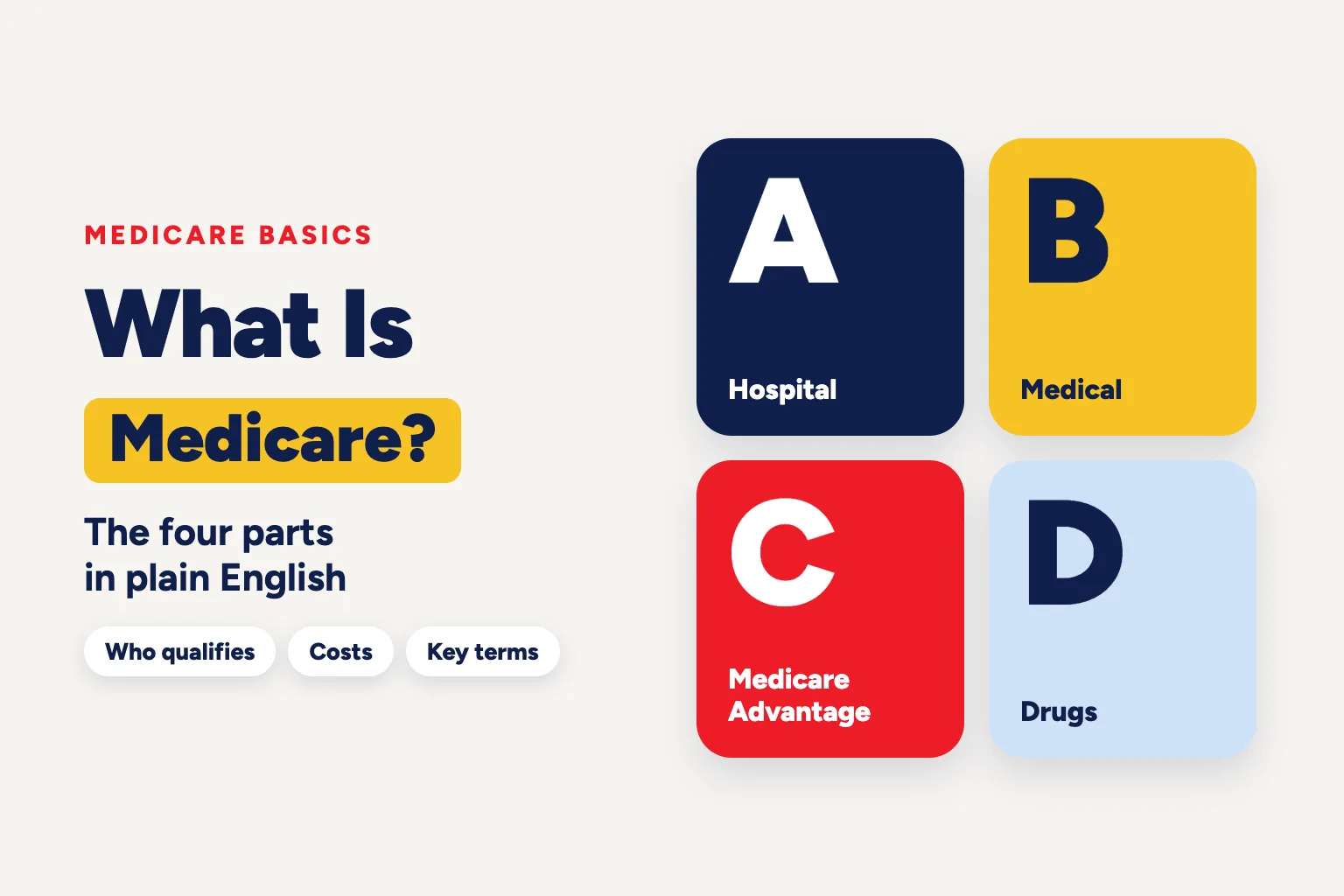
What is Medicare? It is health insurance from the federal government. It is mainly for people 65 or older, and also for some younger people with certain disabilities or conditions. The Centers for Medicare & Medicaid Services (CMS) runs it. For most people, Social Security handles signing up.
This guide is Medicare explained from the start: who can get it, what each part does, what it costs in 2026, and when to sign up. At the end you'll find a short glossary of Medicare terms and answers to common questions.
What is Medicare, and who can get it?
So what is Medicare, in one sentence? Medicare.gov describes it as health insurance for people 65 or older who meet citizenship or residency rules. Medicare & You 2027 lists who meets them: U.S. citizens and nationals, lawful permanent residents (green card holders), and a few other groups. If you aren't sure about your status, check with Social Security.
You may also get Medicare before 65 if:
- you have received Social Security disability benefits for 24 months
- you have ALS (Lou Gehrig's disease); Medicare starts when your disability benefits start
- you have End-Stage Renal Disease (ESRD), meaning kidney failure that needs dialysis or a transplant
Our article on Medicare under 65 covers those paths in more detail.
Is Medicare the same as Medi-Cal?
No. Medicare is a federal program, mostly based on age or disability. Medicaid is a joint federal and state program for people with limited income and resources. In California, Medicaid is called Medi-Cal. If you meet the rules for both, you may be able to have both, and Medi-Cal can help pay Medicare costs. See our guide to Medi-Medi plans.
What are the parts of Medicare?
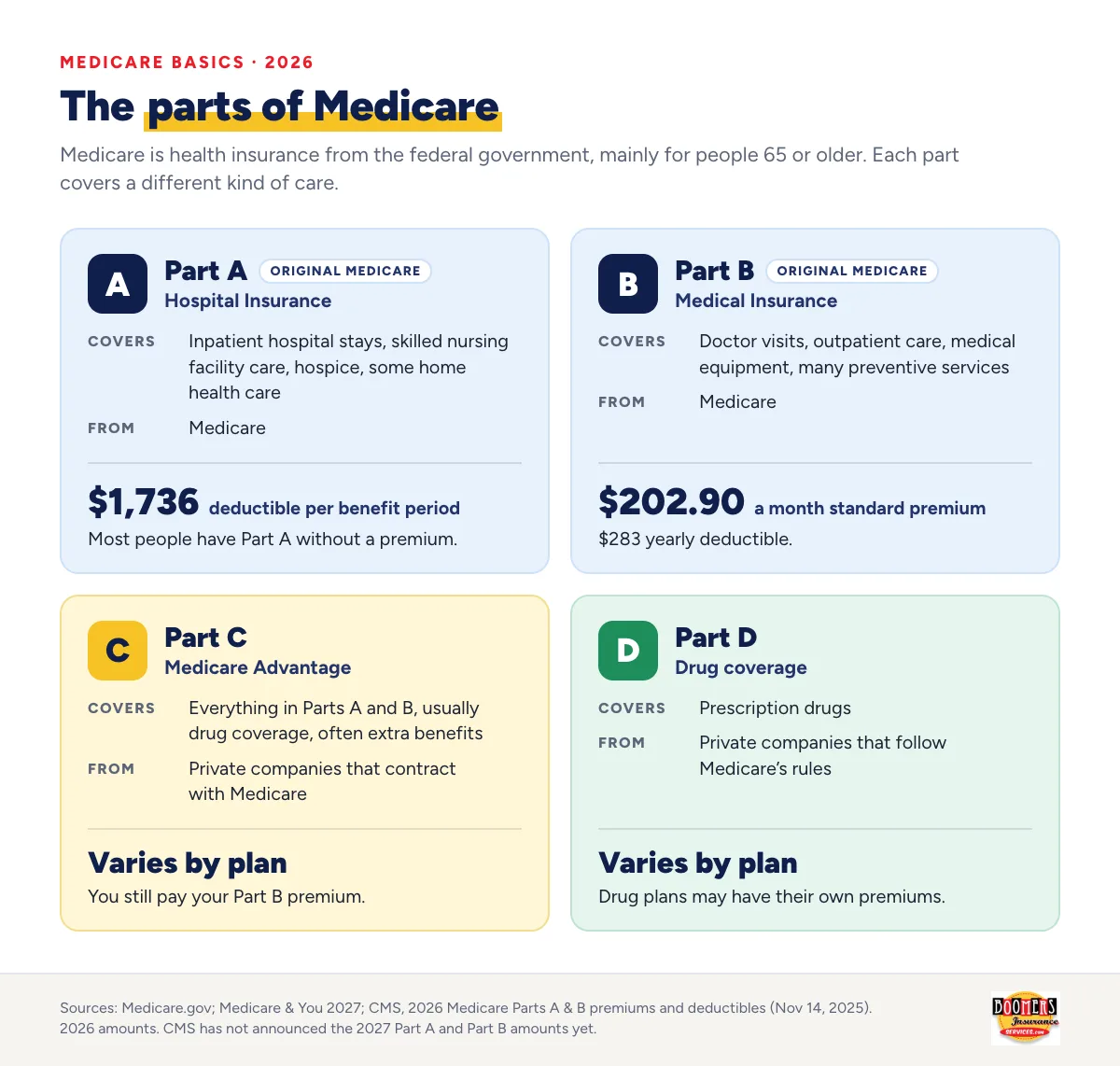
Medicare basics start with its four parts. Each covers a different kind of care.
| Part | What it covers | Who provides it | 2026 cost basics |
|---|---|---|---|
| Part A (Hospital Insurance) | Inpatient hospital stays, skilled nursing facility care, hospice, some home health care | Medicare | Most people have it without a premium; $1,736 deductible per benefit period |
| Part B (Medical Insurance) | Doctor visits, outpatient care, medical equipment, many preventive services | Medicare | $202.90 a month standard premium; $283 yearly deductible |
| Part C (Medicare Advantage) | Everything in Parts A and B, usually drug coverage, often extra benefits | Private companies that contract with Medicare | Varies by plan; you still pay your Part B premium |
| Part D (Drug coverage) | Prescription drugs | Private companies that follow Medicare's rules | Varies by plan |
Figures are from the CMS fact sheet of November 14, 2025. CMS has not announced the 2027 Part A and Part B amounts yet; it usually does in the fall. Our Medicare cost guide explains every cost in detail.
What are your two main choices?
When you first get Medicare, and at set times each year, you choose how to get your coverage. There are two main ways.
Original Medicare
Original Medicare is Part A and Part B. You can see any doctor or hospital in the U.S. that takes Medicare. After the deductible you usually pay 20% coinsurance for Part B services, and Original Medicare has no yearly limit on what you pay. Many people add:
- a Part D plan for prescription drugs
- a Medigap policy (Medicare Supplement Insurance), which helps pay your share of costs in Original Medicare
Medicare Advantage (Part C)
Medicare Advantage plans bundle Parts A and B, and usually Part D, into one plan. Private companies that contract with Medicare offer them. Medicare.gov says you may need to use doctors in the plan's network. You may also need approval before some services. Plans have a yearly limit on what you pay out of pocket, and many offer extras such as dental, vision or hearing benefits.
Each choice has trade-offs. Our article on Medicare Advantage vs. Medigap in California compares them side by side.
When do you sign up for Medicare?
Timing matters, because signing up late can mean a penalty that lasts for years.
- Initial Enrollment Period. Seven months around your 65th birthday: the three months before your birthday month, that month, and the three months after.
- Open Enrollment. October 15 to December 7 every year. You can change your health or drug plan, and changes start January 1.
- Medicare Advantage Open Enrollment Period. January 1 to March 31, only for people already in a Medicare Advantage plan.
- Special Enrollment Periods. Certain life events, such as losing job-based coverage or moving, can open a window at other times.
If you already get Social Security benefits when you turn 65, you are usually enrolled in Parts A and B automatically. If not, you sign up through Social Security. Our Turning 65 checklist walks you through each step.
What doesn't Medicare cover?
Original Medicare leaves some common needs out. It doesn't cover:
- long-term custodial care, such as help with bathing or dressing in a nursing home
- most routine dental care and dentures
- eye exams for glasses
- hearing aids and exams to fit them
Some Medicare Advantage plans include some dental, vision or hearing benefits, and what they cover varies. Read more in does Medicare cover dental, vision and hearing and does Medicare cover long-term care.
Medicare terms: a short glossary
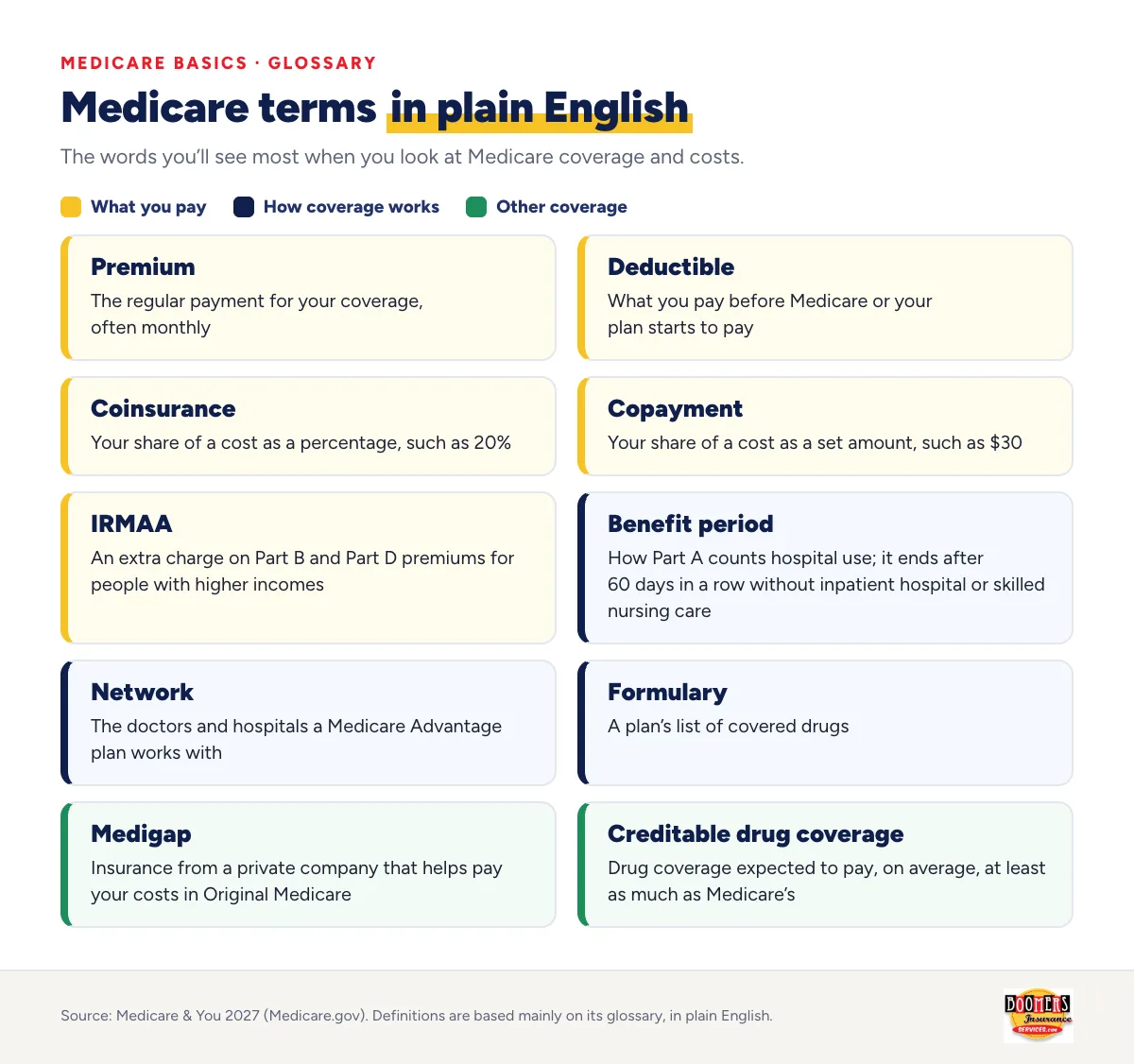
Medicare terminology can be confusing. These are the words you'll see most, based mainly on the definitions in Medicare & You 2027:
| Term | What it means |
|---|---|
| Premium | The regular payment for your coverage, often monthly |
| Deductible | What you pay before Medicare or your plan starts to pay |
| Coinsurance | Your share of a cost as a percentage, such as 20% |
| Copayment | Your share of a cost as a set amount, such as $30 |
| Benefit period | How Part A counts hospital use; it ends after 60 days in a row without inpatient hospital or skilled nursing care |
| Network | The doctors and hospitals a Medicare Advantage plan works with |
| Formulary | A plan's list of covered drugs |
| Medigap | Insurance from a private company that helps pay your costs in Original Medicare |
| Creditable drug coverage | Drug coverage expected to pay, on average, at least as much as Medicare's |
| IRMAA | An extra charge on Part B and Part D premiums for people with higher incomes |
If IRMAA applies to you, our guide to the IRMAA brackets has the 2026 table and what to expect for 2027.
Next steps
- Note your Initial Enrollment Period dates, three months before your 65th birthday month.
- Check whether you have job-based coverage that could let you delay Part B without a penalty.
- List your doctors and prescriptions. You'll need them to compare plans.
- Go through the Turning 65 checklist.
Talk with a licensed Boomers agent
A licensed Boomers agent can go over the Medicare plans we represent in your area and check them against your doctors and prescriptions. Our help is at no cost to you.
Find a licensed agent near you · See upcoming Medicare events
Or call 1-800-815-1943 (TTY 711), Monday – Friday, 9 AM – 5 PM Pacific.
Frequently asked questions
These are Medicare FAQs we hear often. You'll find more on our Medicare FAQs page.
Do I have to sign up for Medicare at 65?
Not always. If you or your spouse still work and have coverage through a job with 20 or more employees, you may be able to delay Part B without a penalty. Check with the employer's benefits office first. Our article on Medicare and employer insurance explains the rules.
Do I pay for Medicare?
Most people have Part A without a premium, because they or a spouse paid Medicare taxes long enough while working. Part B has a monthly premium, $202.90 for most people in 2026. Drug plans, Medicare Advantage plans and Medigap policies may have their own premiums.
Can I use any doctor with Medicare?
With Original Medicare, you can see any doctor in the U.S. who takes Medicare. Medicare Advantage plans usually have networks, and some only cover care outside the network in emergencies. Always check that your doctors take the plan you're considering.
Where can I get help with Medicare questions?
You can call 1-800-MEDICARE (1-800-633-4227, TTY 1-877-486-2048) or visit Medicare.gov. In California, HICAP (1-800-434-0222) offers confidential one-on-one counseling at no cost. A licensed agent can also explain the plans in your area.
Sources
- Get started with Medicare (Medicare.gov)
- Parts of Medicare (Medicare.gov)
- Medicare & You 2027 (Medicare.gov)
- 2026 Medicare Parts A & B premiums and deductibles (CMS.gov, November 14, 2025)
- Medicare costs (Medicare.gov)
- When can I sign up for Medicare? (Medicare.gov)
- Medicare counseling: HICAP (California Department of Aging)
Talk with a licensed Boomers agent
A licensed agent can go over the Medicare plans we represent in your area, check them against your doctors and prescriptions, and answer your questions. There is no cost to you and no obligation to enroll.
Monday – Friday, 9 AM – 5 PM PT