
What Is Medicare Part B? Coverage, Costs and When to Sign Up
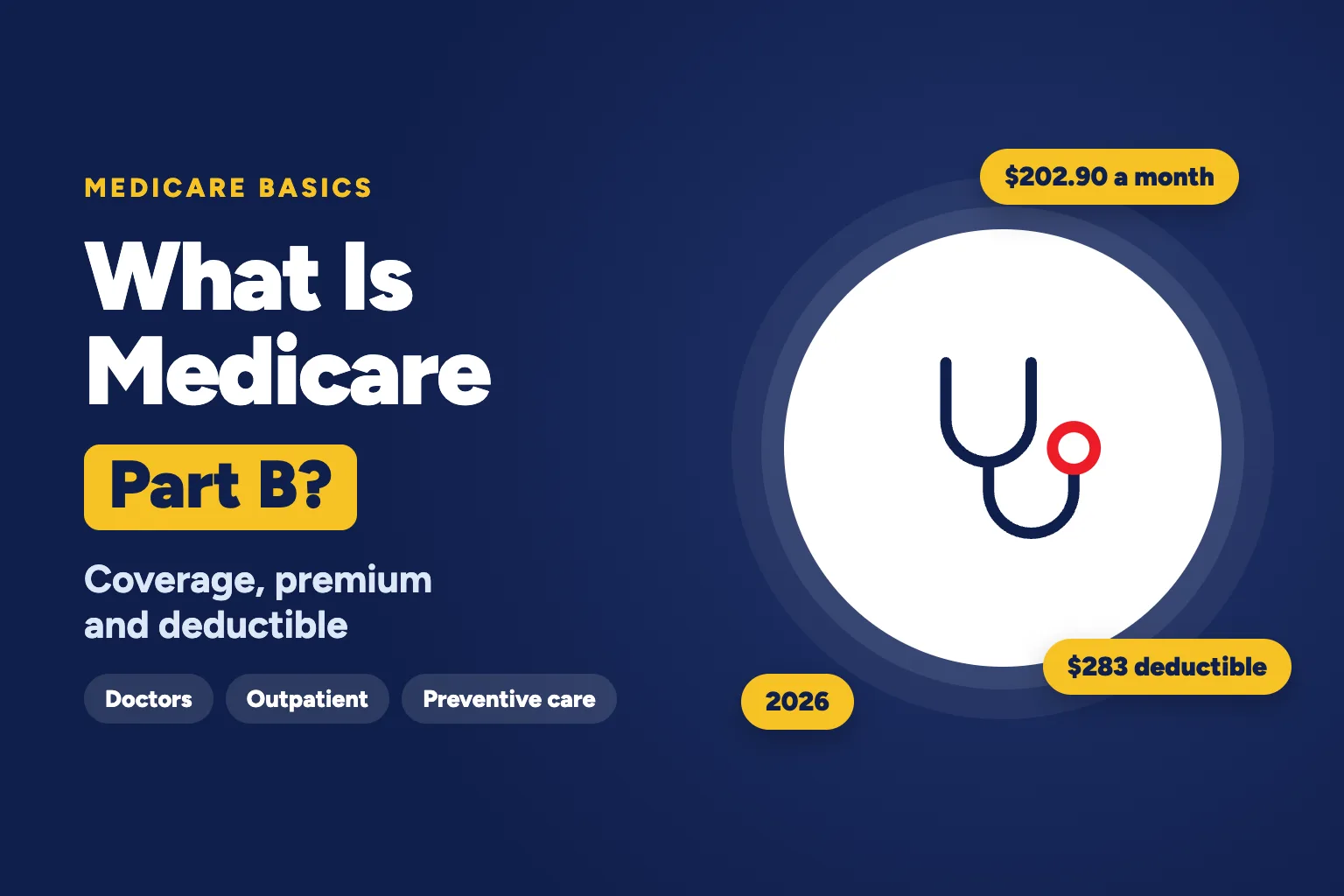
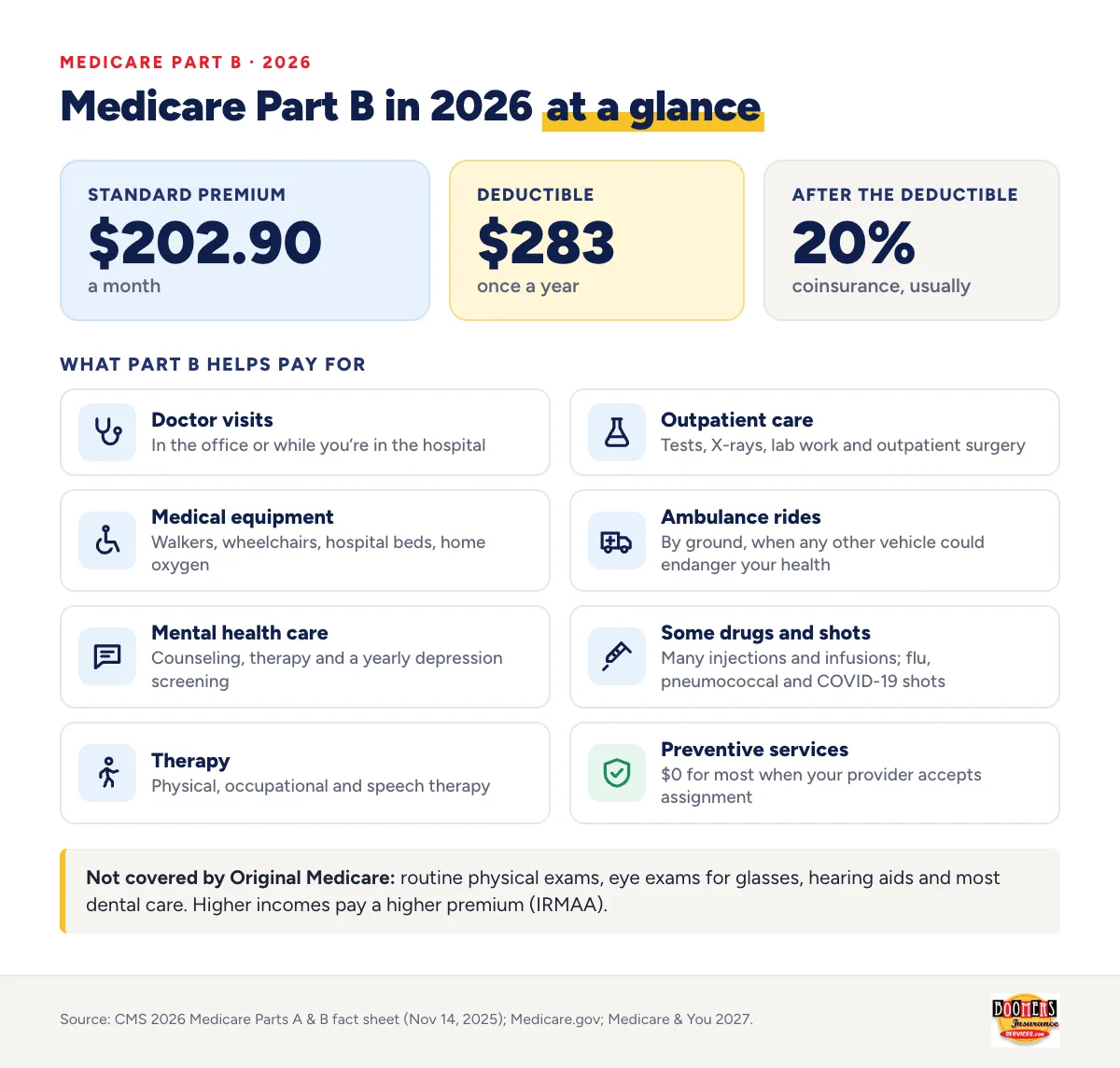
What is Medicare Part B? It is the part of Original Medicare that helps pay for doctor visits, outpatient care, medical equipment and many preventive services. In 2026 the standard premium is $202.90 a month and the deductible is $283. After that, you usually pay 20% coinsurance.
What is Medicare Part B? It is the medical insurance part of Original Medicare. It helps pay for doctor visits, outpatient care, medical equipment and many preventive services. Part A is the hospital part. Together they make up Original Medicare.
This guide explains what Part B covers, what it costs in 2026, how you pay the premium and when to sign up. It also covers the late penalty and how to delay Part B safely if you still have coverage through a job.
What is Medicare Part B, in plain words?
So what is Medicare Part B? Medicare.gov says Part B helps cover two kinds of care:
- Medically necessary services. These are services or supplies that meet accepted standards of medical practice to diagnose or treat your condition.
- Preventive services. This is care to prevent illness, such as the flu, or to find it early, when treatment is likely to work well.
Part B is run by the federal government. You pay a monthly premium for it, and most people have it taken out of their Social Security benefits. If you join a Medicare Advantage plan, you still have Part B and you generally keep paying the Part B premium.
What does Medicare Part B cover?
Medicare & You 2027 says Part B helps cover doctor services, outpatient care, some home health services, durable medical equipment, mental health services, limited outpatient prescription drugs and other medical services. Common examples:
- Doctor visits, in the office or while you are in the hospital
- Outpatient care, such as tests, X-rays, lab work and outpatient surgery
- Durable medical equipment, such as walkers, wheelchairs, hospital beds and home oxygen equipment, when a doctor orders it for use in your home
- Ambulance rides, by ground, when any other vehicle could endanger your health
- Mental health care, including counseling, therapy and a yearly depression screening
- Some drugs, mostly ones a provider gives you, like many injections and infusions, plus flu, pneumococcal and COVID-19 shots
- Physical, occupational and speech therapy when a provider certifies you need it
Preventive services under Part B
Part B covers many preventive services. These include a one-time "Welcome to Medicare" visit, a yearly "Wellness" visit and many screenings and shots. Medicare.gov says you pay nothing for most preventive services if your provider accepts assignment. Assignment means the provider agrees to accept the amount Medicare allows as full payment.
What Part B doesn't cover
Original Medicare doesn't cover everything. It doesn't cover routine physical exams, eye exams for glasses, hearing aids or most dental care. It also doesn't cover non-medical long-term care, like help with bathing and dressing. Read more in does Medicare cover dental, vision and hearing and does Medicare cover long-term care.
Medicare Part A and B: what is the difference?
People often say "Medicare Part A and B" in one breath. They work together, but they pay for different kinds of care.
| Part A (Hospital Insurance) | Part B (Medical Insurance) | |
|---|---|---|
| Main care | Inpatient hospital stays, skilled nursing facility care, hospice, some home health care | Doctor services, outpatient care, preventive services, medical equipment, some home health care |
| Monthly premium in 2026 | Most people have Part A without a premium (based on work history) | $202.90 standard premium (higher for higher incomes) |
| Deductible in 2026 | $1,736 for each benefit period | $283 once a year |
| Your share after the deductible | $0 for days 1–60 of a hospital stay; daily amounts after that | Usually 20% coinsurance |
| How you get it | Automatic for many people; otherwise through Social Security | Same; you can turn it down, but a late penalty may apply if you sign up later |
Source: CMS fact sheet of November 14, 2025, and Medicare.gov. CMS announces the next year's amounts in the fall. It had not published the 2027 Part A and Part B figures when we checked on November 4, 2026.
What does Part B cost in 2026?
Part B has three main costs: a monthly premium, a yearly deductible and your share of each bill.
The Part B premium 2026
The Part B premium 2026 is $202.90 a month for most people. Medicare.gov says you pay it each month, even if you don't use any Part B services that month.
The Part B deductible 2026 and the 20%
The Part B deductible 2026 is $283 for the year. Once you have paid it, you usually pay 20% coinsurance for each covered service. You usually pay 20% when your provider accepts assignment. A provider who doesn't accept assignment can charge more, in many cases up to 15% above the amount Medicare allows. There's no yearly limit on what you pay out of pocket unless you have supplemental coverage, like a Medigap policy, or join a Medicare Advantage plan. Our article on Medicare Advantage vs. Medigap in California compares the two.
Higher premiums for higher incomes (IRMAA)
If your income is above a set level, you pay more for Part B. This extra amount is called the income-related monthly adjustment amount, or IRMAA. In 2026 it starts above $109,000 for a single tax filer and $218,000 for a joint return, generally based on your 2024 tax return. The total Part B premium then ranges from $284.10 to $689.90 a month. Our Medicare cost guide has the full table and explains how to ask Social Security for a new decision after a life change.
If your income is limited, a Medicare Savings Program may help pay the premium. See Extra Help and the Medicare Savings Programs.
How do you pay the Part B premium?
How to pay the Part B premium depends on whether you get benefits.
- From your benefits. If you get Social Security or Railroad Retirement Board benefits, the premium is usually taken out of your payment.
- By a bill from Medicare. If you don't get those benefits, Medicare sends you a bill. Part B is usually billed every 3 months. You get a monthly bill instead if you also pay a Part A premium or a Part D IRMAA, or if you use Medicare Easy Pay.
You can pay a Medicare bill in your secure Medicare account online, by Medicare Easy Pay (automatic payments from your bank account), through your bank's bill-pay service, or by mail. Medicare.gov says all Medicare bills are due on the 25th of the month.
When should you sign up for Part B?
Your first chance is your Initial Enrollment Period. It lasts 7 months: the 3 months before the month you turn 65, that month, and the 3 months after.
- If you already get Social Security or Railroad Retirement Board benefits, you get Part A and Part B automatically. Your Medicare card arrives about 3 months before your 65th birthday.
- If you don't get those benefits yet, you sign up through Social Security, online at ssa.gov, by phone or at an office.
When Part B starts depends on when you sign up. Sign up before the month you turn 65, and coverage starts the month you turn 65. Sign up in your birthday month or the 3 months after, and it starts the next month. Our Turning 65 checklist walks through each step.
How does the Part B late enrollment penalty work?
If you miss your first chance and don't qualify for a Special Enrollment Period, you can sign up from January 1 to March 31 each year. Coverage then starts the month after you sign up. You may also pay a penalty.
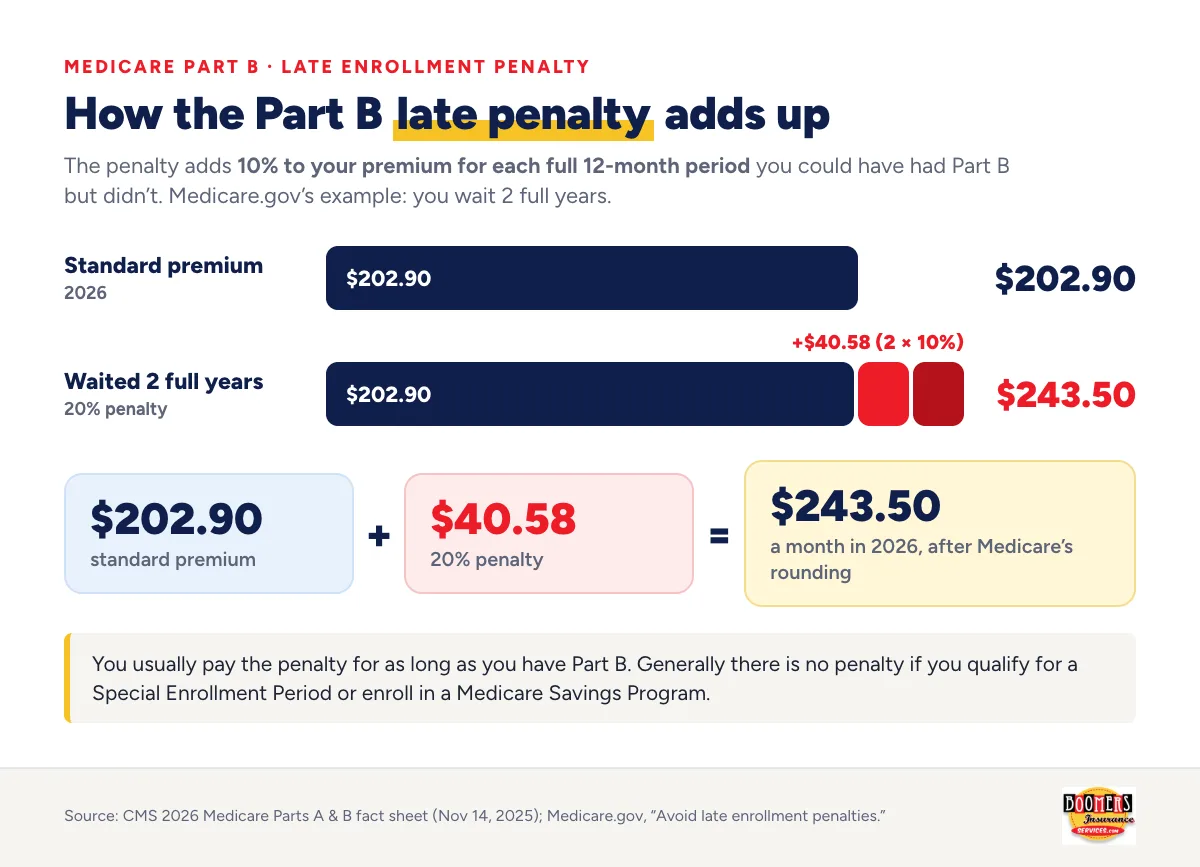
The penalty adds 10% to your premium for each full 12-month period you could have had Part B but didn't. You usually pay it for as long as you have Part B. Medicare.gov's example: wait 2 full years, and you pay a 20% penalty. In 2026, that adds $40.58 to the $202.90 standard premium, for a $243.50 monthly premium after Medicare's rounding. Generally there is no penalty if you qualify for a Special Enrollment Period or enroll in a Medicare Savings Program.
Can you delay Part B if you still work?
Often, yes. If you or your spouse are still working and have health coverage from that job, you may be able to delay Part B without a penalty. You then get 8 months to sign up after the job or the coverage ends, whichever comes first. COBRA and retiree coverage don't count as coverage from current work. Check with the employer's benefits office first. Our article on Medicare and employer insurance explains the rules, and Medicare Special Enrollment Periods covers other situations.
Next steps
- Mark your Initial Enrollment Period dates on a calendar.
- If you still have job coverage, ask the benefits office whether you need Part B now.
- Check whether your income puts you in an IRMAA bracket.
- List your doctors and prescriptions before you compare Medigap, Medicare Advantage and drug plans.
Talk with a licensed Boomers agent
A licensed Boomers agent can go over the Medicare plans we represent in your area and check them against your doctors and prescriptions.
Find a licensed agent near you · See upcoming Medicare events
Or call 1-800-815-1943 (TTY 711), Monday – Friday, 9 AM – 5 PM Pacific.
Frequently asked questions
Is Medicare Part B required?
No, Part B is your choice. But if you turn it down and don't have other coverage that lets you delay it, such as coverage from current work, you may pay a late penalty later. Talk with Social Security or the employer's benefits office before you decide.
Do I need Part B if I join a Medicare Advantage plan?
Yes. You need both Part A and Part B to join a Medicare Advantage plan. You generally keep paying the Part B premium too, unless a program like Medi-Cal or a Medicare Savings Program pays it for you.
Does Part B cover prescription drugs?
Only a limited number. Part B mostly covers drugs a provider gives you, like many injections and infusions, plus some others, such as certain oral cancer drugs. Most drugs you fill at a pharmacy fall under Medicare drug coverage (Part D) instead.
Will the Part B premium change in 2027?
It can change every year. CMS announces the new Part B premium and deductible in the fall. It had not published the 2027 amounts when we checked on November 4, 2026. Our cost guide will show them once they are out.
Sources
- What Part B covers (Medicare.gov)
- Medicare costs (Medicare.gov)
- Pay premiums (Medicare.gov)
- Avoid late enrollment penalties (Medicare.gov)
- When does Medicare coverage start? (Medicare.gov)
- Prescription drugs (outpatient) (Medicare.gov)
- Medicare & You 2027 (Medicare.gov)
- 2026 Medicare Parts A & B premiums and deductibles (CMS.gov, November 14, 2025)
Talk with a licensed Boomers agent
A licensed agent can go over the Medicare plans we represent in your area, check them against your doctors and prescriptions, and answer your questions. There is no cost to you and no obligation to enroll.
Monday – Friday, 9 AM – 5 PM PT