
Medicare Supplement Plans Explained: Medigap Plan Letters A to N
Medicare Supplement plans, also called Medigap, are private policies that help pay costs Original Medicare leaves to you. In most states they come in 10 standard letters, A to N. Plans with the same letter offer the same basic benefits.

Medicare Supplement plans, also called Medigap, are policies sold by private insurance companies. They help pay your share of costs in Original Medicare, such as deductibles, coinsurance and copayments. In most states, the plans are standardized and named by letters: A, B, C, D, F, G, K, L, M and N. Plans with the same letter offer the same basic benefits, whichever company sells them.
This guide compares the plan letters using the 2026 chart from Medicare’s Medigap booklet. It also covers who can buy Plans C and F, how companies set premiums, and when you can buy a policy without health questions. California rules are included.
What are Medicare Supplement plans, and what are they not?
Medicare Supplement Insurance works alongside Original Medicare (Part A and Part B). When you get covered care, Medicare pays its share first. Then your Medigap policy pays its share. Generally, you need Part A and Part B to buy a policy, and you keep paying your Part B premium.
A few basics from Medicare’s booklet, Choosing a Medigap Policy:
- Each policy must be clearly labeled “Medicare Supplement Insurance.”
- A policy covers one person. Spouses buy their own.
- Policies sold after 2005 don’t include drug coverage. For that, people join a separate Part D plan.
- A company can’t cancel a policy sold since 1992 as long as you stay enrolled and pay the premium.
- Medigap generally doesn’t cover long-term care, dental, vision, hearing aids, glasses or private-duty nursing.
Medicare supplemental insurance is also not the same as these, which are separate kinds of coverage:
- Medicare Advantage plans (Part C)
- Medicare drug plans (Part D)
- Medicaid (Medi-Cal in California)
- Employer, retiree, COBRA or union coverage
- TRICARE and veterans’ benefits
- Long-term care insurance
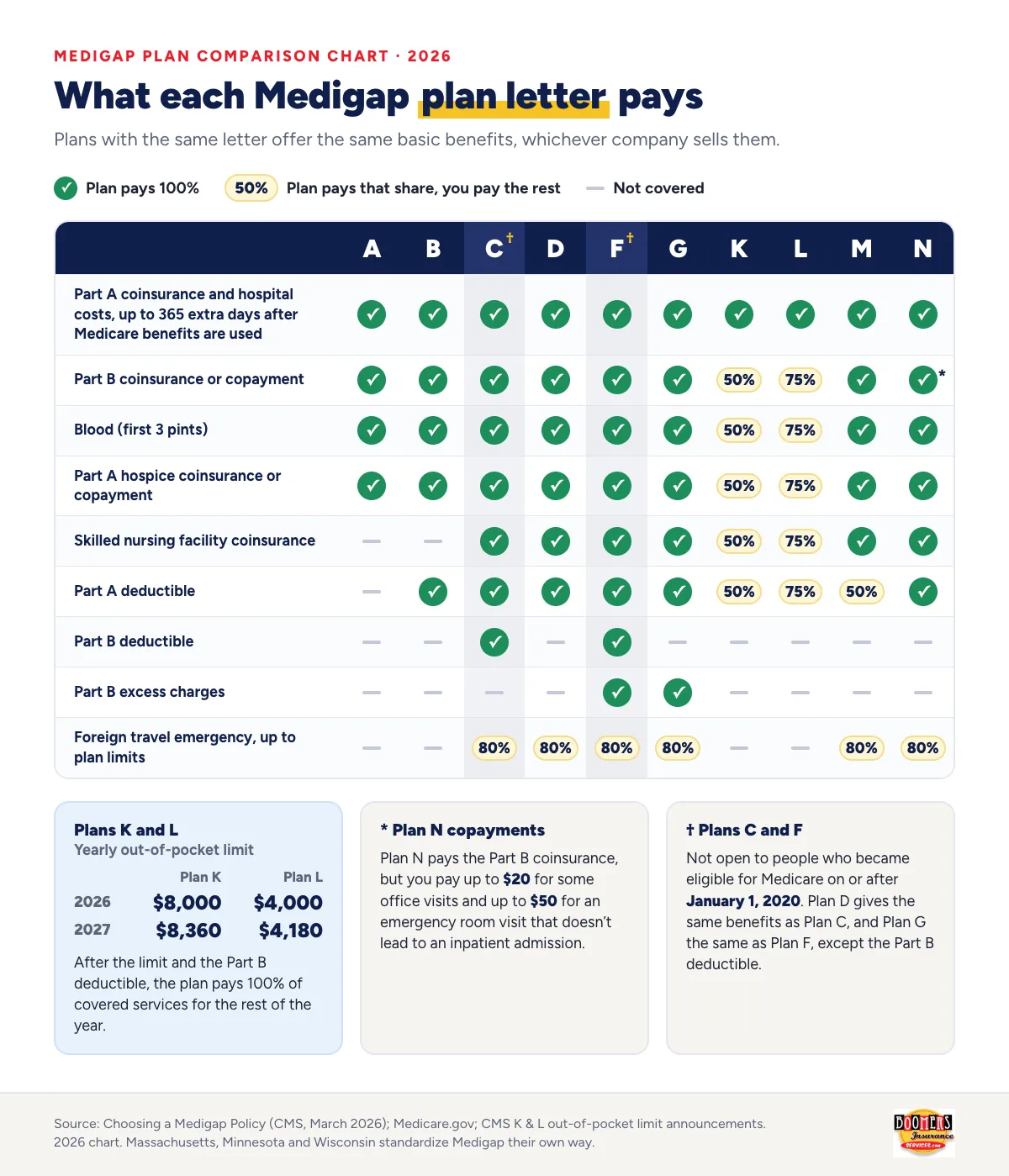
Medigap plan comparison chart for 2026
This chart follows the one Medicare publishes for 2026. “Yes” means the plan pays 100% of that cost. A percentage means the plan pays that share and you pay the rest.
| Benefit | A | B | C | D | F | G | K | L | M | N |
|---|---|---|---|---|---|---|---|---|---|---|
| Part A coinsurance and hospital costs, up to 365 extra days after Medicare benefits are used | Yes | Yes | Yes | Yes | Yes | Yes | Yes | Yes | Yes | Yes |
| Part B coinsurance or copayment | Yes | Yes | Yes | Yes | Yes | Yes | 50% | 75% | Yes | Yes* |
| Blood (first 3 pints) | Yes | Yes | Yes | Yes | Yes | Yes | 50% | 75% | Yes | Yes |
| Part A hospice coinsurance or copayment | Yes | Yes | Yes | Yes | Yes | Yes | 50% | 75% | Yes | Yes |
| Skilled nursing facility coinsurance | No | No | Yes | Yes | Yes | Yes | 50% | 75% | Yes | Yes |
| Part A deductible | No | Yes | Yes | Yes | Yes | Yes | 50% | 75% | 50% | Yes |
| Part B deductible | No | No | Yes | No | Yes | No | No | No | No | No |
| Part B excess charges | No | No | No | No | Yes | Yes | No | No | No | No |
| Foreign travel emergency, up to plan limits | No | No | 80% | 80% | 80% | 80% | No | No | 80% | 80% |
*Plan N pays the Part B coinsurance, but you pay a copayment of up to $20 for some office visits. You also pay up to $50 for an emergency room visit that doesn’t lead to an inpatient admission.
What else the Medigap chart doesn’t show
- Plans K and L have a yearly out-of-pocket limit. It is $8,000 for Plan K and $4,000 for Plan L in 2026. CMS set them at $8,360 and $4,180 for 2027. Once you reach the limit and the Part B deductible, the plan pays 100% of covered services for the rest of the year.
- Plans F and G come in a high-deductible version in some states. You pay Medicare-covered costs up to a deductible before the policy pays: $2,950 in 2026 and $3,050 in 2027, according to CMS.
- Excess charges are what a doctor who doesn’t accept assignment may bill above the amount Medicare allows. In many cases, the extra can’t be more than 15%. Among the standard plan letters sold today, only Plans F and G pay them.
For 2026, the Part B deductible is $283 and the Part A deductible is $1,736 per benefit period. Our Medicare costs guide lists the other amounts and what CMS has confirmed for 2027.
Which Medigap plans can you buy if you’re new to Medicare?
Since January 1, 2020, Medigap plans sold to people new to Medicare can’t pay the Part B deductible. So Plans C and F aren’t open to you if you became eligible for Medicare on or after that date. If you were eligible before 2020 but didn’t enroll, you may still be able to buy Plan C or F.
Instead, people new to Medicare can buy Plans D and G. Plan D gives the same benefits as Plan C, and Plan G the same as Plan F, except the Part B deductible. Plans E, H, I and J are no longer sold, but people who have one can generally keep it.
Medigap works differently in Massachusetts, Minnesota and Wisconsin, which standardize their plans their own way.
How do you choose among Medicare Supplement plans?
Start with the benefits, then compare companies. Medicare’s booklet suggests deciding on a plan letter first, since you might not be able to switch later. These questions can help:
- How much cost sharing do you want? Plans K and L pay part of many costs, with a yearly limit. Plan N adds small copayments. Plans with more “Yes” cells in the chart pay more of each bill.
- Do you travel abroad? Several letters pay 80% of emergency care outside the U.S., up to plan limits.
- Do your doctors accept assignment? If some don’t, excess charges may matter to you.
- Is a network acceptable? Medicare SELECT policies, sold in some states, use a hospital network (and sometimes a doctor network). Outside it, for non-emergency care, you may have to pay some or all of what the policy doesn’t cover.
- What else covers you? Retiree coverage often fills some of the same gaps.
A company that sells Medigap policies must offer at least Plan A. It decides which other letters it sells, so not every letter is sold by every company. Medicare.gov has a search tool that shows which companies sell policies where you live.
How are Medigap premiums priced?
The premium is the only difference between policies with the same letter from different companies. Medicare’s booklet says those premiums can differ a lot, so compare the same letter across companies. Each company picks one of three ways to price a policy:
- Community-rated: the premium is generally the same for everyone, whatever their age.
- Issue-age-rated: based on your age when you buy. It doesn’t go up because you get older.
- Attained-age-rated: based on your current age, so it goes up as you get older.
Under any method, premiums may still rise because of inflation and other factors. Where you live, discounts and, outside protected times, your health can also affect the price. We don’t quote premiums here, because they vary by company, plan, age and ZIP code.
When can you buy Medicare Supplement insurance?
Your Medigap open enrollment period
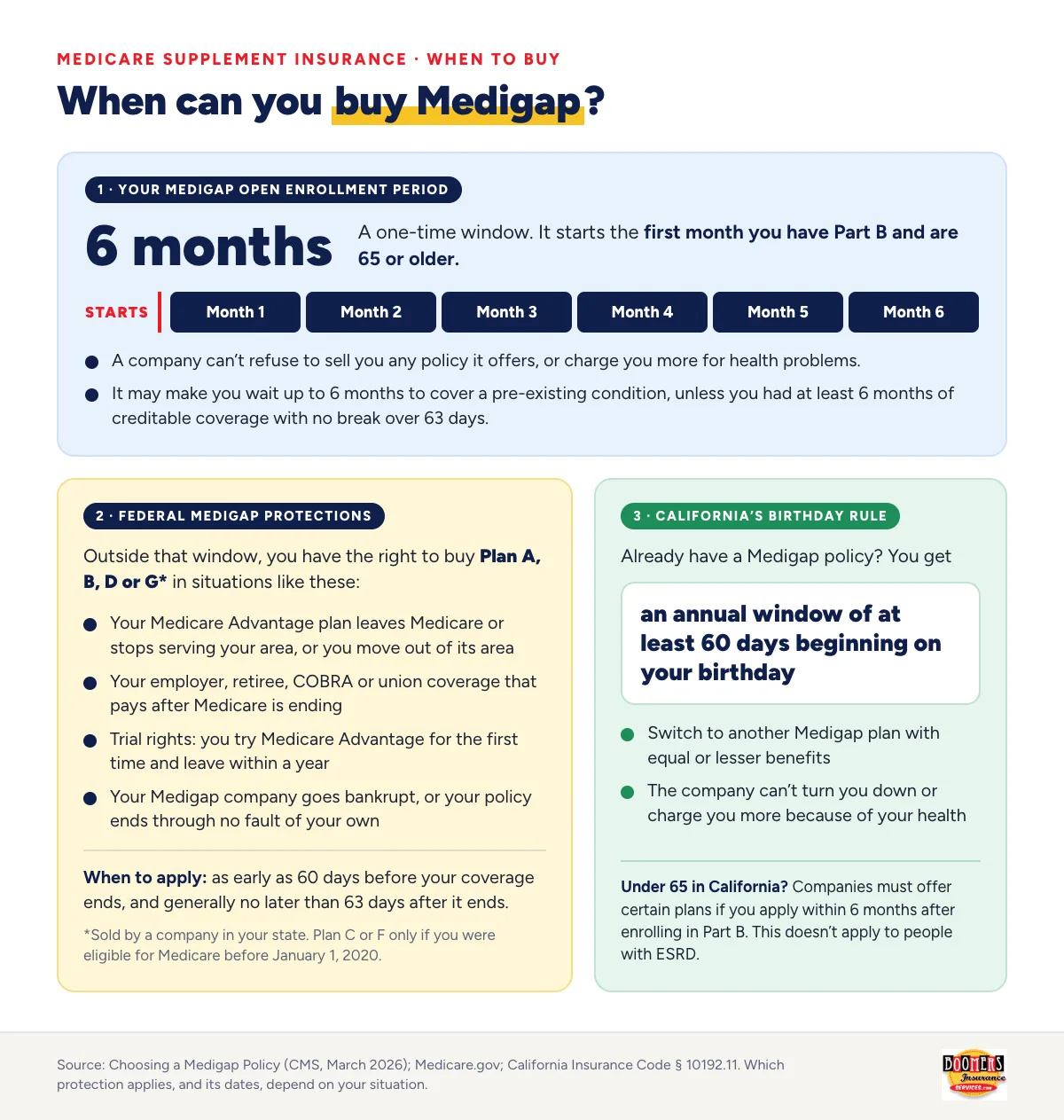
Your Medigap open enrollment period is a one-time, 6-month window. It starts the first month you have Part B and are 65 or older. During it, a company can’t refuse to sell you any policy it offers or charge you more for health problems. It may make you wait up to 6 months to cover a pre-existing condition, unless you had at least 6 months of creditable coverage with no break over 63 days.
If you delay Part B because you have group coverage from your or your spouse’s current job, your window starts when you sign up for Part B. See Medicare and employer insurance for that timing.
What are Medigap protections?
Outside that window, a company can generally use your health to decide whether to sell you a policy. In some situations, federal law gives you the right to buy certain plans anyway. Medicare calls these Medigap protections. Then the company must sell you the policy, must cover your pre-existing conditions and can’t charge more for your health.
Federal Medigap protections at a glance
| Your situation | What you may buy | When to apply |
|---|---|---|
| Your Medicare Advantage plan leaves Medicare, stops serving your area, or has a significant network change, or you move out of its area, and you return to Original Medicare | Plan A, B, D or G* | From 60 days before that coverage ends, until 63 days after |
| Your employer, retiree, COBRA or union coverage that pays after Medicare is ending | Plan A, B, D or G* | Up to 63 days after the latest of: the date the coverage ends, the date on the notice that it’s ending, or the date of a claim denial if that’s how you learn it ended |
| You move out of a Medicare SELECT policy’s area | Plan A, B, D or G*, in your state or the new one | From 60 days before that coverage ends, until 63 days after |
Trial rights and other protections
| Your situation | What you may buy | When to apply |
|---|---|---|
| Trial right: you joined Medicare Advantage or PACE when first eligible at 65 and leave within the first year | Any Medigap policy sold in your state* | From 60 days before that coverage ends, until 63 days after |
| Trial right: you dropped Medigap to try Medicare Advantage for the first time and leave within a year | Your old policy, if the same company still sells it; otherwise Plan A, B, D or G* | From 60 days before that coverage ends, until 63 days after |
| Your Medigap company goes bankrupt, or your policy ends through no fault of your own | Plan A, B, D or G* | Up to 63 days after the policy ends |
| You leave a Medicare Advantage plan or drop a Medigap policy because the company didn’t follow the rules or misled you | Plan A, B, D or G* | Up to 63 days after your coverage ends |
*Sold by a company in your state. Plan C or F only if you were eligible for Medicare before January 1, 2020.
Keep proof that your coverage ended
Keep the letters, notices and envelopes that show your coverage ended. If your Medicare Advantage plan is ending this year, see what to do when a Medicare Advantage plan is ending.
California’s birthday rule
California adds a right for people who already have a Medigap policy. You get an annual window of at least 60 days beginning on your birthday to switch to another Medigap plan with equal or lesser benefits. The company can’t turn you down or charge you more because of your health. The California Department of Insurance explains the rule.
California also requires Medigap companies to offer certain plans to people under 65 with Medicare who apply within 6 months after enrolling in Part B (or after certain other events): Plans A, B, D and G if the company sells them, plus a Plan K or L, or a Plan M or N, chosen by the company. This doesn’t apply to people who have end-stage renal disease (ESRD). Our post on Medicare under 65 explains more.
Medigap plans vs Medicare Advantage: what’s the difference?
Medigap and Medicare Advantage are two separate paths. With Original Medicare and a Medigap policy, you can see any doctor or hospital in the U.S. that accepts Medicare. You can add a separate Part D plan for drugs. Medicare Advantage plans are offered by private companies that contract with Medicare. They often include drug coverage and usually use a network.
You can’t use both. Companies generally can’t sell you a Medigap policy while you’re in Medicare Advantage, unless you’re switching back to Original Medicare. The same is generally true if you have Medicaid. Our Medicare Advantage vs Medigap comparison goes into the trade-offs.
Next steps
- Note your Part B start date. Your 6-month Medigap window starts then, if you’re 65 or older.
- Pick a plan letter first, using the chart above and your expected care.
- Compare the same letter across companies, and ask how each prices its policy.
- Plan your drug coverage. Medigap doesn’t include it.
- Turning 65 soon? Our Turning 65 checklist puts the steps in order.
Talk with a licensed Boomers agent
A licensed Boomers agent can go over the Medicare plans we represent in your area and check them against your doctors and prescriptions. We can also walk you through the plan letters and your Medigap timing. For one-on-one counseling from the state, call HICAP at 1-800-434-0222.
Find a licensed agent near you · See upcoming Medicare events
Or call 1-800-815-1943 (TTY 711), Monday – Friday, 9 AM – 5 PM Pacific.
Frequently asked questions
Is Medicare supplemental insurance the same as Medigap?
Yes. “Medigap,” “Medicare Supplement Insurance” and “Medicare supplemental insurance” all describe the same kind of policy. Private companies sell it, and it works only with Original Medicare.
Are Medigap plans the same in every state?
In most states, yes: a Plan G in one state has the same basic benefits as a Plan G in another. Massachusetts, Minnesota and Wisconsin standardize Medigap in their own way. Premiums and the letters on sale still differ by company and area.
Can I change Medicare Supplement plans later?
Federal law generally gives you that right only in your open enrollment period or with a Medigap protection. Otherwise the new company may ask health questions. In California, the birthday rule also lets you move to a plan with equal or lesser benefits. If you switch, you get 30 days to review the new policy, and you pay both premiums for the month you have both.
Does supplemental insurance for Medicare cover prescription drugs?
No. Medigap policies sold after 2005 don’t include drug coverage. If you want drug coverage, you can join a separate Medicare drug plan (Part D). Our Part D out-of-pocket cap guide explains the 2026 and 2027 limits.
Do Medigap plans cover hearing aids or dental care?
Generally not. Medigap policies generally don’t cover hearing aids, dental, vision, glasses or long-term care. Our post on hearing aid coverage looks at other ways to pay.
Sources
- Choosing a Medigap Policy, March 2026 (Medicare.gov)
- Compare Medigap plan benefits (Medicare.gov)
- Medicare & You 2027 handbook (Medicare.gov)
- K & L out-of-pocket limits announcements (CMS.gov)
- F, G & J deductible announcements (CMS.gov)
- 2026 Medicare Parts A & B premiums and deductibles (CMS.gov)
- Does your provider accept Medicare as full payment? (Medicare.gov)
- California Insurance Code § 10192.11, Medigap open enrollment and the birthday rule (California Legislative Information)
- Informing Seniors and the Senior Insurance Bill of Rights, Form 805 (California Department of Insurance, July 2025)
- Medicare counseling: HICAP (California Department of Aging)
Talk with a licensed Boomers agent
A licensed agent can go over the Medicare plans we represent in your area, check them against your doctors and prescriptions, and answer your questions. There is no cost to you and no obligation to enroll.
Monday – Friday, 9 AM – 5 PM PT