
Shingles Vaccine Cost With Medicare: What Part D and Part B Pay
The shingles vaccine cost with Medicare depends on whether you have Medicare drug coverage (Part D). Medicare.gov says you pay nothing for the shingles vaccine if you have Part D, with no copayment and no deductible. Part B covers flu, pneumococcal, COVID-19 and, if eligible, hepatitis B shots.
The shingles vaccine cost with Medicare comes down to one question: do you have Medicare drug coverage (Part D)? Medicare.gov says you pay nothing for the shingles vaccine if you have Part D. Your plan won't charge a copayment or apply a deductible for it.
Other common shots are covered by a different part of Medicare. Part B (Medical Insurance) covers flu, pneumococcal and COVID-19 vaccines, and hepatitis B vaccines if you're eligible. This article explains which part pays for which shot in 2026 and 2027. It uses Medicare.gov, the Medicare & You 2027 handbook and the Centers for Disease Control and Prevention (CDC). It isn't medical advice. Your doctor or pharmacist can tell you which vaccines are right for you.
Does Medicare cover the shingles vaccine?
Yes. Medicare drug coverage (Part D) covers the shingles vaccine. Part A and Part B don't list it as a covered vaccine, so the coverage comes through a drug plan. You can have Part D in two ways:
- A stand-alone Medicare drug plan that works with Original Medicare.
- A Medicare Advantage plan that includes drug coverage.
Both kinds of plan are offered by private companies that contract with Medicare. Our guide to what Medicare Part D is explains how drug plans work.
Medicare.gov describes the shingles vaccine this way: it can protect you against the varicella-zoster virus, which causes a painful skin rash and sometimes serious complications, like long-term pain.
What is the shingles vaccine cost with Part D?
You pay nothing for the shingles vaccine if you have Part D. Medicare.gov says your Part D plan won't charge you a copayment or apply a deductible for vaccines that the Advisory Committee on Immunization Practices (ACIP) recommends.
That matters because Part D plans can have a yearly deductible for other drugs. In 2026 a plan's deductible can be up to $615, and in 2027 up to $700. The deductible doesn't apply to these vaccines.
The rule covers more than shingles. Medicare.gov says Part D covers all adult vaccines ACIP recommends that aren't covered under Part B. Its examples include vaccines for respiratory syncytial virus (RSV), whooping cough and measles.
Why did the cost change in 2023?
A federal law, the Inflation Reduction Act, changed it. The Centers for Medicare & Medicaid Services (CMS) said in its fact sheet on the law that people with Medicare drug coverage would pay nothing out of pocket for adult vaccines ACIP recommends, including the shingles vaccine, starting in 2023.
What if the vaccine isn't on your plan's drug list?
Medicare & You 2027 covers this case. If a recommended vaccine isn't on your plan's drug list yet, you can ask for a coverage exception or get reimbursed. Contact your plan for details. It is also sensible to ask your plan where to get the shot before you go, such as which pharmacies it works with.
What is the shingles vaccine cost without Part D?
Without Part D, Medicare doesn't pay for the shingles vaccine. Medicare.gov lists the shingles vaccine under Medicare drug coverage (Part D). If you have other drug coverage, like a retiree plan or coverage from the Department of Veterans Affairs, ask that plan what it pays. If you have no drug coverage, ask the pharmacy for its price before you get the shot. We don't quote prices here because they vary.
When can you sign up for Part D?
You can generally join a Part D plan when you first get Medicare, or during Medicare Open Enrollment, October 15 to December 7 each year. Coverage chosen during Open Enrollment starts January 1. Some life events, like losing other drug coverage, give you a Special Enrollment Period.
If you go without Part D or other creditable drug coverage, you may owe a late enrollment penalty when you join later. If your income is limited, Extra Help can lower Part D costs for people who qualify.
How do you choose a drug plan?
Compare plans on the drugs you take, not on vaccines, because the vaccine rule is the same in each Part D plan. The Medicare Plan Finder at Medicare.gov/plan-compare lets you enter your prescriptions and pharmacies. Look at these points:
- The drug list and drug tiers. Each plan has its own list of covered drugs, and it sorts them into drug tiers with different costs.
- The premium and deductible. These vary by plan.
- The out-of-pocket cap. Your yearly spending on covered drugs stops at $2,100 in 2026 and $2,400 in 2027.
- Insulin. A plan can't charge more than $35 for a one-month supply of each covered insulin.
- The Medicare Prescription Payment Plan. It spreads your drug costs over the year in monthly bills. It doesn't lower what you owe.
Our article on the Part D out-of-pocket cap and the payment plan explains the last two points.
Which vaccines does Medicare cover, and under which part?
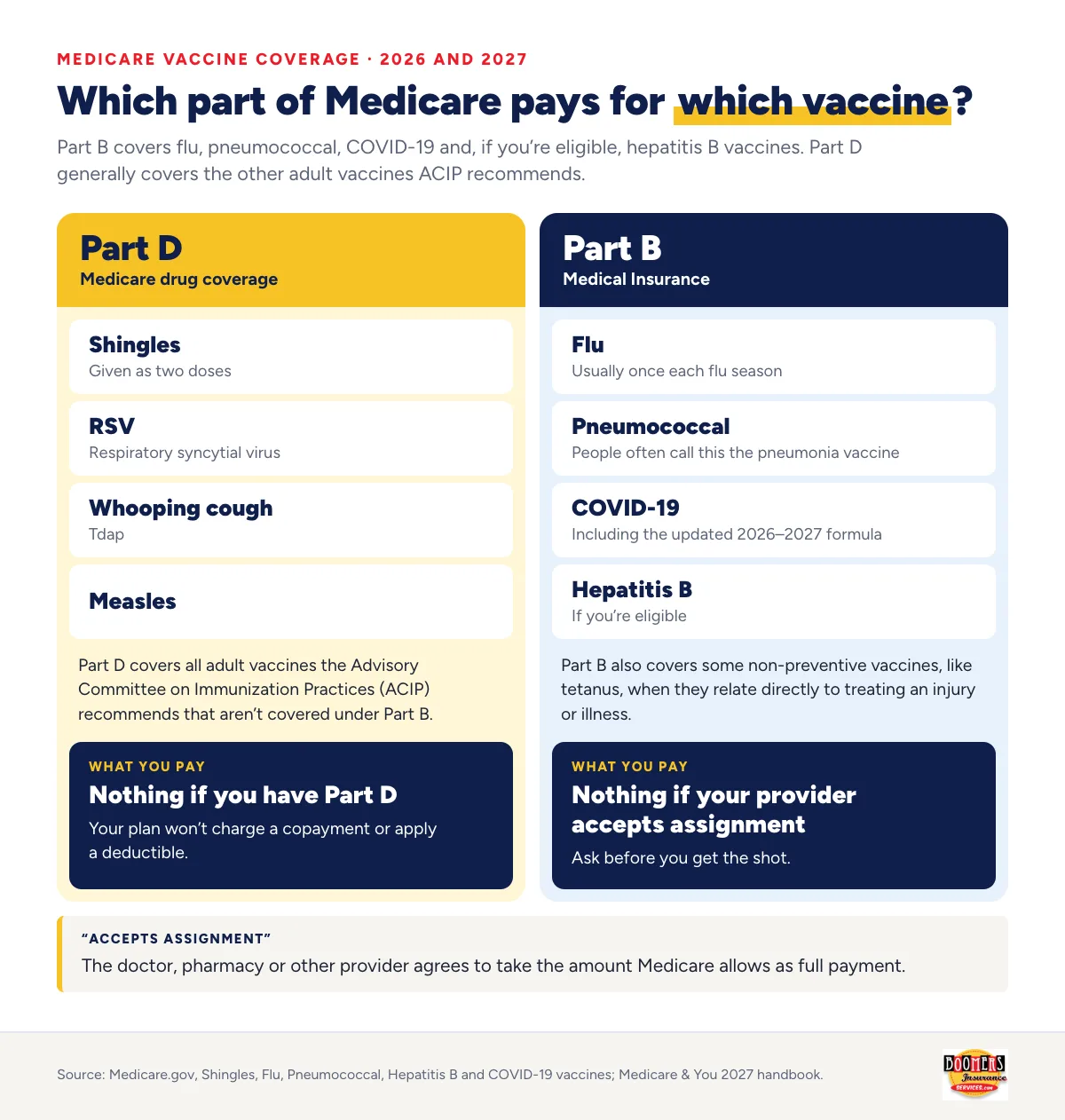
Part B covers flu, pneumococcal, COVID-19 and, if you're eligible, hepatitis B vaccines. Part D generally covers the other adult vaccines ACIP recommends. The table shows what Medicare.gov and Medicare & You 2027 say for each one.
| Vaccine | Which part covers it | What you pay |
|---|---|---|
| Shingles | Part D | Nothing if you have Part D |
| RSV, whooping cough (Tdap), measles and other ACIP-recommended adult vaccines | Part D | Nothing if you have Part D |
| Flu | Part B | Nothing if your provider accepts assignment |
| Pneumococcal | Part B | Nothing if your provider accepts assignment |
| COVID-19 | Part B | Nothing if your provider accepts assignment |
| Hepatitis B, if you're eligible | Part B | Nothing if your provider accepts assignment |
"Accepts assignment" means the doctor, pharmacy or other provider agrees to take the amount Medicare allows as full payment. Ask before you get the shot. Our guide to what Medicare Part B is explains assignment and the rest of Part B.
Does Medicare cover flu shots and the pneumonia vaccine?
Yes. Part B covers both, and you pay nothing if your provider accepts assignment for giving the vaccine. Here is what Medicare says about each Part B shot.
- Flu. Part B covers the seasonal flu vaccine, usually once each flu season. Medicare.gov says you can get it at many places, including your doctor's office and your local pharmacy.
- Pneumococcal. People often call this the pneumonia vaccine. Part B covers pneumococcal vaccines, which help prevent pneumococcal infections, like certain types of pneumonia. Medicare says to talk with your doctor about which vaccines are right for you.
- COVID-19. Part B covers FDA-approved and FDA-authorized COVID-19 vaccines, including the updated 2026–2027 formula. Bring your red, white and blue Medicare card so the provider or pharmacy can bill Medicare.
- Hepatitis B. Part B covers it only if you meet at least one condition, listed below.
Who is eligible for the hepatitis B vaccine under Part B?
Medicare.gov says you must meet at least one of these conditions:
- You've never gotten a complete series of hepatitis B vaccines.
- You don't know your vaccination history.
- You have a health condition or situation that puts you at medium or high risk for hepatitis B. Medicare's examples are diabetes, End-Stage Renal Disease (ESRD) or living with someone who has hepatitis B.
Part B also covers some non-preventive vaccines, like tetanus, when they relate directly to treating an injury or illness. A tetanus shot given only for prevention falls under Part D.
Who does the CDC recommend the shingles vaccine for?
The CDC recommends the shingles vaccine for adults 50 and older, and for adults 19 and older with weakened immune systems. It is given as two doses. The CDC's shingles vaccination page, dated August 19, 2025, gives this schedule:
- Adults 50 and older: 2 doses, separated by 2 to 6 months.
- Adults 19 and older with weakened immune systems due to disease or therapy: 2 doses. If needed, the second dose can be given 1 to 2 months after the first.
The CDC says about 1 in 3 people in the United States will have shingles in their lifetime, and the risk increases with age. It also says there is no maximum age for getting the vaccine.
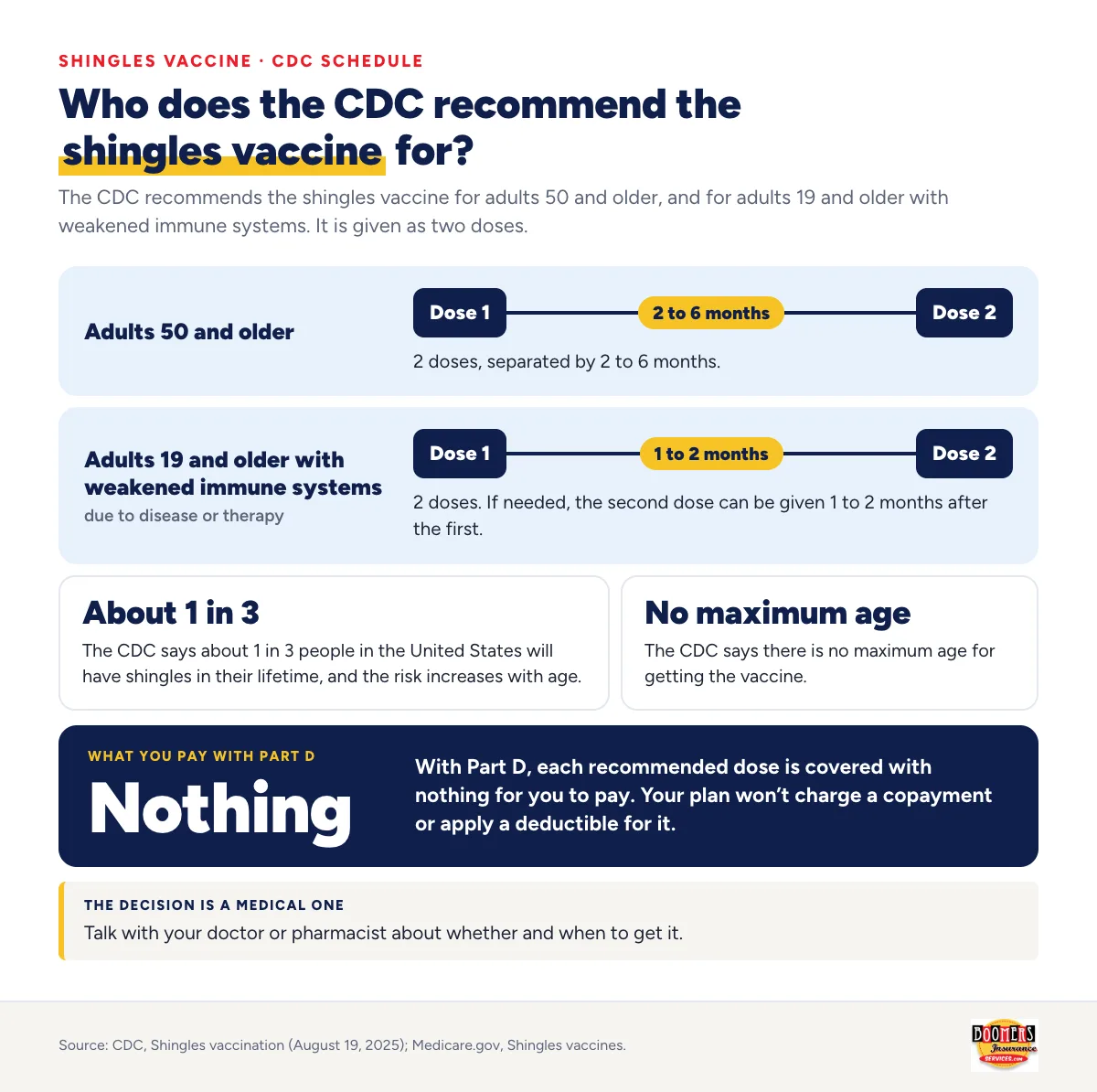
Medicare's coverage follows these recommendations, but the decision is a medical one. Talk with your doctor or pharmacist about whether and when to get it. With Part D, each recommended dose is covered with nothing for you to pay.
What if you're in a Medicare Advantage plan?
The same rules apply, but through your plan. If your Medicare Advantage plan includes drug coverage, that coverage is Part D, so you pay nothing for the shingles vaccine and other vaccines ACIP recommends. Your plan also covers the Part B vaccines.
Plans have their own networks and rules. Call the number on your plan card and ask where to get each shot. Our guide to what Medicare Advantage is explains how these plans work. If your plan has no drug coverage, ask the plan what your options are.
Next steps
Start by finding out whether you have Part D, because that decides the shingles vaccine cost. Then plan the other shots with your doctor.
- Check your drug coverage. Look at your plan card or your Medicare account to see whether you have Part D.
- Ask your doctor or pharmacist which vaccines are right for you. The CDC's schedule is linked under Sources.
- Call your plan to ask where to get the shingles vaccine.
- Ask about assignment before you get a flu, pneumococcal, COVID-19 or hepatitis B shot under Part B.
- Have no drug coverage? Read what Medicare covers, and note the Open Enrollment dates above. In California, HICAP, the Health Insurance Counseling and Advocacy Program, answers Medicare questions at 1-800-434-0222.
- Turning 65 soon? Our Turning 65 checklist lists each step, including drug coverage.
Talk with a licensed Boomers agent
A licensed Boomers agent can go over the Medicare plans we represent in your area and check them against your doctors and prescriptions.
Find a licensed agent near you · See upcoming Medicare events
Or call 1-800-815-1943 (TTY 711), Monday – Friday, 9 AM – 5 PM Pacific.
Frequently asked questions
Is the shingles vaccine covered by Medicare Part B?
No. Medicare.gov lists the shingles vaccine under Medicare drug coverage (Part D). Part B covers flu, pneumococcal and COVID-19 vaccines, and hepatitis B vaccines if you're eligible.
Do I pay a deductible for Medicare Part D vaccines?
No. Medicare.gov says your Part D plan won't charge you a copayment or apply a deductible for vaccines ACIP recommends. That includes the shingles vaccine. Other drugs on your plan can still have a deductible, up to $615 in 2026 and $700 in 2027.
Does Medicare cover both doses of the shingles vaccine?
Yes, if you have Part D. The CDC says the shingles vaccine is given as a two-dose series, and Medicare.gov says your Part D plan won't charge a copayment or apply a deductible for vaccines ACIP recommends. Ask your plan where to get each dose.
Does Medicare cover the RSV vaccine?
Yes, under Part D. Medicare.gov names the RSV vaccine among the adult vaccines Part D covers, and you pay nothing for it if you have Part D. Ask your doctor whether it is recommended for you.
Where can I get vaccines that Medicare covers?
Medicare.gov says you can get a flu vaccine at many places, including your doctor's office and your local pharmacy. For vaccines covered by Part D, ask your plan where to go. For Part B shots, ask whether the provider accepts assignment.
Sources
- Shingles vaccines (Medicare.gov)
- Flu vaccines (Medicare.gov)
- Pneumococcal vaccines (Medicare.gov)
- Hepatitis B vaccines (Medicare.gov)
- COVID-19 vaccine (Medicare.gov)
- Medicare & You 2027 handbook, pages 44–56 (Medicare.gov)
- How much does Medicare drug coverage cost? (Medicare.gov)
- Inflation Reduction Act fact sheet (CMS.gov)
- Shingles vaccination, August 19, 2025 (CDC)
- Medicare counseling: HICAP (California Department of Aging)
Talk with a licensed Boomers agent
A licensed agent can go over the Medicare plans we represent in your area, check them against your doctors and prescriptions, and answer your questions. There is no cost to you and no obligation to enroll.
Monday – Friday, 9 AM – 5 PM PT