
How to Compare Medicare Advantage Plans and Other Medicare Options
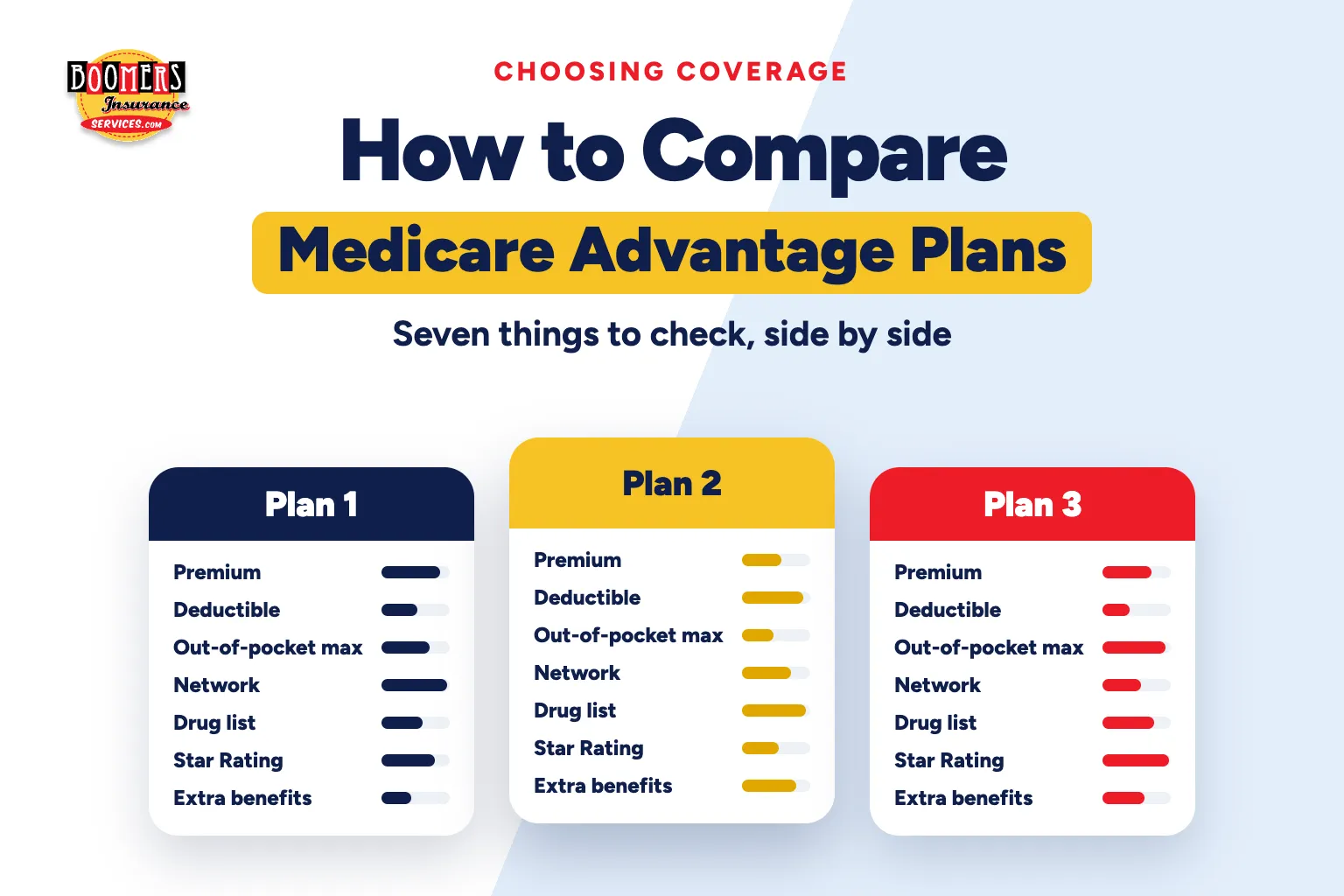
To compare Medicare Advantage plans, look at the same seven things for each one: premium, deductible, out-of-pocket maximum, provider network, drug list and pharmacies, Star Rating and extra benefits. First decide between Original Medicare and a Medicare Advantage plan. This guide covers both steps.
Before you compare Medicare Advantage plans, it helps to know what you are comparing them with. Medicare gives you two main ways to get coverage. One is Original Medicare, often with a Medigap policy and a drug plan. The other is a Medicare Advantage plan, also called Part C.
This guide covers both steps for 2026 and 2027. It shows how the two paths differ, what to check in each plan, how the Medicare Plan Finder works and when you can switch. We don't name or rank any plan or company here.
What are the two main ways to get Medicare coverage?
Medicare.gov describes two choices: Original Medicare or Medicare Advantage. With Original Medicare, you can add a Medicare drug plan (Part D) and Medicare Supplement Insurance (Medigap). A Medicare Advantage plan comes from a private company that contracts with Medicare, and most include drug coverage.
| Original Medicare, with Medigap and Part D added | Medicare Advantage (Part C) | |
|---|---|---|
| Doctors and hospitals | Any doctor or hospital that takes Medicare, anywhere in the U.S. | You may need to use providers in the plan's network and service area |
| Referrals and approvals | In most cases, no referral or prior authorization | You may need a referral, and prior authorization for certain services |
| Premiums | Part B premium, plus a Medigap premium and a Part D premium | Part B premium, and you may also pay the plan's premium |
| Yearly limit on what you pay | Original Medicare has no yearly limit. Medigap or other coverage can pay part of your share | Each plan has a yearly limit for covered services |
| Drug coverage | A separate Medicare drug plan | Included in most plans |
| Extra benefits | Not covered: routine eye exams and most dental care | Plans may offer some vision, hearing and dental services |
The standard Part B premium is $202.90 a month in 2026 and $209.40 in 2027. You can't buy Medigap to cover your costs in a Medicare Advantage plan. Our guide to Medicare Advantage vs Medigap compares the two paths in more depth.
Who can join a Medicare Advantage plan?
You need both Part A and Part B, and you must live in the plan's service area. Medicare.gov also says you generally must be a U.S. citizen or national, a lawful permanent resident, or in one of a few other listed immigration categories. To join a separate Medicare drug plan, you need Part A or Part B.
Each plan has its own service area, so a plan a relative has may not be offered where you live. Our overview of what Medicare Advantage is explains the plan types.
What should you check when you compare Medicare Advantage plans?
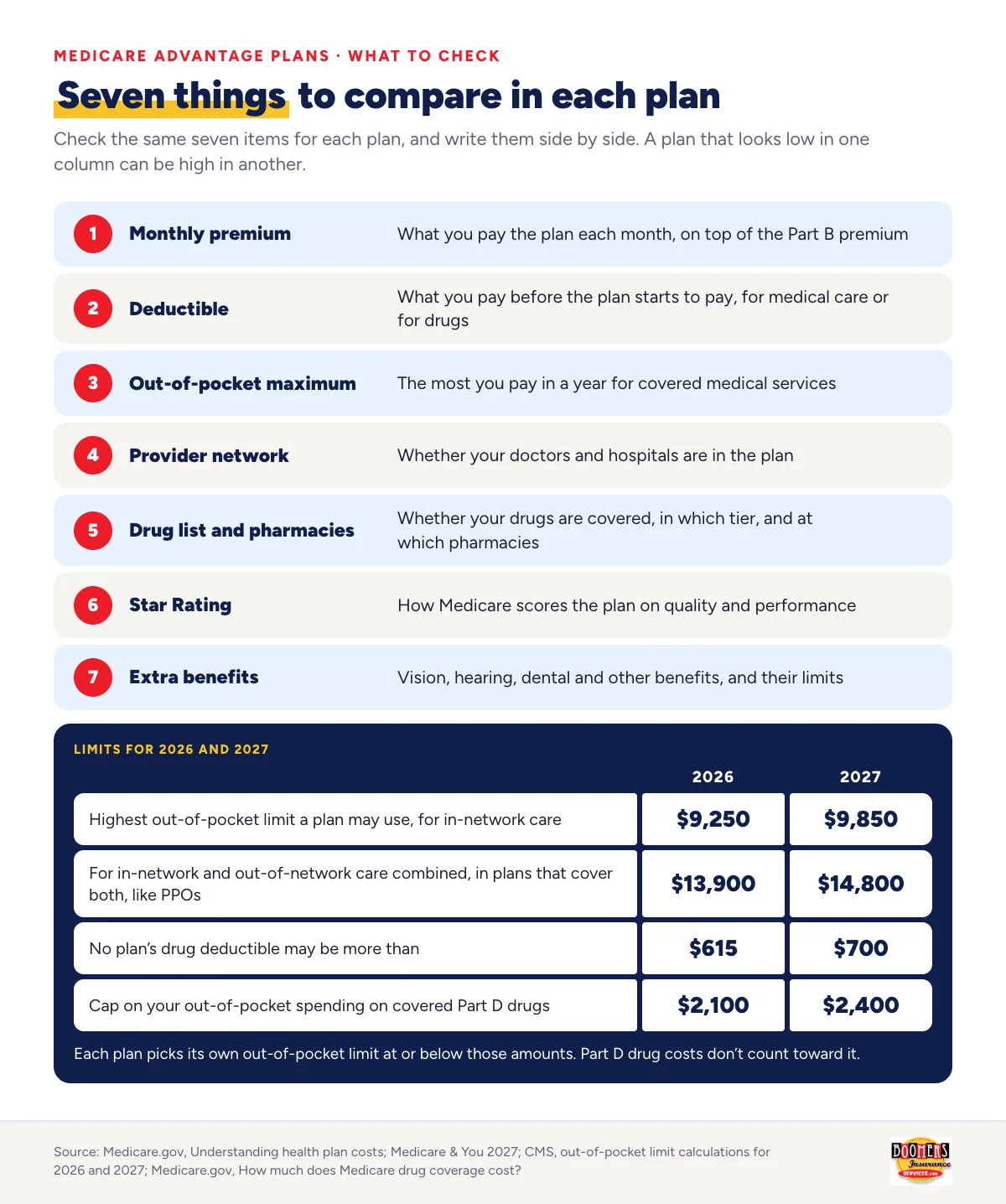
Check the same seven items for each plan, and write them side by side. A plan that looks low in one column can be high in another.
| What to compare | What it tells you |
|---|---|
| Monthly premium | What you pay the plan each month, on top of the Part B premium |
| Deductible | What you pay before the plan starts to pay, for medical care or for drugs |
| Out-of-pocket maximum | The most you pay in a year for covered medical services |
| Provider network | Whether your doctors and hospitals are in the plan |
| Drug list and pharmacies | Whether your drugs are covered, in which tier, and at which pharmacies |
| Star Rating | How Medicare scores the plan on quality and performance |
| Extra benefits | Vision, hearing, dental and other benefits, and their limits |
Premium, deductible and out-of-pocket maximum
Medicare.gov says each plan sets its own premiums, deductibles and copayments. What you pay the plan can change only once a year, on January 1. Drug coinsurance amounts can still move during the year as drug prices change. Look at copayments and coinsurance for the care you use most, like specialist visits and hospital stays.
CMS, the Centers for Medicare & Medicaid Services, sets the highest out-of-pocket limit a plan may use. For 2026 that ceiling is $9,250 for in-network care and $13,900 for in-network and out-of-network care combined in plans that cover both, like PPOs. For 2027 the ceilings are $9,850 and $14,800. Each plan picks its own limit at or below those amounts. Part D drug costs don't count toward it.
Doctors, hospitals and the provider network
Ask each doctor's office whether it is in the plan's network for the coming year. In a Health Maintenance Organization (HMO), you generally must use network providers, except for emergency care, urgent care and out-of-area dialysis. In a Preferred Provider Organization (PPO), you may also go out of network, but you may pay more. Our Medicare Advantage HMO vs PPO guide explains the rules. If you live in another state for part of the year, Medicare.gov says to check whether the plan covers you there.
Drug list, tiers and pharmacies
Each plan has its own list of covered drugs, called a formulary. Plans sort drugs into tiers, and a drug in a lower tier generally costs less. The handbook adds that your costs may be less at a preferred pharmacy. No plan's drug deductible may be more than $615 in 2026 or $700 in 2027. Your out-of-pocket spending on covered Part D drugs is capped at $2,100 in 2026 and $2,400 in 2027. Our Medicare Part D guide covers the details.
What do Medicare Star Ratings mean?
Medicare rates plans from 1 to 5 stars on quality and performance. CMS publishes new ratings each year. The 2027 ratings went on the Medicare Plan Finder on October 8, 2026. CMS says Medicare Advantage plans with drug coverage are rated on up to 43 measures. A rating describes past performance. It doesn't tell you whether your own doctors or drugs are covered.
Extra benefits
Most plans offer benefits Original Medicare doesn't cover, like vision, hearing and dental care. The handbook says these benefits "are generally limited." Check with the plan before you join to learn what is covered. Compare the limits, not only the list.
How do you use the Medicare Plan Finder?
The Medicare Plan Finder is the comparison tool at Medicare.gov/plan-compare. It shows the Medicare Advantage plans and Medicare drug plans in your area, with their costs and Star Ratings. It lets you do a Medicare plan comparison with your own drugs and doctors.
- List your prescriptions. Include the dose and how often you take each drug.
- Add your drugs. Medicare.gov says to add the drugs you take regularly to get an estimate of your monthly and yearly cost for each plan.
- Add your pharmacies. With a Medicare account, you can keep your prescriptions and pharmacies on file.
- Add your providers. The handbook says the results then show whether they are in network with each plan.
- Compare the seven items in the table above for the plans you are considering.
- Confirm with the plan. Call the plan and your doctors' offices before you join.
You can join on the Plan Finder by selecting "Enroll," by contacting the plan, or by calling 1-800-MEDICARE (1-800-633-4227, TTY 1-877-486-2048). Medicare's help line is open 24 hours a day, 7 days a week, except some federal holidays.
How to compare Medicare plans if you stay in Original Medicare
Compare two things separately: the Medigap policy and the drug plan. In most states, including California, Medigap plans with the same letter have the same benefits, whatever company sells them. Medicare.gov says price is the only difference, so compare the same letter from one company to the next. Our Medicare Supplement plans guide explains the letters.
For the drug plan, use the Plan Finder steps above. Check the premium, the deductible, your drugs' tiers and your pharmacy.
What does the Annual Notice of Change tell you?
It tells you what changes in your current plan on January 1. Your plan sends the Annual Notice of Change (ANOC) by September 30. It lists changes in coverage, costs, provider networks, service area and more. Read it before you look at other plans.
By October 15 your plan sends the Evidence of Coverage (EOC), or a notice telling you how to get it. It gives the full details of what the plan covers and what you pay. If these documents don't arrive, contact your plan. Our Annual Enrollment guide lists what to review each fall.
When can I switch Medicare plans?
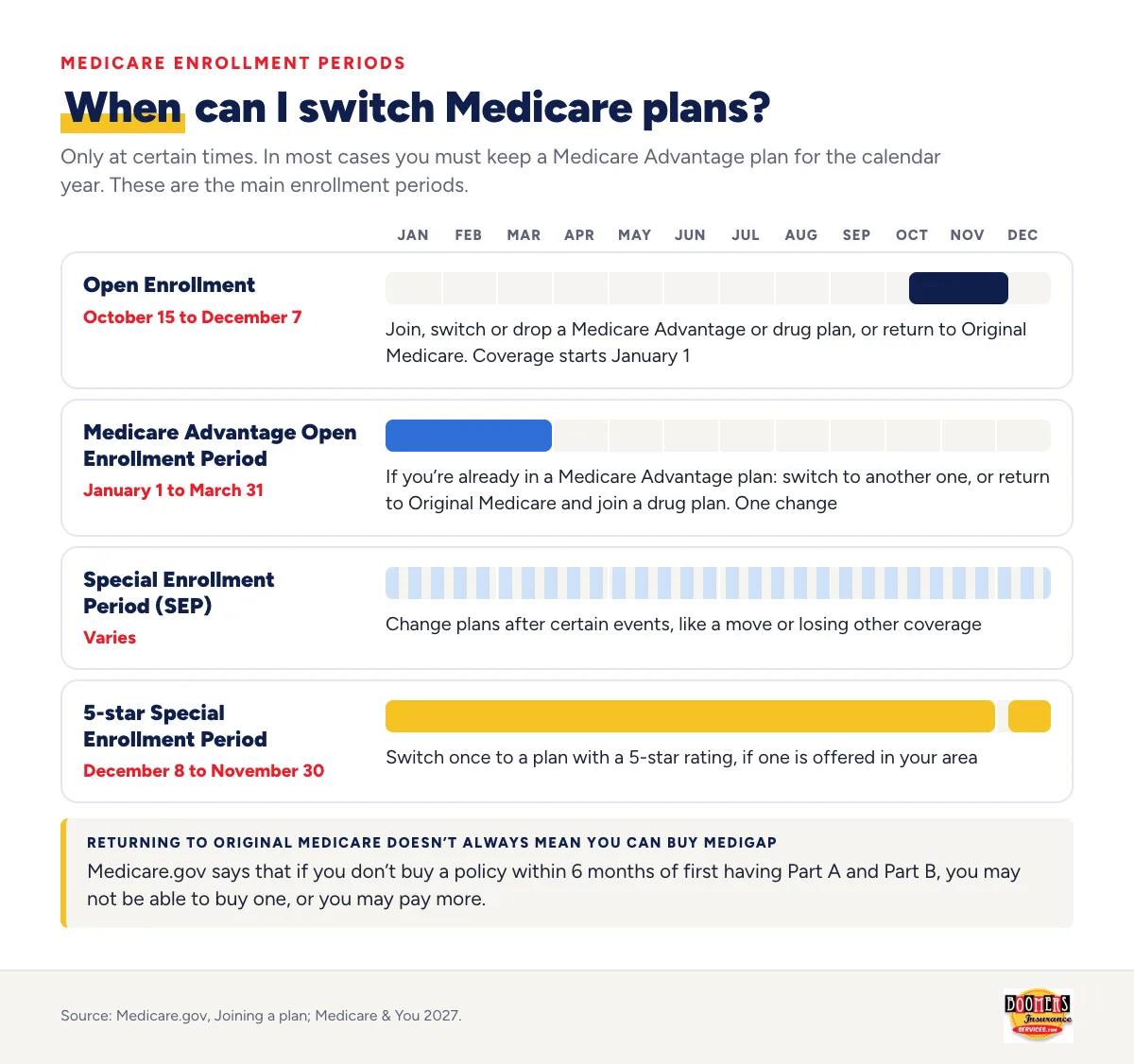
Only at certain times. The handbook says that in most cases you must keep a Medicare Advantage plan for the calendar year. These are the main enrollment periods:
| Period | Dates | What you can do |
|---|---|---|
| Open Enrollment | October 15 to December 7 | Join, switch or drop a Medicare Advantage or drug plan, or return to Original Medicare. Coverage starts January 1 |
| Medicare Advantage Open Enrollment Period | January 1 to March 31 | If you're already in a Medicare Advantage plan: switch to another one, or return to Original Medicare and join a drug plan. One change |
| Special Enrollment Period (SEP) | Varies | Change plans after certain events, like a move or losing other coverage |
| 5-star Special Enrollment Period | December 8 to November 30 | Switch once to a plan with a 5-star rating, if one is offered in your area |
Returning to Original Medicare doesn't always mean you can buy Medigap. Medicare.gov says that if you don't buy a policy within 6 months of first having Part A and Part B, you may not be able to buy one, or you may pay more. It also says there is a special right to buy Medigap if you go back to Original Medicare within 12 months of joining a Medicare Advantage plan. See our guide to Medicare Special Enrollment Periods.
Mistakes to avoid when you compare plans
Checking one number and skipping the rest can leave you with costs you didn't expect. Our Medicare Advantage pros and cons post goes deeper. Watch for these:
- Choosing on premium alone. Copayments, the deductible and the yearly limit also shape what you pay.
- Assuming your doctor is in the network. Providers can join or leave a network at any time during the year, so confirm before you join and again each fall.
- Skipping the drug list. A plan's drug coverage and costs can change each year.
- Reading extras as unlimited. The handbook says they are generally limited.
- Letting the plan renew unread. The ANOC shows what changes in January.
Next steps
Gather your information first, then compare. These steps work whether you are new to Medicare or reviewing your coverage:
- Write down your doctors, hospitals, drugs and pharmacies.
- Decide between Original Medicare and Medicare Advantage.
- Run the Medicare Plan Finder with your drugs and providers.
- Read your ANOC if you already have a plan.
- Ask for help. HICAP, California's Health Insurance Counseling & Advocacy Program, gives one-on-one counseling at 1-800-434-0222 and isn't connected to any insurance company.
Talk with a licensed Boomers agent
A licensed Boomers agent can go over the Medicare plans we represent in your area and check them against your doctors and prescriptions. The plans we represent are not the full list in your area. The Plan Finder and 1-800-MEDICARE can show you the rest.
Find a licensed agent near you · See upcoming Medicare events
Or call 1-800-815-1943 (TTY 711), Monday – Friday, 9 AM – 5 PM Pacific.
Frequently asked questions
What is the Medicare Plan Finder?
It is the tool on Medicare.gov for finding and comparing Medicare Advantage plans and Medicare drug plans in your area. You can add your drugs, pharmacies and providers. There is a separate Medicare.gov tool for finding Medigap policies.
How often should I compare Medicare Advantage plans?
Review your coverage each year. Plan costs and coverage can change every January, and the handbook suggests starting on October 1. If you keep your current plan, any changes to its costs or benefits start January 1. Read your Annual Notice of Change to see what is changing. If your plan won't be offered next year, it sends you a separate letter that explains your options.
Is a plan with more stars always the right one for me?
Not necessarily. Star Ratings measure quality and performance across a plan's members. You still need to check your own doctors, drugs and costs.
Where can I get help comparing Medicare plans?
Call 1-800-MEDICARE or your State Health Insurance Assistance Program (SHIP). In California that is HICAP, at 1-800-434-0222. Medicare.gov says SHIPs aren't connected to any insurance company or health plan. A licensed agent can also help with the plans the agent represents.
Sources
- Your coverage options (Medicare.gov)
- Compare Original Medicare & Medicare Advantage (Medicare.gov)
- Joining a plan (Medicare.gov)
- Compare types of Medicare Advantage Plans (Medicare.gov)
- Understanding health plan costs (Medicare.gov)
- How much does Medicare drug coverage cost? (Medicare.gov)
- Get Medigap costs (Medicare.gov)
- Helpful tools (Medicare.gov)
- Plan Annual Notice of Change (Medicare.gov)
- Medicare & You 2027, pages 10–14, 65–67, 75–76, 84–89 and 114 (Medicare.gov PDF)
- 2027 Medicare Advantage and Part D Star Ratings (CMS.gov, October 8, 2026)
- Medicare Advantage Rates & Statistics: out-of-pocket limit calculations for 2026 and 2027 (CMS.gov)
- 2027 Medicare Parts A & B premiums and deductibles (CMS.gov, November 17, 2026)
- Medicare counseling: HICAP (California Department of Aging)
Talk with a licensed Boomers agent
A licensed agent can go over the Medicare plans we represent in your area, check them against your doctors and prescriptions, and answer your questions. There is no cost to you and no obligation to enroll.
Monday – Friday, 9 AM – 5 PM PT