
Medicare Supplement Plan F: Coverage and Who Can Still Buy It
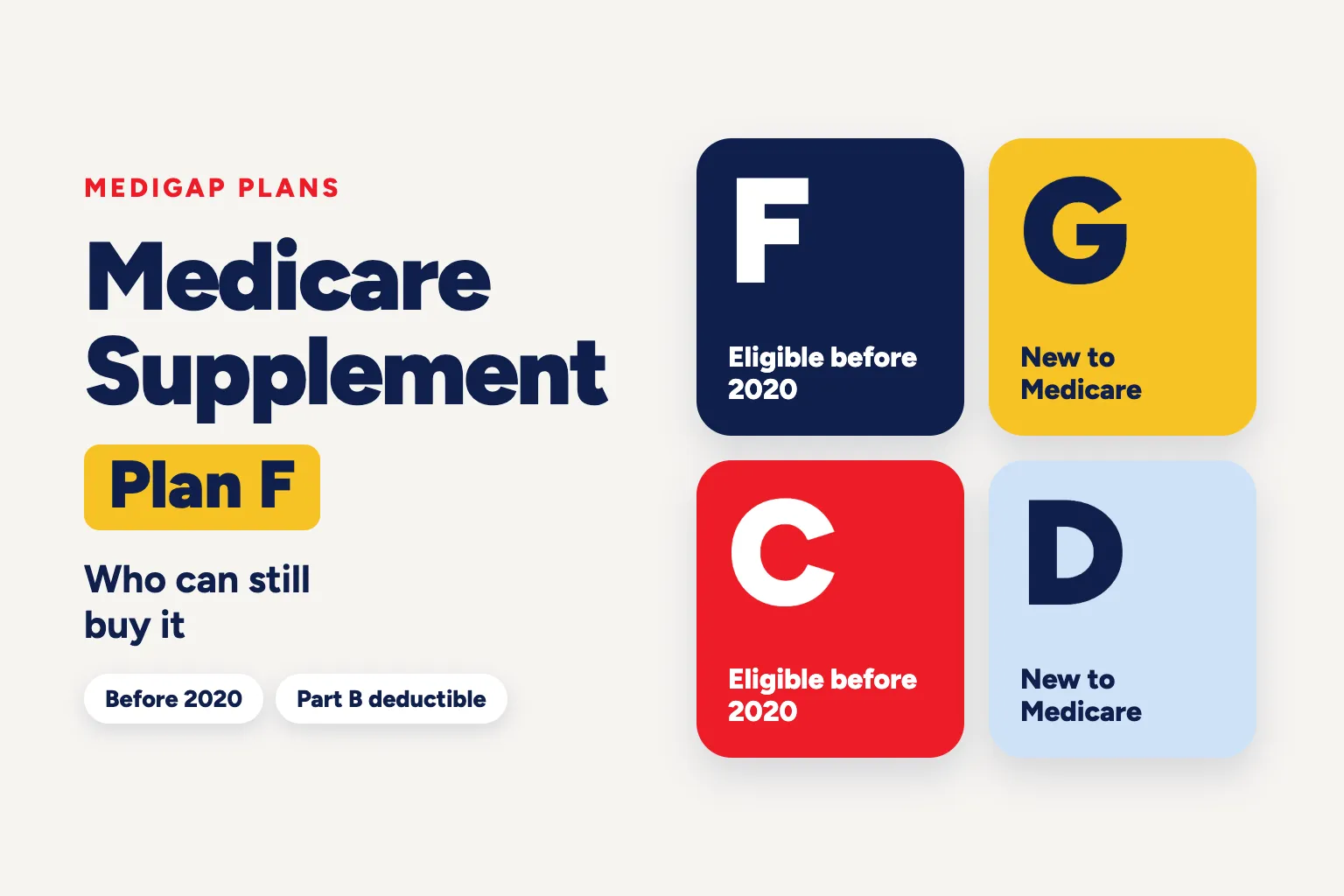
Medicare Supplement Plan F is a standardized Medigap plan that pays your share of Original Medicare's covered costs, including the Part B deductible. People new to Medicare on or after January 1, 2020 can't buy it.
Medicare Supplement Plan F is one of the standardized Medigap plans sold by private insurance companies. It works with Original Medicare (Part A and Part B). After Medicare pays its share of a covered service, Plan F pays your share, including the Part B deductible. That deductible is $283 in 2026 and $292 in 2027.
There is one large limit. Medigap plans sold to people new to Medicare on or after January 1, 2020 aren't allowed to pay the Part B deductible. So people new to Medicare can't buy Plan F. This guide explains what Plan F pays, who may still be able to buy or keep it, and what people new to Medicare can buy instead.
What does Medicare Supplement Plan F cover?
Plan F pays 100% of each Medicare cost-sharing item on Medicare's Medigap benefits chart, and 80% of foreign travel emergency care. Medigap plans with the same letter offer the same basic benefits, whatever company sells them. So Medicare Supplement Plan F coverage is the same from one company to the next in most states. Here is the chart for Plans F, G and N:
| Cost in Original Medicare | Plan F | Plan G | Plan N |
|---|---|---|---|
| Part A coinsurance and hospital costs, up to 365 extra days after Medicare benefits are used | 100% | 100% | 100% |
| Part A deductible ($1,736 per benefit period in 2026; $1,776 in 2027) | 100% | 100% | 100% |
| Skilled nursing facility coinsurance | 100% | 100% | 100% |
| Part A hospice coinsurance or copayment | 100% | 100% | 100% |
| Blood (first 3 pints) | 100% | 100% | 100% |
| Part B coinsurance or copayment | 100% | 100% | 100%, except some copayments |
| Part B deductible ($283 in 2026; $292 in 2027) | 100% | Not covered | Not covered |
| Part B excess charges | 100% | 100% | Not covered |
| Foreign travel emergency, up to plan limits | 80% | 80% | 80% |
Plan F pays 100% of each cost-sharing item on Medicare's chart, and 80% of foreign travel emergency care. You still pay the Plan F premium, and you keep paying your Part B premium to Medicare.
What Medicare Plan F doesn't cover
Plan F only pays toward care that Original Medicare covers, plus emergency care abroad. It doesn't pay for:
- Prescription drugs. Medigap policies sold after 2005 don't include drug coverage. You can join a separate Medicare drug plan (Part D).
- Dental or vision care, hearing aids or glasses. Medigap generally doesn't cover these.
- Long-term care, like non-skilled care in a nursing home, or private-duty nursing.
- Part of foreign travel emergency care: the first $250 each year, 20% of the rest, and anything over the $50,000 lifetime limit. The care must begin in the first 60 days of a trip.
Why can't people new to Medicare buy Plan F?
A federal law changed the rules. The Medicare Access and CHIP Reauthorization Act of 2015 (MACRA) says that, from January 1, 2020, a Medigap policy that pays the Part B deductible may not be sold to someone newly eligible for Medicare. Plan F and Plan C both pay that deductible, so both are closed to people new to Medicare.
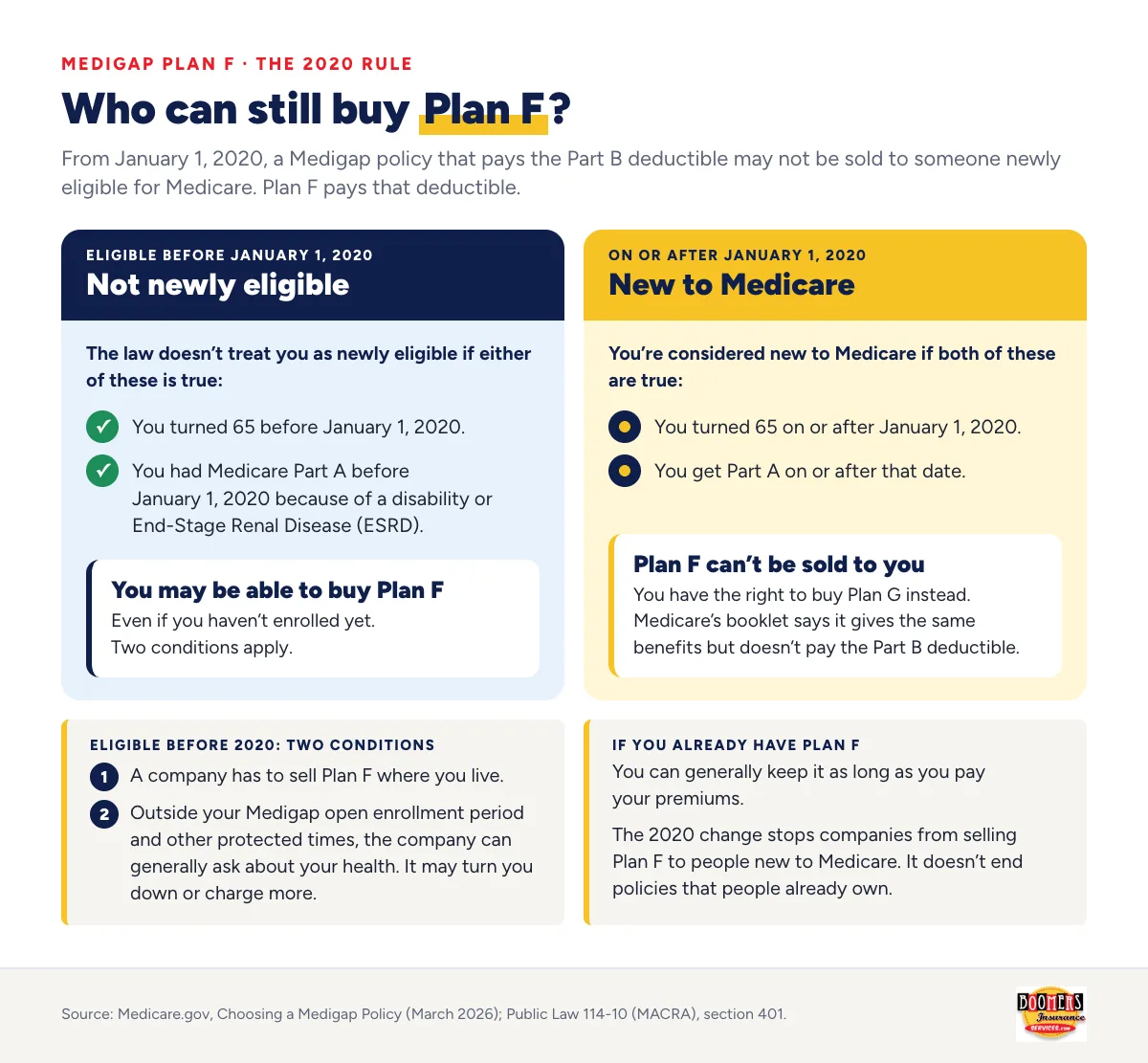
Medicare's Medigap booklet puts it this way: you're considered new to Medicare if you turned 65 on or after January 1, 2020, and get Part A on or after that date. The law doesn't treat you as newly eligible if either of these is true:
- You turned 65 before January 1, 2020.
- You had Medicare Part A before January 1, 2020 because of a disability or End-Stage Renal Disease (ESRD).
People new to Medicare have the right to buy Plan G instead of Plan F, and Plan D instead of Plan C. Medicare's booklet says these give the same benefits but don't pay the Part B deductible. Our Medicare Supplement Plan G guide explains that plan.
Who can still buy or keep Plan F?
Two groups can: people who already have Plan F, and people who were eligible for Medicare before January 1, 2020. Each group has its own conditions.
If you already have Plan F
You can generally keep it. Medicare.gov says that once you buy a Medigap policy, you keep it as long as you pay your premiums. Standardized policies renew each year, even if you have health problems. A company can drop you only in a few cases, such as when you stop paying premiums or weren't truthful on the application.
If you were eligible before 2020 but haven't bought it
Medicare's booklet says you may be able to buy Plan F if you were eligible for Medicare before January 1, 2020, even if you haven't enrolled yet. Two conditions apply:
- A company has to sell Plan F where you live.
- Outside your Medigap open enrollment period and other protected times, the company can generally ask about your health. It may turn you down or charge more.
Your Medigap open enrollment period is a one-time, 6-month window. It starts the first month you have Part B and are 65 or older. Our Medicare vs Medigap guide explains this window and the other protected times.
Plan F vs Plan G: what's the difference?
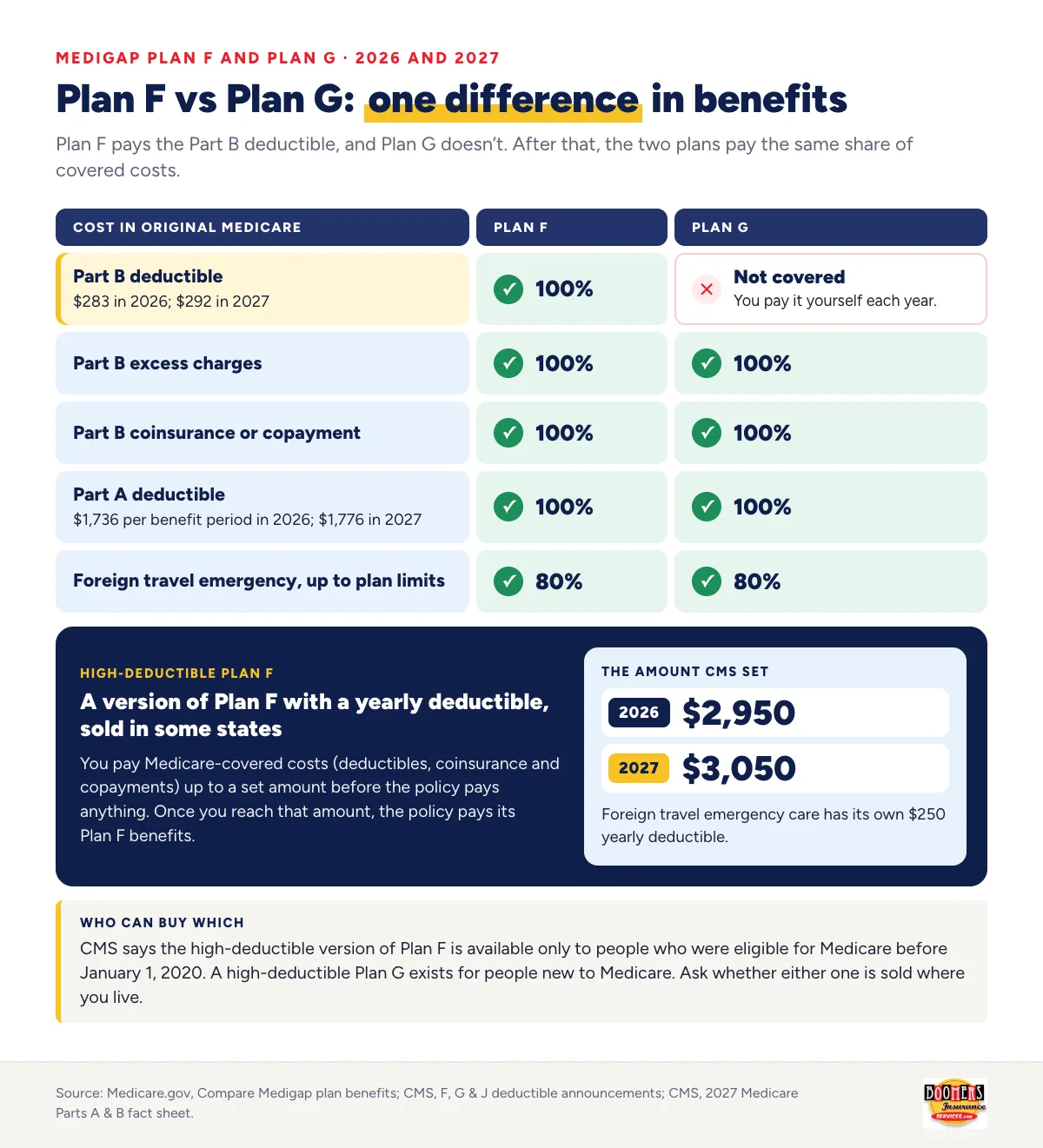
There is one difference in benefits: Plan F pays the Part B deductible, and Plan G doesn't. With Plan G, you pay that deductible yourself each year ($283 in 2026, $292 in 2027). After that, the two plans pay the same share of covered costs, including Part B excess charges.
The premiums are a separate matter. Premiums vary by company and where you live, and with some pricing methods by your age, so we don't quote them. Compare an actual Plan F quote with an actual Plan G quote, and count the Part B deductible you would pay with Plan G.
If you have Plan F and think about moving to Plan G, check the timing first. Outside a protected time, a company can generally ask health questions before it sells you a new policy. If you do switch, Medicare.gov says not to cancel your first policy until you have decided to keep the second one.
For the other letters, see our Medicare Supplement plans overview and our Medicare Supplement Plan N guide.
What is high-deductible Plan F?
It is a version of Plan F with a yearly deductible, sold in some states. You pay Medicare-covered costs (deductibles, coinsurance and copayments) up to a set amount before the policy pays anything. The Centers for Medicare & Medicaid Services (CMS) set that amount at:
- $2,950 for 2026
- $3,050 for 2027
Once you reach that amount, the policy pays its Plan F benefits. Foreign travel emergency care has its own $250 yearly deductible. CMS says the high-deductible version of Plan F is available only to people who were eligible for Medicare before January 1, 2020. A high-deductible Plan G exists for people new to Medicare. Ask whether either one is sold where you live.
What should Plan F owners in California know?
California adds a yearly chance to change Medigap policies. If you already have a Medigap policy in California, you have an annual window of at least 60 days beginning on your birthday. In it, you can switch to another Medigap plan with equal or lesser benefits, without medical screening or a new waiting period.
Which plans count as equal or lesser depends on the policy you have now. Federal law still applies: Plan F can't be sold to someone who is new to Medicare. To check your own case, call HICAP, California's Health Insurance Counseling & Advocacy Program, at 1-800-434-0222. You can also call the California Department of Insurance at 1-800-927-4357.
Next steps
Start with your own dates, then compare the plans you are able to buy. These steps put it in order.
- Check when you became eligible for Medicare. Before January 1, 2020, Plan F may still be open to you. On or after that date, look at Plan G and Plan N instead.
- If you have Plan F, note your birthday window if you live in California.
- Ask your doctors whether they accept assignment. Plans F and G pay Part B excess charges; Plan N doesn't.
- Keep drug coverage separate. Plan F doesn't include it, so look at a Part D plan.
- Turning 65 soon? Our Turning 65 checklist lists each step.
Talk with a licensed Boomers agent
A licensed Boomers agent can go over the Medicare plans we represent in your area and check them against your doctors and prescriptions.
Find a licensed agent near you · See upcoming Medicare events
Or call 1-800-815-1943 (TTY 711), Monday – Friday, 9 AM – 5 PM Pacific.
Frequently asked questions
Is there a Medicare Part F?
No. Medicare has Part A, Part B, Part C and Part D. People who search for "Medicare Part F" usually mean Plan F, which is a Medigap plan letter, not a part of Medicare. A private insurance company sells it, and it works only with Original Medicare.
Is Plan F being discontinued for people who have it?
No. If you already have Plan F, you can generally keep it as long as you pay your premiums. The 2020 change stops companies from selling Plan F to people new to Medicare. It doesn't end policies that people already own.
Can I buy Plan F if I turned 65 in 2020 or later?
Generally not. If you turned 65 on or after January 1, 2020 and got Part A on or after that date, you're considered new to Medicare, and Plan F can't be sold to you. An exception may apply if you had Medicare before 2020 because of a disability or ESRD. Plan G is the letter open to you instead. Outside your Medigap open enrollment period and other protected times, a company can generally ask about your health.
Does Medicare Supplement Plan F cover the Part B deductible?
Yes. Plan F pays the Part B deductible, which is $283 in 2026 and $292 in 2027. It is one of only two letters on Medicare's chart that do; Plan C is the other. Neither can be sold to people new to Medicare.
Sources
- Choosing a Medigap Policy, March 2026 (Medicare.gov)
- Compare Medigap plan benefits (Medicare.gov)
- Learn how Medigap works (Medicare.gov)
- Can I change my Medigap policy? (Medicare.gov)
- Medicare coverage outside the United States (Medicare.gov)
- F, G & J deductible announcements (CMS.gov)
- 2027 Medicare Parts A & B premiums and deductibles (CMS.gov, November 17, 2026)
- Public Law 114-10 (MACRA), section 401 (GovInfo)
- Medicare Supplement Insurance "Medigap" (California Department of Insurance)
- Informing seniors guide, updated July 2025 (California Department of Insurance)
- Medicare counseling: HICAP (California Department of Aging)
Talk with a licensed Boomers agent
A licensed agent can go over the Medicare plans we represent in your area, check them against your doctors and prescriptions, and answer your questions. There is no cost to you and no obligation to enroll.
Monday – Friday, 9 AM – 5 PM PT