
Medicare Home Health Care: What Does Medicare Cover at Home?
Medicare home health care covers part-time skilled nursing and therapy in your home when you’re homebound and a doctor or other provider orders it from a Medicare-certified agency. You pay nothing for covered services in 2026, and 20% for medical equipment after the Part B deductible.
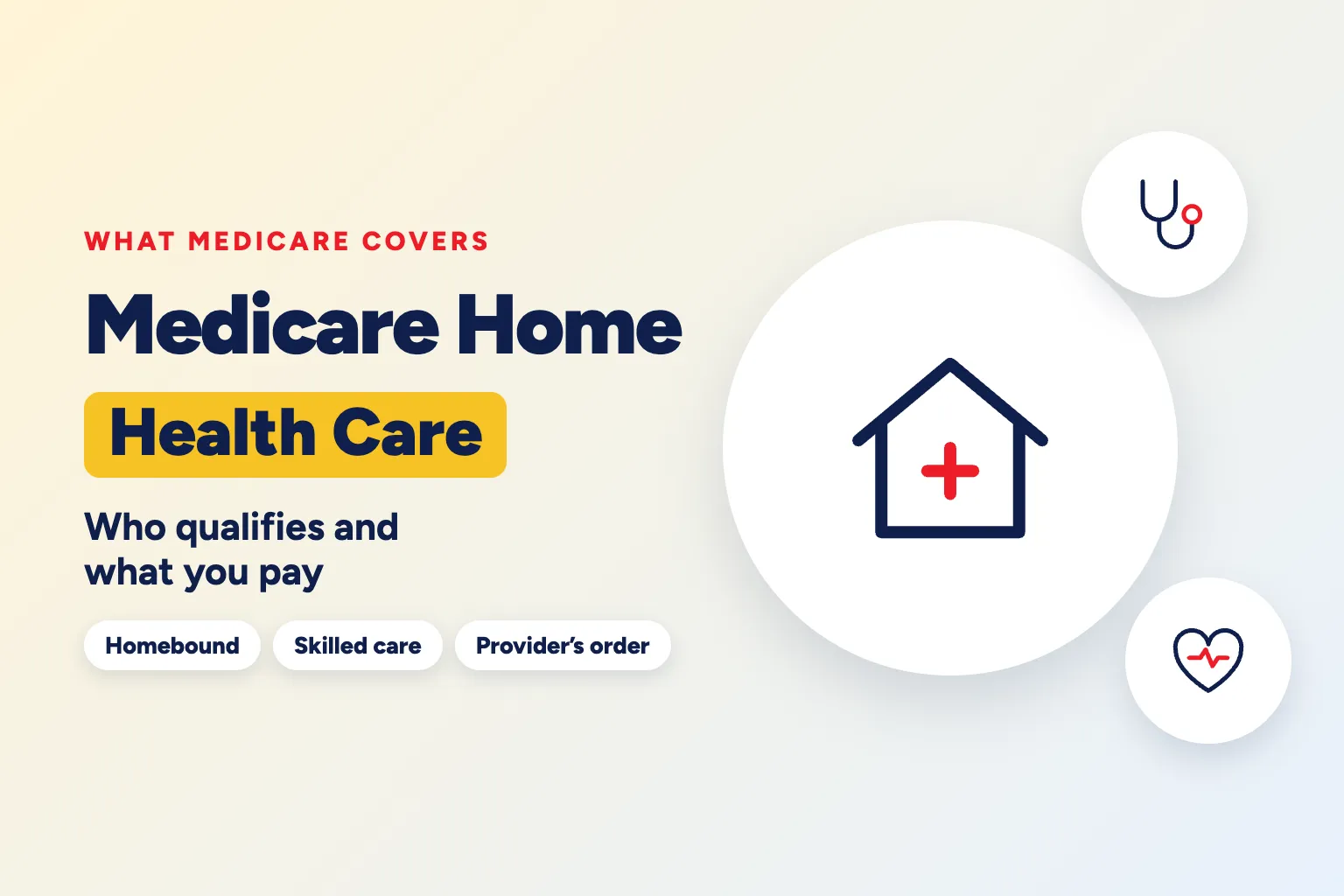
Medicare home health care is skilled care you get in your own home, such as a nurse’s visits and therapy, for a limited number of hours. Original Medicare covers it when you’re homebound, need part-time skilled care, and a doctor or other provider orders it from a Medicare-certified home health agency. You pay nothing for covered home health services in 2026.
It is not round-the-clock care. It also doesn’t pay for help with bathing or dressing when that’s the only care you need. This article explains who can get it, what’s covered, what you pay, how long it lasts, and how it works with a Medicare Advantage plan.
Does Medicare cover home health care? The short answer
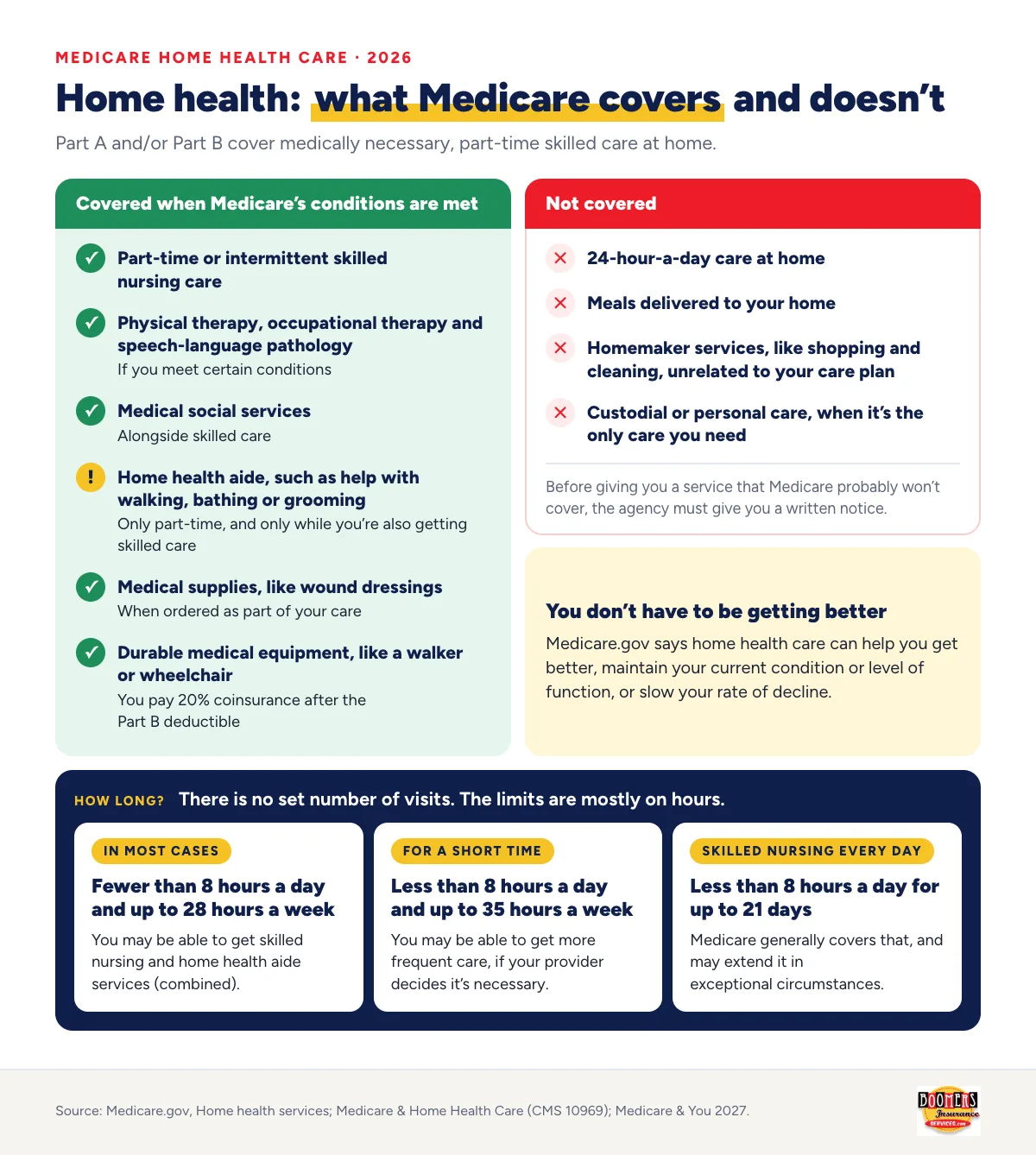
Yes, when Medicare’s conditions are met. Part A and/or Part B cover medically necessary, part-time skilled care at home. Medicare doesn’t cover 24-hour care, meals or personal care alone. This table shows where the line falls:
| Service at home | Does Original Medicare pay? |
|---|---|
| Part-time or intermittent skilled nursing care | Yes |
| Physical therapy, occupational therapy and speech-language pathology | Yes, if you meet certain conditions |
| Medical social services | Yes, alongside skilled care |
| Home health aide, such as help with walking, bathing or grooming | Only part-time, and only while you’re also getting skilled care |
| Medical supplies, like wound dressings | Yes, when ordered as part of your care |
| Durable medical equipment, like a walker or wheelchair | Yes; you pay 20% coinsurance after the Part B deductible |
| 24-hour-a-day care at home | No |
| Meals delivered to your home | No |
| Homemaker services, like shopping and cleaning, unrelated to your care plan | No |
| Custodial or personal care, when it’s the only care you need | No |
Who qualifies for home health care under Medicare?
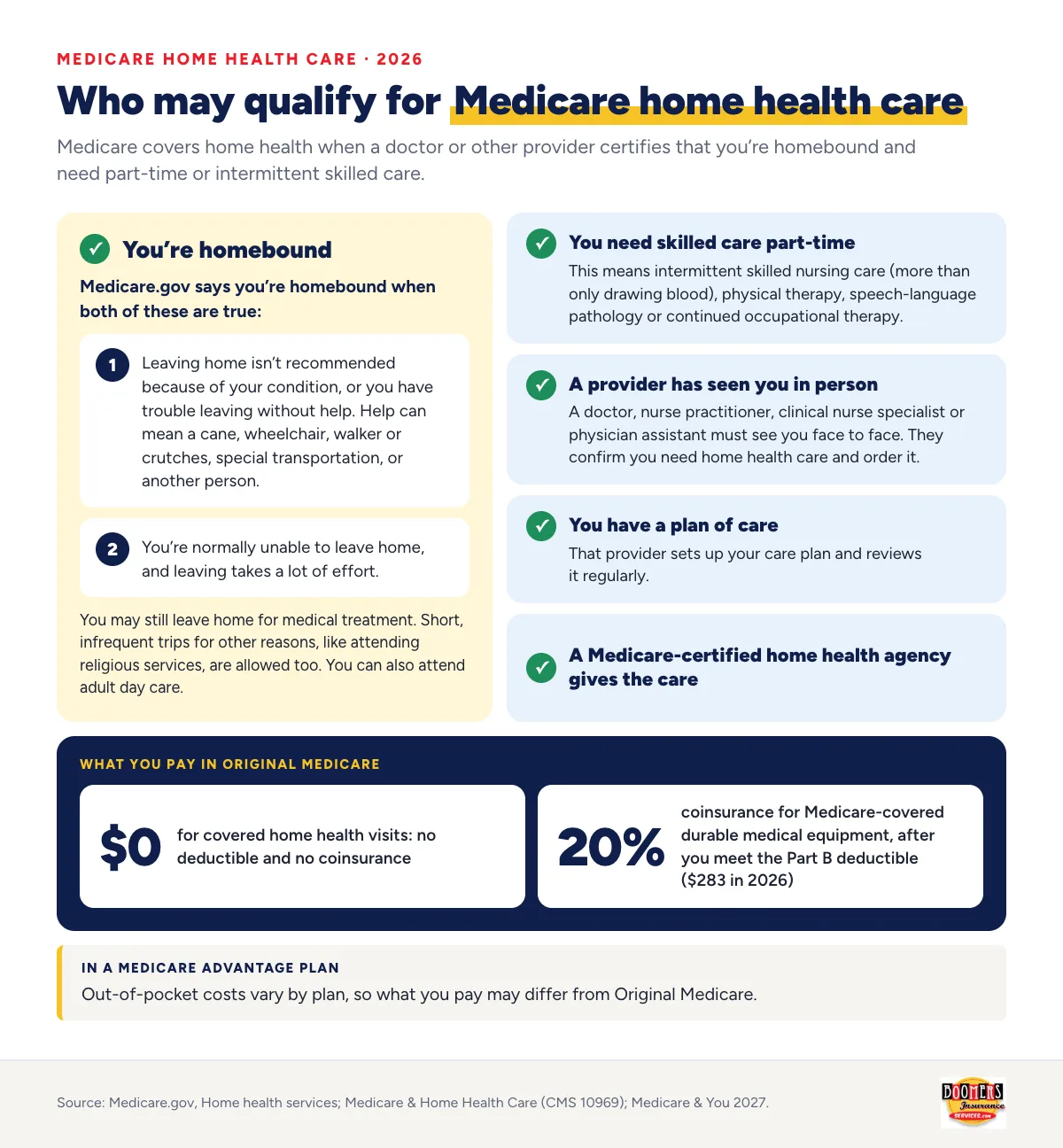
Medicare covers home health when a doctor or other provider certifies that you’re homebound and need part-time or intermittent skilled care. Medicare.gov and Medicare’s home health booklet list these conditions:
- You need skilled care part-time. This means intermittent skilled nursing care (more than only drawing blood), physical therapy, speech-language pathology or continued occupational therapy.
- You’re homebound. The next section explains what that means.
- A provider has seen you in person. A doctor, nurse practitioner, clinical nurse specialist or physician assistant must see you face to face. They confirm you need home health care and order it.
- You have a plan of care. That provider sets up your care plan and reviews it regularly.
- A Medicare-certified home health agency gives the care.
What does “homebound” mean?
Medicare.gov says you’re homebound when both of these are true:
- Leaving home isn’t recommended because of your condition, or you have trouble leaving without help. Help can mean a cane, wheelchair, walker or crutches, special transportation, or another person.
- You’re normally unable to leave home, and leaving takes a lot of effort.
You may still leave home for medical treatment. Short, infrequent trips for other reasons, like attending religious services, are allowed too. You can also attend adult day care.
When Medicare won’t cover care at home
Medicare.gov says you won’t qualify for home health services if you need more than part-time or intermittent skilled care. People who are expected to need full-time skilled nursing care over a long period usually don’t meet the conditions.
What does Medicare home health care cover?
It covers skilled care and the services that support it, as listed in your plan of care. The home health agency must give you everything in that plan, through its own staff or another agency. Covered services include:
- Skilled nursing care: wound care for pressure sores or a surgical wound, injections, intravenous or nutrition therapy, monitoring a serious illness, and teaching you and your caregivers
- Therapy: physical therapy, occupational therapy and speech-language pathology services
- Medical social services: counseling or help finding community resources, only alongside skilled care
- Home health aide care: part-time help with walking, bathing, grooming or feeding, only while you’re also getting skilled nursing or therapy
- Medical supplies for use at home, when your provider orders them
- Durable medical equipment, which Medicare pays for separately from the home health care
- Injectable osteoporosis drugs for women who meet certain criteria (you generally pay up to 20% for the drug itself after the Part B deductible; the nurse’s visit costs you nothing)
You don’t have to be getting better. Medicare.gov says home health care can help you get better, maintain your current condition or level of function, or slow your rate of decline.
Most prescription drugs aren’t part of the home health benefit. They are generally covered through Medicare drug coverage (Part D) instead. Our article on what Medicare covers lists the main benefits in each part.
What isn’t covered by Medicare home health care?
Medicare doesn’t pay for care that is round-the-clock or mainly non-medical. Medicare.gov lists four things the home health benefit leaves out:
- 24-hour-a-day care at your home
- Home meal delivery
- Homemaker services, like shopping and cleaning, that aren’t related to your care plan
- Custodial or personal care that helps with daily living, like bathing, dressing or using the bathroom, when this is the only care you need
Before giving you a service that Medicare probably won’t cover, the agency must give you a written notice. It is called an Advance Beneficiary Notice of Noncoverage. It names the service and explains why Medicare probably won’t pay.
What do you pay for home health care?
In Original Medicare, you pay nothing for covered home health visits: no deductible and no coinsurance. The main cost is medical equipment. After you meet the Part B deductible ($283 in 2026), you pay 20% coinsurance for Medicare-covered durable medical equipment.
A Medigap policy may pay some or all of that 20%. It helps to ask whether the equipment supplier accepts assignment. That means the supplier takes the amount Medicare allows as full payment, and you pay only your 20% share.
Before your care starts, the agency should tell you how much Medicare will pay. It should also tell you, verbally and in writing, about any item or service Medicare won’t pay for and what it will cost you.
Part A or Part B: which one pays?
Medicare & You 2027 says home health is covered under Part A and/or Part B. Under rules from the Centers for Medicare & Medicaid Services (CMS), the split works like this for people with both parts:
- Part A pays for up to 100 visits when the care follows a hospital stay of at least 3 days in a row, or a covered skilled nursing facility stay, and starts within 14 days of discharge.
- Part B pays for visits after those 100, and for home health care that doesn’t follow such a stay.
If you have only one part, that part pays. This split decides which part of Medicare pays the agency. It is not a limit on your visits, and what you pay is the same either way. See what Medicare Part A is for hospital and skilled nursing facility rules.
How long will Medicare pay for home health care?
There is no set number of visits. Medicare & You 2027 says Medicare covers home health services as long as you need part-time or intermittent skilled services and as long as you’re homebound. Medicare.gov adds: “If you qualify, you can get unlimited home health visits.”
The limits are mostly on hours. If you need skilled nursing every day, Medicare generally covers that for less than 8 hours a day for up to 21 days, and may extend it in exceptional circumstances.
- In most cases, you may be able to get skilled nursing and home health aide services (combined) for fewer than 8 hours a day and up to 28 hours a week.
- For a short time, you may be able to get more frequent care, less than 8 hours a day and up to 35 hours a week, if your provider decides it’s necessary.
Your provider and the home health team review your plan of care at least once every 60 days. Care continues while your provider keeps ordering it and you still meet the conditions.
What if your care is ending?
The agency should give you a written Notice of Medicare Non-Coverage at least 2 days before your covered services end. If you think they are ending too soon, you may have the right to a fast appeal. An independent reviewer then decides whether the services should continue. The notice explains how to ask.
How does home health care work with a Medicare Advantage plan?
Medicare Advantage plans are offered by private companies that contract with Medicare. They must cover all medically necessary services that Original Medicare covers, except hospice and a few others. So home health care is covered, but the plan’s own rules can apply:
- Network. Medicare’s booklet says a plan may require you to get home health services from agencies it contracts with.
- Approval. You may need approval from the plan, called prior authorization, before it covers certain services.
- Costs. Out-of-pocket costs vary by plan, so what you pay may differ from Original Medicare.
- Extra benefits. Some plans offer extra benefits that Original Medicare doesn’t cover. Medicare & You 2027 says these are generally limited.
Check with your plan before care starts, and read its Evidence of Coverage. Our article on what Medicare Advantage is explains networks and approvals.
Where does long-term custodial care fit?
It doesn’t fit under home health. Medicare and most health insurance, including Medigap, don’t pay for long-term custodial care at home or in a facility. Families usually pay for it themselves, with long-term care insurance, or through Medicaid (Medi-Cal in California) if they meet its rules. These pages and programs are places to start:
- Long-term care. Our article on Medicare and long-term care covers nursing homes, skilled nursing stays and Medi-Cal.
- Memory care. See whether Medicare covers memory care if dementia is the reason for care.
- PACE. The Program of All-Inclusive Care for the Elderly (PACE) serves people 55 or older who live in a PACE service area, are certified by the state as needing a nursing home level of care, and can live safely in the community with help from PACE. Read our guide to PACE in California.
- In-Home Supportive Services (IHSS). This California program gives in-home assistance to eligible people who are aged, blind or disabled, so they can stay safely in their own homes. You need a Medi-Cal eligibility determination. Apply through your county IHSS office.
Mistakes to avoid with home health care
Most problems come from expecting more than the benefit gives, or from missing a notice. Watch for these:
- Expecting a caregiver all day. Home health is part-time. Daily help with bathing, meals and supervision is custodial care.
- Thinking you must improve to keep care. Skilled care that maintains your condition or slows decline can be covered too.
- Using an agency that isn’t Medicare-certified, or one outside your Medicare Advantage plan’s network, without checking first.
- Setting a notice aside. The notice about your care ending explains how to ask for a fast appeal.
- Accepting visits your doctor didn’t order. Medicare’s booklet lists this as a sign of fraud. Report it at 1-800-MEDICARE (TTY 1-877-486-2048).
Next steps
Start with your doctor, because home health care begins with a provider’s order. Then check the agency and your costs:
- Ask your doctor whether you meet the homebound and skilled care conditions.
- Ask for the list of agencies that serve your area, and compare them at Medicare.gov/care-compare. Your provider must tell you if their organization has a financial interest in one.
- Call your plan first if you’re in Medicare Advantage, to ask about its network and approval rules.
- Ask the agency what Medicare will pay and what you’ll owe.
- Plan for daily help if you need it. In California, HICAP counselors can explain your options at 1-800-434-0222.
Talk with a licensed Boomers agent
A licensed Boomers agent can go over the Medicare plans we represent in your area and check them against your doctors and prescriptions. We can also explain how those plans handle home health care, networks and prior approval.
Find a licensed agent near you · See upcoming Medicare events
Or call 1-800-815-1943 (TTY 711), Monday – Friday, 9 AM – 5 PM Pacific.
Frequently asked questions
Does Medicare pay for a home health aide?
Only part-time, and only while you’re also getting skilled nursing care or therapy. Medicare doesn’t pay for an aide when personal care, like bathing and dressing, is the only care you need.
Do I need a hospital stay before Medicare covers home health care?
No. Home health care doesn’t require a hospital stay first. A hospital stay only affects whether Part A or Part B pays the agency. You still need to be homebound, need skilled care and have a provider’s order.
Is home health Medicare coverage different in a Medicare Advantage plan?
The plan must cover medically necessary home health care, but its rules can differ. You may have to use agencies in the plan’s network and get approval first. Your costs may differ too, so check with your plan.
How do I find a Medicare-certified home health agency?
Your doctor or other provider should give you a list of agencies that serve your area. You can also search and compare agencies at Medicare.gov/care-compare. You have a say in which agency you use.
Sources
- Home health services (Medicare.gov)
- Medicare & Home Health Care, booklet 10969 (Medicare.gov)
- Medicare & You 2027 handbook (Medicare.gov)
- Medicare Benefit Policy Manual, Chapter 7: Home Health Services (CMS.gov)
- Find and compare home health agencies (Medicare.gov)
- Long-term care (Medicare.gov)
- PACE (Medicare.gov)
- In-Home Supportive Services (California Department of Social Services)
Talk with a licensed Boomers agent
A licensed agent can go over the Medicare plans we represent in your area, check them against your doctors and prescriptions, and answer your questions. There is no cost to you and no obligation to enroll.
Monday – Friday, 9 AM – 5 PM PT