
How to Sign Up for Medicare: A Step-by-Step Guide
How to sign up for Medicare depends on one thing: whether you already get Social Security or Railroad Retirement benefits. If you do, Parts A and B usually start on their own at 65.

How to sign up for Medicare comes down to one question: are you already getting Social Security or Railroad Retirement Board (RRB) benefits? If you are, you usually get Part A and Part B automatically at 65. If you aren't, you apply through Social Security, not through Medicare itself.
This guide covers each route, the dates that matter, the forms for people with job-based coverage, and what to do once your Medicare card arrives. The rules below are current for 2026 and 2027.
Is Medicare enrollment automatic for you?
For many people, Medicare enrollment happens without an application. Medicare.gov says you get Part A and Part B automatically at 65 if you started Social Security benefits at least 4 months before you turned 65.
If that's you, here is what to expect:
- Your red, white and blue Medicare card arrives in the mail about 3 months before your 65th birthday.
- Coverage starts on the first day of the month you turn 65. If your birthday is on the 1st, it starts the month before.
- If you do nothing, you keep Part B, and the premium comes out of your Social Security or RRB payment.
- If you don't want Part B yet, follow the instructions in your welcome package before the start date on your card.
Turning down Part B can make sense if you have coverage through your own or your spouse's current job. Without that, you may face a delay and a penalty later. People under 65 who get disability benefits are usually enrolled after 24 months; our article on Medicare under 65 explains those rules.
How to sign up for Medicare if you're not enrolled automatically
If you aren't getting Social Security or RRB benefits yet, you need to apply. You don't have to start retirement benefits to get Medicare. Medicare.gov says you can sign up for Part A and Part B on their own, or apply for benefits and choose Part B at the same time.
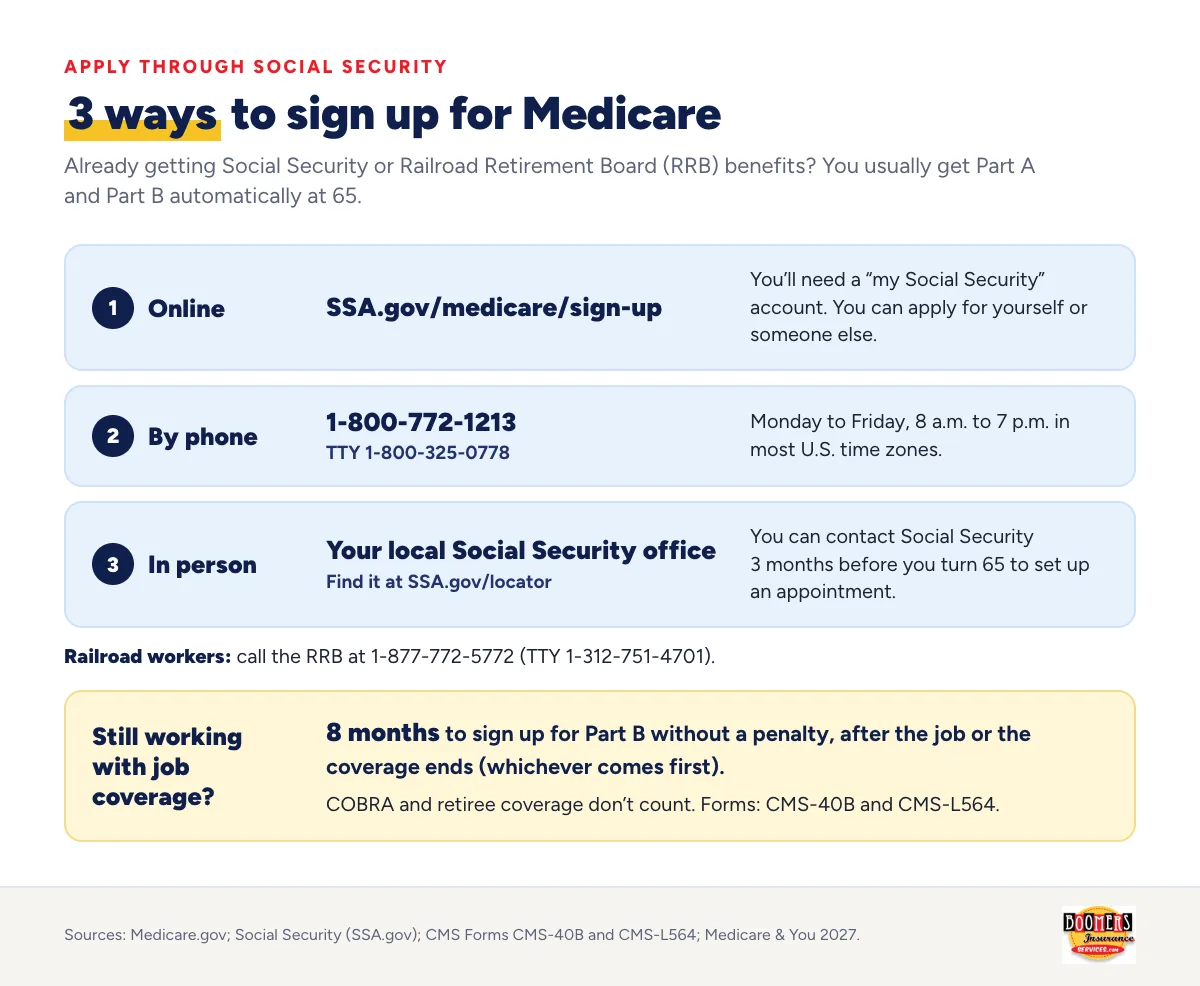
How to apply for Medicare: three ways
| Way to apply | How | Good to know |
|---|---|---|
| Online | SSA.gov/medicare/sign-up | You'll need a "my Social Security" account. You can apply for yourself or for someone else. |
| By phone | 1-800-772-1213 (TTY 1-800-325-0778) | Monday to Friday, 8 a.m. to 7 p.m. in most U.S. time zones. Say you want Parts A and B, or Part A only. |
| In person | Your local Social Security office (SSA.gov/locator) | Medicare & You 2027 says you can also contact Social Security 3 months before you turn 65 to set up an appointment. |
| Railroad workers | Railroad Retirement Board, 1-877-772-5772 (TTY 1-312-751-4701) | For you, or if your spouse worked for a railroad. |
Medicare.gov calls the online route the easiest and fastest way to sign up.
What the Medicare application asks for
Social Security's online Medicare application asks for basic details about you, including where you were born. It also asks for the start and end dates of any group health plan coverage you've had, now or after age 65. Have those dates ready before you start.
You give personal details like these only to Social Security. A licensed agent can explain every step without them. Medicare.gov says your welcome package with your card is mailed about 2 weeks after you sign up. If your card is lost or damaged later, see Medicare card replacement.
When can you sign up? Your Initial Enrollment Period
Your first chance to sign up is your Initial Enrollment Period. It lasts 7 months: the 3 months before the month you turn 65, that month, and the 3 months after. If your birthday is on the 1st, everything moves a month earlier: your window starts 4 months before your birthday month, and signing up early gets you coverage from the first day of the month before.
If you have Part A without a premium, it starts the month you turn 65. Part B starts on a date that depends on when you sign up:
| If you sign up for Part B… | Your coverage starts… |
|---|---|
| In one of the 3 months before your birthday month | The first day of your birthday month |
| In your birthday month | The first day of the next month |
| In one of the 3 months after your birthday month | The first day of the next month |
Here is an example. Say you turn 65 on June 15, 2027. Your window runs from March 1 to September 30, 2027. Sign up in April and Part B starts June 1. Sign up in July and it starts August 1.
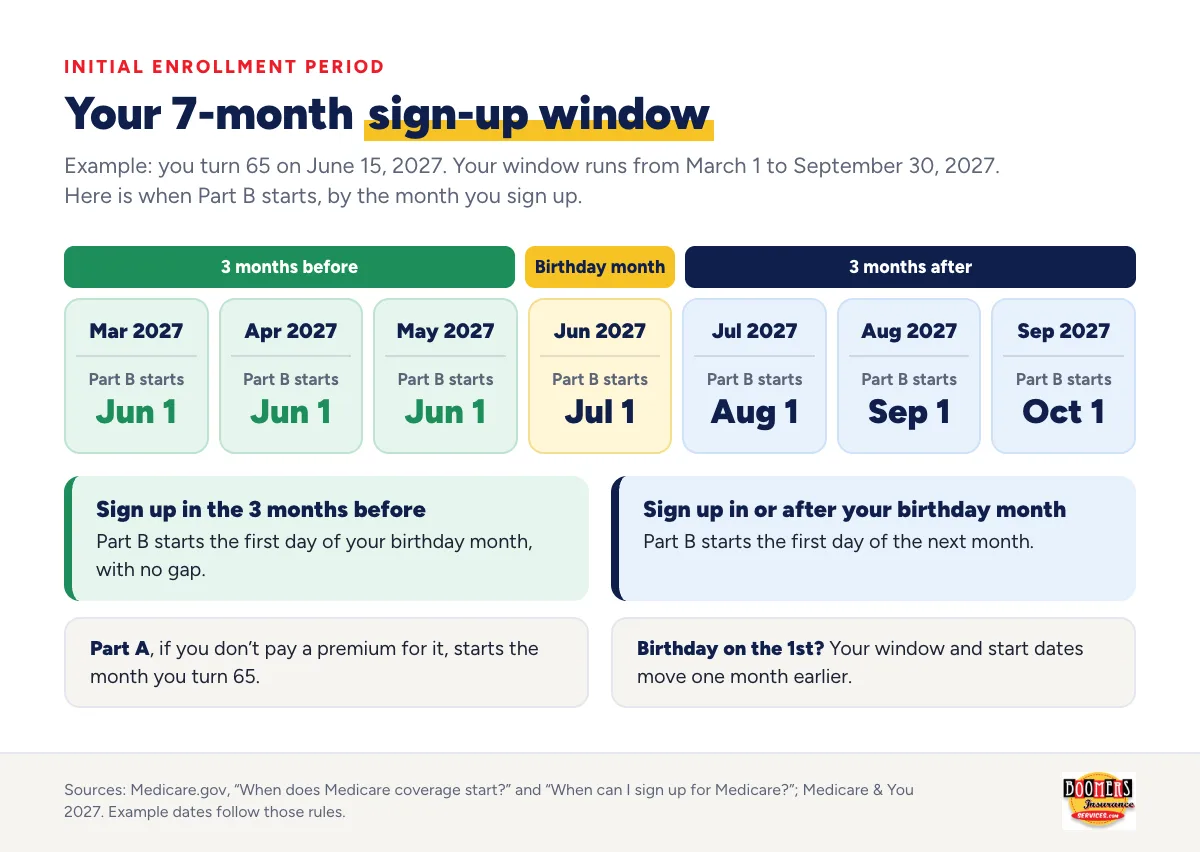
Signing up early in the window avoids a gap. Our Turning 65 checklist puts every date on one page.
How to sign up for Medicare Part B later through a job
If you or your spouse still work and have group health coverage from that job, you may be able to delay Part B. Medicare.gov notes that you may want Part A at 65 even while working, because most people don't pay a premium for it. Ask the employer's benefits office first. With fewer than 20 employees, the job plan may expect Medicare to pay first.
When the job or the coverage ends, you have 8 months to sign up for Medicare Part B without a penalty. The clock starts with whichever ends first. COBRA and retiree coverage don't count as job coverage, and taking COBRA doesn't extend the 8 months.
To sign up during this Special Enrollment Period:
- Apply online at SSA.gov/medicare/sign-up/part-b-only if you already have Part A.
- Or use Form CMS-40B (Request for Enrollment in Medicare Part B), mailed or faxed to your local Social Security office.
- Send Form CMS-L564 (Request for Employment Information) with it. You fill in Section A and the employer fills in Section B.
- If the employer can't complete it, fill in Section B yourself as well as you can, but don't sign it. Then send proof of your job-based coverage.
Coverage generally starts the month after you sign up. If you sign up while still working, or within the first full month after the coverage ends, you can ask to delay the start by up to 3 months. Our guide to Medicare and employer insurance covers Health Savings Accounts and who pays first.
Missed your window? General Enrollment and penalties
If you miss your Initial Enrollment Period and have no Special Enrollment Period, you can sign up from January 1 to March 31 each year. This is the General Enrollment Period. Coverage starts the month after you sign up.
Late sign-up can add a penalty to your premium:
- Part B: 10% for each full 12-month period you could have had Part B but didn't. You usually pay it for as long as you have Part B.
- Part D: 1% of the national base beneficiary premium for each month you went without Part D or creditable drug coverage. A gap of 63 days or more counts.
- Part A: only if you have to buy it. The premium may go up 10%, for twice the number of years you didn't sign up.
Some other situations open a Special Enrollment Period, such as losing Medi-Cal or a natural disaster. Our article on Medicare Special Enrollment Periods lists them.
After Parts A and B: drug coverage, Medicare Advantage or Medigap
Signing up for Medicare at 65 is two steps for most people. First you get Parts A and B. Then you decide how to fill the gaps:
- A Medicare drug plan (Part D). You need Part A or Part B to join one.
- A Medicare Advantage plan (Part C). You need both Part A and Part B. Private companies that contract with Medicare offer these plans.
- A Medigap policy. Your Medigap open enrollment period lasts 6 months from the first month you have Part B and are 65 or older.
You can join a drug or Medicare Advantage plan during the same 7-month window. If you ask before Part A or B starts, the plan starts the same day. If you ask later, it starts the first of the month after the plan gets your request. Compare the two main paths in Medicare Advantage vs. Medigap, and see what drug costs look like in our Part D out-of-pocket cap guide.
A step-by-step checklist for signing up for Medicare at 65
- Write down your 7-month window. It opens 3 months before your birthday month.
- Check whether you already get Social Security or RRB benefits. If you do, watch for your card about 3 months before you turn 65.
- If you have job coverage, ask the benefits office whether you need Part B at 65.
- Apply online, by phone or in person. Keep your health plan dates handy.
- If you delay Part B, keep proof of your job coverage for Form CMS-L564 later.
- Keep any letter that says your drug coverage is creditable.
- When your card arrives, check your name and the start dates for Part A and Part B.
- List your doctors and prescriptions, then compare drug, Medicare Advantage and Medigap options.
The 2026 standard Part B premium is $202.90 a month. Our Medicare cost guide shows every 2026 figure and what is confirmed for 2027 so far.
Next steps
- Mark your Initial Enrollment Period on a calendar.
- Decide whether to apply online, by phone or in person.
- If you're still working, talk with your benefits office before you turn down Part B.
- Read the Turning 65 checklist.
Talk with a licensed Boomers agent
A licensed Boomers agent can go over the Medicare plans we represent in your area and check them against your doctors and prescriptions.
Find a licensed agent near you · See upcoming Medicare events
Or call 1-800-815-1943 (TTY 711), Monday – Friday, 9 AM – 5 PM Pacific.
Frequently asked questions
Can I sign up for Medicare without taking Social Security?
Yes. You can apply for Medicare only and start retirement benefits later. Apply online at SSA.gov, by phone or at a Social Security office. Unless you have coverage from your or your spouse's current job, sign up during your Initial Enrollment Period to avoid a gap in Part B coverage or a late enrollment penalty.
How long does a Medicare application take?
Medicare.gov says your welcome package with your Medicare card is mailed about 2 weeks after you sign up. To have Part B start on the first day of your birthday month, apply in one of the 3 months before it. Have your health plan dates ready so the application isn't held up.
Can I sign up for Medicare Part B online?
Yes, if you already have Part A and you're signing up because job-based coverage is ending: go to SSA.gov/medicare/sign-up/part-b-only, and include Form CMS-L564 or other proof of your coverage. During the General Enrollment Period (January 1–March 31), call Social Security or mail or fax Form CMS-40B to your local office.
Where can I get help with how to sign up for Medicare?
Social Security answers questions at 1-800-772-1213 (TTY 1-800-325-0778). In California, HICAP (1-800-434-0222) gives one-on-one counseling at no cost. Medicare is at 1-800-MEDICARE (TTY 1-877-486-2048) for questions about plans.
Sources
- How do I sign up for Medicare? (Medicare.gov)
- When does Medicare coverage start? (Medicare.gov)
- When can I sign up for Medicare? (Medicare.gov)
- Ready to sign up for Part A & Part B (Medicare.gov)
- Joining a plan (Medicare.gov)
- Avoid late enrollment penalties (Medicare.gov)
- Sign up for Medicare (Social Security)
- Form CMS-40B, Request for Enrollment in Medicare Part B (CMS.gov)
- Form CMS-L564, Request for Employment Information (CMS.gov)
- Medicare & You 2027 (Medicare.gov)
- Medicare counseling: HICAP (California Department of Aging)
Talk with a licensed Boomers agent
A licensed agent can go over the Medicare plans we represent in your area, check them against your doctors and prescriptions, and answer your questions. There is no cost to you and no obligation to enroll.
Monday – Friday, 9 AM – 5 PM PT