
What Is Medicare Part A? Hospital Coverage and 2026 Costs
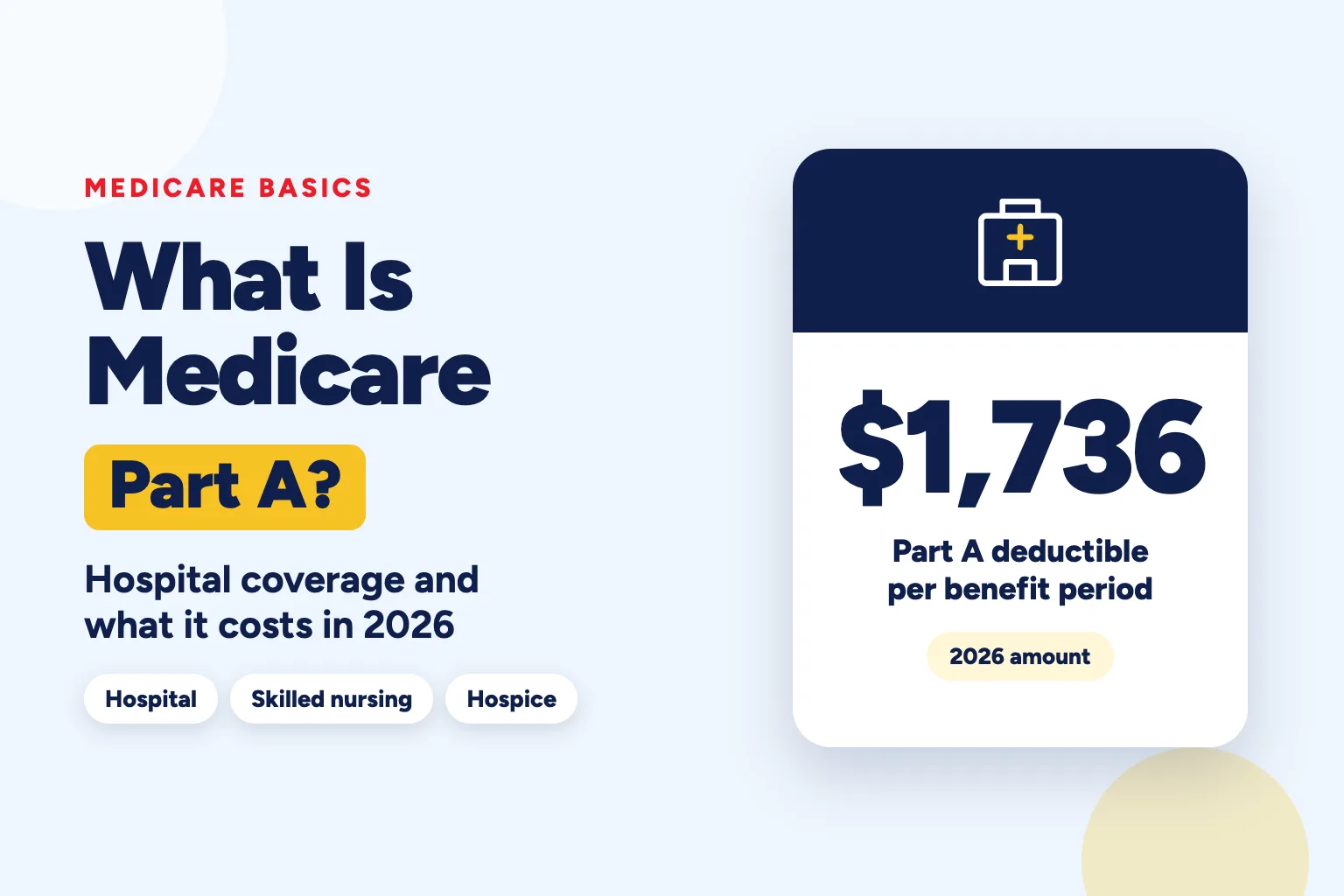
What is Medicare Part A? It is Medicare's hospital insurance. It helps pay for inpatient hospital stays, short-term care in a skilled nursing facility, hospice and some home health care. Most people don't pay a monthly premium for it, but in 2026 there is a $1,736 deductible for each benefit period.
What is Medicare Part A? It is the hospital insurance part of Original Medicare. It helps pay for care when you are admitted to a hospital, and for some care after a hospital stay. It also covers hospice and some home health care.
Most people don't pay a monthly premium for Part A, but it isn't without cost. This guide explains what Part A covers, what it doesn't, what you pay in 2026, and how it works with a job's health plan.
What is Medicare Part A, in plain English?
Medicare has four parts. Part A is hospital insurance, and Part B is medical insurance for doctors and outpatient care. Together they make up Original Medicare, which the federal government runs.
So what is Medicare Part A in practice? Medicare.gov says it "helps pay for inpatient care you get in hospitals, critical access hospitals, and skilled nursing facilities". It also helps cover hospice and some home health care. If you start Social Security benefits at least 4 months before you turn 65, you usually get Part A and Part B automatically.
What does Medicare Part A cover?
| Type of care | What Part A helps pay for | Key conditions |
|---|---|---|
| Inpatient hospital care | A semi-private room, meals, general nursing, certain drugs, and other hospital services and supplies | You are formally admitted with a doctor's order, and the hospital takes Medicare |
| Skilled nursing facility (SNF) care | Short-term skilled nursing and therapy, a semi-private room, meals, medications and supplies | A qualifying inpatient stay first; up to 100 days in each benefit period |
| Hospice care | Comfort care for a terminal illness, from a hospice team | A hospice doctor and your doctor certify a life expectancy of 6 months or less |
| Home health care | Part-time or intermittent skilled care at home | You are homebound; Part A and Part B both cover home health |
Medicare hospital coverage also includes inpatient rehabilitation facilities, long-term care hospitals and inpatient psychiatric care. Part A only pays for up to 190 days of inpatient care in a stand-alone psychiatric hospital in your lifetime. That limit doesn't apply to a Medicare-certified psychiatric unit that is part of a general or critical access hospital.
Inpatient or outpatient: why it matters
You are an inpatient only when the hospital formally admits you with a doctor's order. Time in the emergency room or under "observation" is outpatient care, even overnight. Outpatient care falls under Part B, and it doesn't count toward the 3-day stay that SNF coverage needs.
Doctors' services during a hospital stay are also covered by Part B, not Part A. You generally pay 20% coinsurance for them after the Part B deductible. Ask the hospital staff if you aren't sure of your status.
Skilled nursing care after a hospital stay
Part A covers SNF care only after a qualifying hospital stay of at least 3 days in a row as an inpatient. The day you leave doesn't count. You generally need to enter the SNF within 30 days, and you must need daily skilled care in a Medicare-certified facility.
Some exceptions exist. A doctor in an Accountable Care Organization with a 3-day rule waiver may not need the 3 days. Medicare Advantage plans may also waive it. Our article on long-term care explains what happens when skilled care ends.
What doesn't Part A cover?
Part A pays for medical care in a facility. It doesn't pay for:
- long-term custodial care, such as help with bathing, dressing or using the bathroom, when that is the only care you need
- private-duty nursing
- a private room, unless it's medically necessary
- a TV or phone in your room when there is a separate charge
- personal care items, like razors or slipper socks
- room and board when you get hospice care at home or in a nursing home
Most long-term care isn't medical, so Medicare and Medigap don't pay for it. Medi-Cal may help if you meet its rules. The Medi-Cal asset limit is $130,000 for one person in 2026, plus $65,000 for each extra person. It is scheduled to drop to $21,000 for one person and $31,000 for two no sooner than July 1, 2027.
What does Part A cost in 2026?
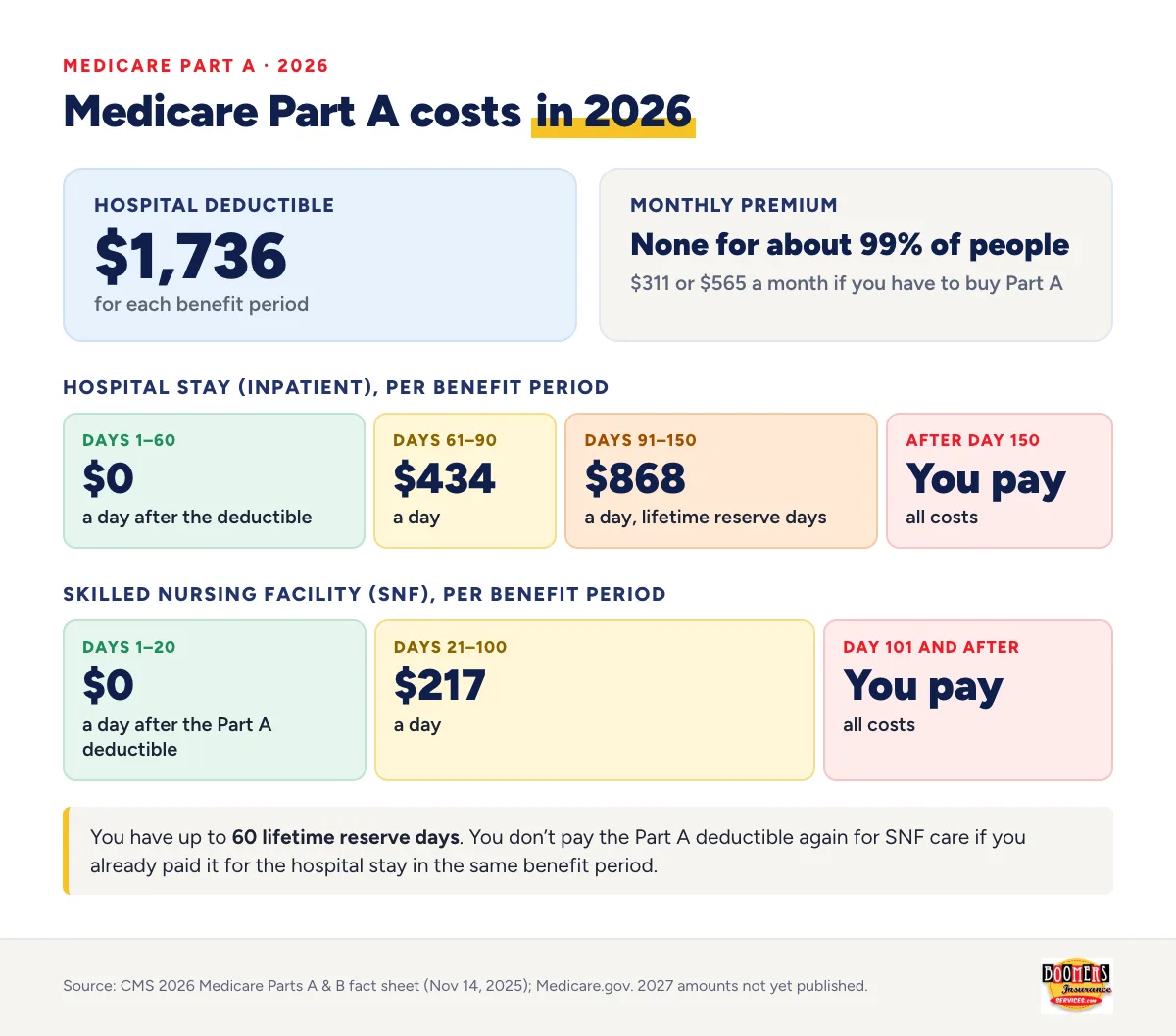
These are the 2026 amounts from the CMS fact sheet of November 14, 2025 and Medicare.gov:
| Part A cost | 2026 amount |
|---|---|
| Monthly premium | None for about 99% of people; $311 or $565 a month if you have to buy Part A |
| Hospital deductible | $1,736 for each benefit period |
| Hospital days 1–60 | $0 a day after the deductible |
| Hospital days 61–90 | $434 a day |
| Days 91–150 (lifetime reserve days) | $868 a day, for up to 60 reserve days in your lifetime |
| After day 150 | You pay all costs |
| SNF days 1–20 | $0 a day after the Part A deductible (usually already paid for the hospital stay) |
| SNF days 21–100 | $217 a day |
| SNF day 101 and after | You pay all costs |
| Hospice | $0 for covered services; up to $5 per prescription for pain and symptom drugs; 5% for inpatient respite care |
| Home health | $0 for covered services; 20% for medical equipment after the Part B deductible |
You don't pay the Part A deductible again for SNF care if you already paid it for the hospital stay in the same benefit period. Original Medicare has no yearly limit on what you pay. That's why many people add a Medigap policy or choose a Medicare Advantage plan.
CMS hasn't announced the 2027 Part A amounts as of November 4, 2026; it publishes them in the fall. Our Medicare cost guide will show them once they're out.
Medicare Part A premium: who pays one?
You can usually get Part A without a premium if you or your spouse paid Medicare taxes long enough while working. CMS puts that at 40 quarters of coverage, about 10 years of work. In 2026, Social Security gives one work credit for every $1,890 of covered earnings, up to 4 credits a year.
If you have 30 to 39 quarters, Part A costs $311 a month in 2026. With fewer than 30, it costs $565. In most cases, if you buy Part A you must also have Part B. Medicare.gov says people who get Medicare before 65 usually don't pay a Part A premium.
If you have to buy Part A and don't sign up when you're first able to, your premium may go up 10%. You pay that higher premium for twice the number of years you didn't sign up. If a Part A premium is hard to pay, our guide to Extra Help and Medicare Savings Programs explains programs that may help.
How does a Part A benefit period work?
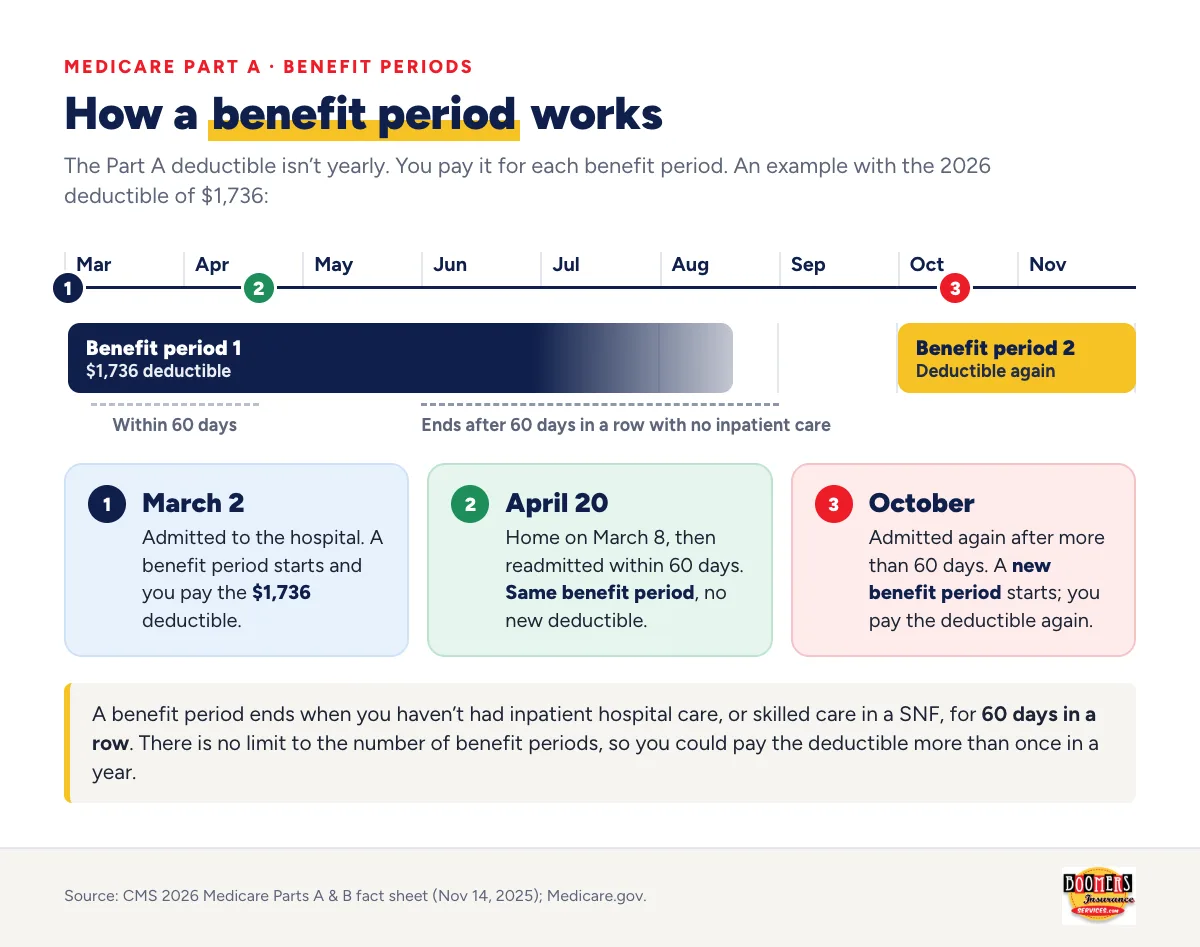
The Part A deductible isn't yearly. It applies to each benefit period. A benefit period begins the day you're admitted as an inpatient in a hospital or SNF. It ends when you haven't had inpatient hospital care, or skilled care in a SNF, for 60 days in a row.
Here is an example of how the Part A deductible for 2026 works:
- You are admitted to the hospital on March 2. A benefit period starts, and you pay the $1,736 deductible.
- You go home on March 8, then are readmitted on April 20. That is within 60 days, so it's the same benefit period. You don't pay a new deductible.
- You stay healthy until you're admitted again in October. More than 60 days have passed, so a new benefit period starts and you pay the deductible again.
There is no limit to the number of benefit periods. You could pay the deductible more than once in a year.
How does Part A work with a job's coverage or an HSA?
Many people sign up for Part A at 65 even while still working, because most don't pay a premium for it. Medicare.gov suggests this. If the employer has 20 or more employees, the job's plan generally pays first. Check with the benefits office before you decide.
A Health Savings Account (HSA) needs care. You can't put money into an HSA once any part of Medicare starts. If you sign up for Part A without a premium after 65, your coverage can start up to 6 months back, but not before the month you turned 65.
Medicare & You 2027 says: if you sign up 6 or more months after you turn 65, stop HSA contributions 6 months before the month you apply. If you sign up sooner, make your last contribution the month before you turn 65 (2 months before, if your birthday is on the 1st).
IRS Publication 969 adds that your HSA contribution limit is zero for every month you're enrolled in Medicare, including months of retroactive coverage, and your employer's contributions count toward that limit. Our guide to Medicare and employer insurance walks through the timing.
Generally, you can drop Part A only if you pay a premium for it.
Part A in a Medicare Advantage plan
If you join a Medicare Advantage plan, the plan covers your Part A services. Private companies that contract with Medicare run these plans, and their costs differ from Original Medicare. A plan may charge copayments in the first 60 days of a hospital stay and in the first 20 days at a SNF. Plans also have a yearly limit on what you pay out of pocket.
Hospice is an exception. Original Medicare pays for hospice even if you're in a Medicare Advantage plan. Compare how plans use networks in our Medicare Advantage HMO vs PPO article.
Next steps
- Check that you have enough work credits, or a spouse who does.
- If you still work, ask the benefits office how the job plan works with Part A.
- Note the Part A costs that could matter to you, like the deductible and SNF days.
- Go through the Turning 65 checklist.
Talk with a licensed Boomers agent
A licensed Boomers agent can go over the Medicare plans we represent in your area and check them against your doctors and prescriptions.
Find a licensed agent near you · See upcoming Medicare events
Or call 1-800-815-1943 (TTY 711), Monday – Friday, 9 AM – 5 PM Pacific.
Frequently asked questions
Do most people pay a premium for Medicare Part A?
No. CMS says about 99% of people with Medicare don't pay a Part A premium, because they have at least 40 quarters of work that paid Medicare taxes. Others can buy Part A for $311 or $565 a month in 2026. Part B has its own premium, $202.90 a month for most people in 2026.
How many hospital days does Part A cover?
Part A covers up to 90 days in each benefit period, with your share rising after day 60. You also have 60 lifetime reserve days you can use once. After day 150 in a benefit period, you pay all costs.
Does Part A cover a nursing home?
Part A covers short-term skilled care in a SNF, up to 100 days per benefit period, after a qualifying hospital stay. It doesn't cover long-term custodial care. You pay for that yourself, unless you have long-term care insurance or Medi-Cal covers it.
What is Medicare Part A going to cost in 2027?
CMS hadn't published the 2027 Part A deductible or premiums as of November 4, 2026. It announces them each fall, for example on November 14, 2025 for 2026. Until then, the 2026 figures above are the latest.
Sources
- What Part A covers (Medicare.gov)
- Inpatient hospital care (Medicare.gov)
- Skilled nursing facility care (Medicare.gov)
- Hospice care (Medicare.gov)
- Home health services (Medicare.gov)
- Long-term care (Medicare.gov)
- Medicare costs (Medicare.gov)
- When does Medicare coverage start? (Medicare.gov)
- 2026 Medicare Parts A & B premiums and deductibles (CMS.gov, November 14, 2025)
- How you earn credits (Social Security)
- Medicare & You 2027 (Medicare.gov)
- Medi-Cal asset limit FAQ (California Department of Health Care Services)
Talk with a licensed Boomers agent
A licensed agent can go over the Medicare plans we represent in your area, check them against your doctors and prescriptions, and answer your questions. There is no cost to you and no obligation to enroll.
Monday – Friday, 9 AM – 5 PM PT