
Medicare vs Medicaid: What’s the Difference, and Can You Have Both?
Medicare vs Medicaid comes down to who each program serves. Medicare is federal health insurance for people 65 or older and some younger people with a disability. Medicaid, called Medi-Cal in California, is run by each state under federal rules and helps people with limited income and resources.
Medicare vs Medicaid: the names sound alike, but they are two different programs. Medicare is federal health insurance for people 65 or older. It also covers some younger people with a disability. Medicaid is run by each state, with federal rules and funds. It helps pay health costs for some people with limited income and resources. In California, it is called Medi-Cal.
Some people qualify for both. Then the two programs work together, and Medicaid can help pay what Medicare leaves to you. Below, we explain the difference between Medicare and Medicaid, who qualifies, what each covers in 2026 and how to apply.
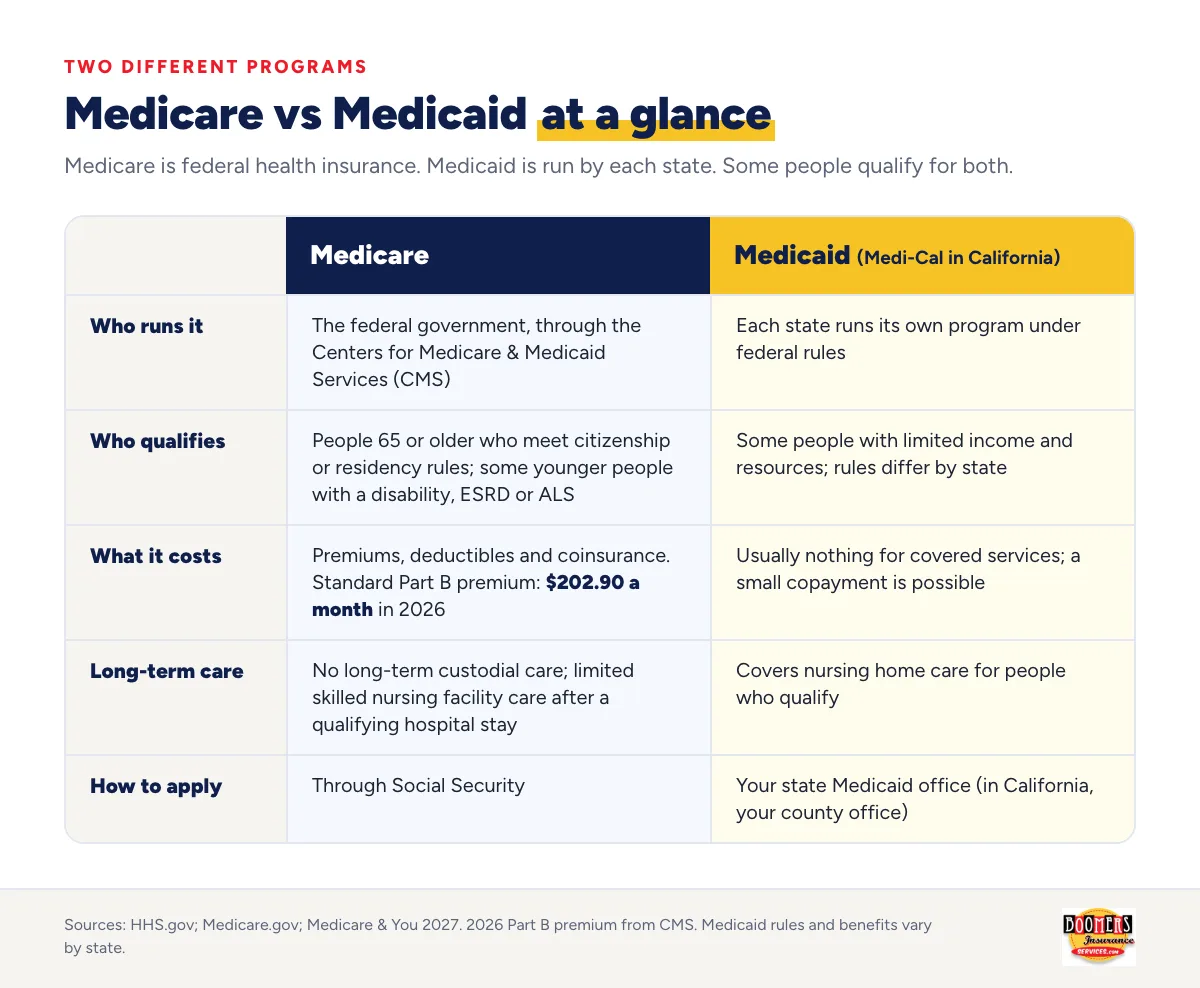
Medicare vs Medicaid at a glance
| Medicare | Medicaid (Medi-Cal in California) | |
|---|---|---|
| Who runs it | The federal government, through the Centers for Medicare & Medicaid Services (CMS) | Each state runs its own program under federal rules |
| Who it’s for | People 65 or older who meet citizenship or residency rules; some younger people with a disability, End-Stage Renal Disease (ESRD) or ALS | Some people with limited income and resources; rules differ by state |
| Same in every state? | Yes. Costs and coverage follow federal standards | No. Who qualifies and what is covered can vary by state |
| What you pay | Premiums, deductibles and coinsurance. The standard Part B premium is $202.90 a month in 2026 | Usually nothing for covered services; a small copayment is possible |
| Nursing home care | No long-term custodial care; limited skilled nursing facility care after a qualifying hospital stay | Covers nursing home care for people who qualify |
| Where to apply | Social Security | Your state Medicaid office (in California, your county office) |
What is Medicare?
Medicare is run by a federal agency, CMS. Because it is a federal program, your coverage is the same in every state. Your income doesn’t decide whether you get Medicare. But people with higher incomes pay more for Part B and Part D.
Medicare has four parts:
- Part A (hospital insurance): hospital stays, some skilled nursing facility care, hospice and some home health care.
- Part B (medical insurance): doctor visits, outpatient care, medical equipment and many preventive services.
- Part C (Medicare Advantage): plans from private companies that contract with Medicare, bundling Part A, Part B and usually Part D.
- Part D (drug coverage): plans from private insurers that follow Medicare’s rules.
People with Medicare pay part of the costs. In 2026, the standard Part B premium is $202.90 a month and the Part B deductible is $283. The Part A hospital deductible is $1,736 per benefit period. Most people don’t pay a premium for Part A. Our Medicare costs guide lists the 2026 amounts and the 2027 ones announced so far.
What is Medicaid?
Medicaid is a joint federal and state program. The federal government sets the main rules, but each state runs its own program. That is why the names differ, like “Medical Assistance” or “Medi-Cal.” It is also why who qualifies, and what is covered, can vary by state.
To qualify, you generally must live in the state and meet its limits on income and resources (savings and other assets). Some states let people “spend down.” That means you pay some medical bills until your income is low enough to qualify.
People with Medicaid usually pay nothing for covered care. They may owe a small copay for some items. From January 1, 2027 (or earlier in some states), some adults must work or do other approved tasks at least 80 hours a month to keep Medicaid. Medicare.gov says this rule doesn’t apply to people with Medicare.
What’s the difference between Medicare and Medicaid in what they cover?
In coverage, the main Medicare vs Medicaid gap is long-term care. Medicare pays for hospital care, doctor visits and, through Part D, drugs. It doesn’t pay for long-term custodial care. That is daily help with dressing, bathing and using the bathroom, the kind many people get in a nursing home.
Original Medicare also doesn’t cover routine dental care or hearing aids. Full Medicaid can fill many of those gaps. Medicare & You 2027 says people with full Medicaid may get help with care Medicare doesn’t cover, or only partly covers, such as:
- long-term care in a nursing home
- personal care and home- and community-based services
- transportation to medical services
- home-delivered meals
- dental, vision and hearing services
Benefits differ by state. For more on nursing homes and care at home, read does Medicare cover long-term care.
Who is eligible for both Medicare and Medicaid?
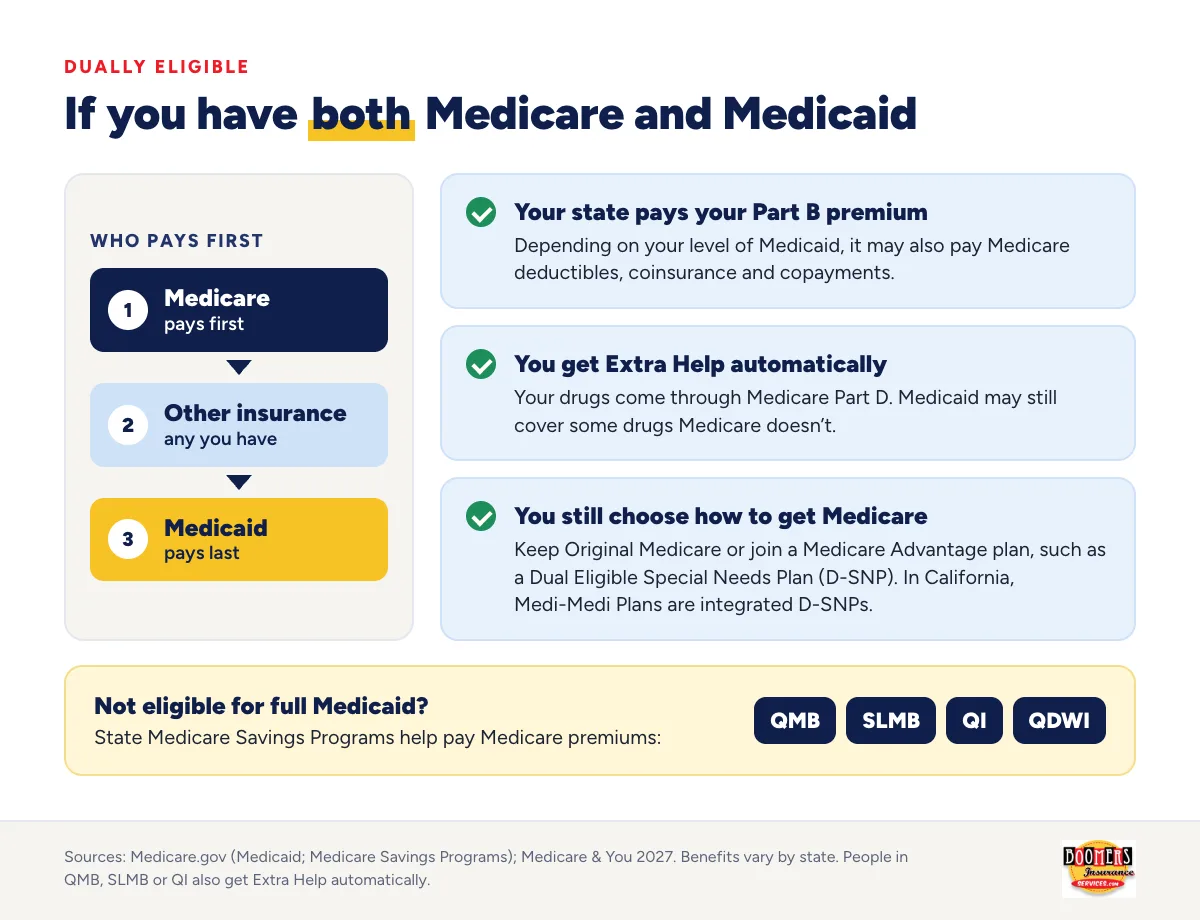
You may be able to get both if you have Medicare and also meet your state’s Medicaid limits. People with Medicare and full Medicaid are called “dually eligible.” Here is how the two work together:
- Medicare pays first. Medicaid pays last, after Medicare and any other insurance you have.
- Your state pays your Part B premium. Depending on your level of Medicaid, it may also pay Medicare deductibles, coinsurance and copayments.
- Your drugs come through Medicare. You get Extra Help with Part D costs automatically. Medicaid may still cover some drugs Medicare doesn’t.
- You still choose how to get Medicare. You can keep Original Medicare or join a Medicare Advantage plan, such as a Dual Eligible Special Needs Plan (D-SNP).
- You can change drug coverage more often. With Medicaid or Extra Help, you may be able to change your drug coverage once a month.
Help if you don’t qualify for full Medicaid
Your income may be too high for full Medicaid but still limited. Then a Medicare Savings Program may help. These state programs (QMB, SLMB, QI and QDWI) help pay Medicare premiums. With QMB, Medicare providers also can’t bill you for Medicare deductibles, coinsurance and copayments. People in QMB, SLMB or QI automatically get Extra Help with drug costs too. Our guide to Extra Help and Medicare Savings Programs explains each one.
Medicare and Medi-Cal in California
Medi-Cal is Medicaid for California. The state’s Department of Health Care Services (DHCS) runs it. A few state rules matter if you have Medicare:
- Asset limit: since January 1, 2026, Medi-Cal counts assets for people 65 or older, people with a disability, people in a nursing home and some other groups. The limit is $130,000 for one person, plus $65,000 for each extra person in the household. It is scheduled to drop to $21,000 for one person and $31,000 for two no sooner than July 1, 2027. Your main home and main vehicle are generally not counted. See our Medi-Cal asset limit guide.
- Medi-Medi Plans: California’s integrated D-SNPs for people with Medicare and full Medi-Cal. Your Medicare and Medi-Cal benefits are managed by the same health plan organization. Read more about Medi-Medi Plans.
- PACE: Medicare.gov says that if you have Medicaid (Medi-Cal in California), you won’t pay a monthly premium for the PACE benefit. Our PACE guide explains who can join.
For one-on-one help, call HICAP at 1-800-434-0222. It is the state’s Medicare counseling program.
How do you apply for Medicare or Medicaid?
The two programs have separate applications:
- Medicare: if you already get Social Security or Railroad Retirement benefits, you are enrolled in Part A and Part B automatically at 65. If not, apply at SSA.gov/medicare/sign-up or call Social Security at 1-800-772-1213 (TTY 1-800-325-0778). Your first chance is a 7-month window around your 65th birthday. Our Turning 65 checklist walks through the timing.
- Medicaid: contact your State Medical Assistance (Medicaid) office. Medicaid.gov has a state map, or call 1-800-MEDICARE (TTY 1-877-486-2048) for your state’s number.
- Medi-Cal: DHCS lists four ways to apply: online through BenefitsCal or Covered California, by phone or in person at your county office, or by mail.
- Extra Help: apply at SSA.gov/extrahelp, unless you get it automatically.
Unsure about a Medicare Savings Program? The Medicare & You 2027 handbook says to apply even if you aren’t sure. The limits vary by state.
Next steps
Once you know the Medicare vs Medicaid basics, these steps can help:
- Check which program fits your situation. Turning 65 points to Medicare; limited income and resources may point to Medicaid as well.
- Ask your state or county office about Medicaid and Medicare Savings Programs if money is tight.
- If you have both, review your drug plan and whether a D-SNP or Medi-Medi Plan suits you.
- In California, note the asset limit dates before your next Medi-Cal renewal.
- Get independent counseling from your State Health Insurance Assistance Program (HICAP in California).
Talk with a licensed Boomers agent
A licensed Boomers agent can go over the Medicare plans we represent in your area and check them against your doctors and prescriptions. We can also explain how plans for people with Medicare and Medi-Cal work in your county.
Find a licensed agent near you · See upcoming Medicare events
Or call 1-800-815-1943 (TTY 711), Monday – Friday, 9 AM – 5 PM Pacific.
Frequently asked questions
Can you have Medicare and Medicaid at the same time?
Yes, if you meet the rules for both. People with Medicare and full-benefit Medicaid are called dually eligible. Medicare pays first, and Medicaid helps with costs Medicare doesn’t pay.
Do I need Medicaid or Medicare if I’m turning 65?
Medicare is the program tied to age 65, whatever your income. Medicaid depends on your income, resources and your state’s rules. You may be able to get both if your income and assets are limited.
Does Medicare or Medicaid pay for a nursing home?
Medicare doesn’t pay for long-term custodial care. It covers limited skilled nursing facility care after a qualifying hospital stay. Medicaid can cover long-term nursing home care for people who qualify.
Is Medi-Cal the same as Medicaid?
Yes. Medi-Cal is the name for Medicaid in California. It follows federal rules, but the state sets some of its own, like the asset limit.
What happens if I lose Medicaid?
Say you could get Medicare but didn’t sign up when you were first eligible. Medicare & You 2027 says you can sign up for Part A and Part B without a late enrollment penalty. You have 6 months after your Medicaid coverage ends to sign up. Medicare.gov’s “Losing Medicaid?” fact sheet explains the other options.
Sources
- What’s the difference between Medicare and Medicaid? (HHS.gov)
- Medicaid (Medicare.gov)
- Medicare & You 2027 handbook (Medicare.gov)
- Medicare Savings Programs (Medicare.gov)
- 2026 Medicare Parts A & B premiums and deductibles (CMS.gov)
- Where can people get help with Medicaid & CHIP? (Medicaid.gov)
- Losing Medicaid? Medicare could be an option (Medicare.gov)
- Apply for Medi-Cal (California DHCS)
- Medi-Cal asset limit FAQ (California DHCS)
- Medicare counseling: HICAP (California Department of Aging)
Talk with a licensed Boomers agent
A licensed agent can go over the Medicare plans we represent in your area, check them against your doctors and prescriptions, and answer your questions. There is no cost to you and no obligation to enroll.
Monday – Friday, 9 AM – 5 PM PT