
Medicare Part D Out-of-Pocket Cap and the Prescription Payment Plan
Medicare limits what you pay for covered Part D drugs to $2,100 in 2026 and $2,400 in 2027. Learn what counts toward that limit and how the Medicare Prescription Payment Plan spreads your costs over the year.
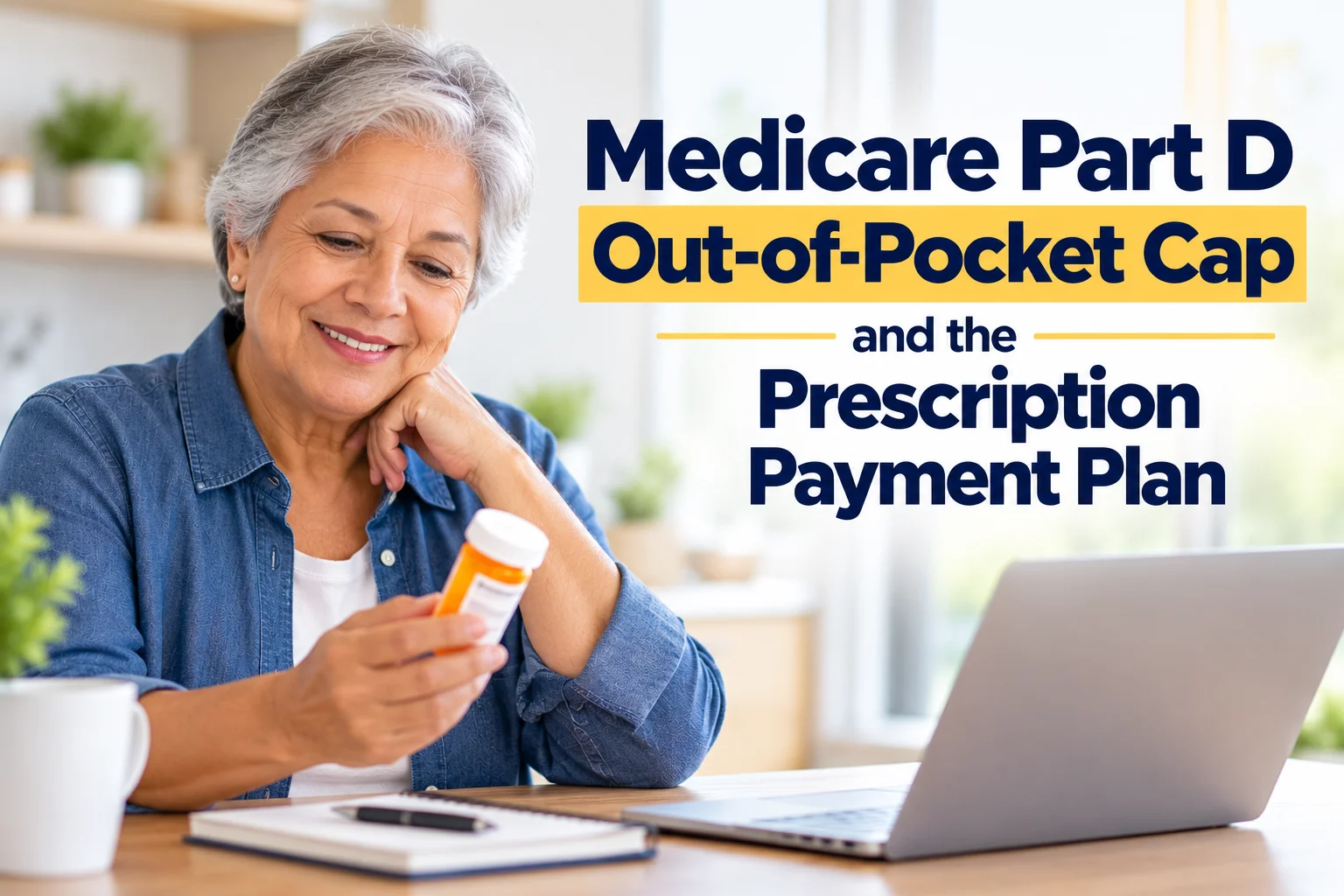
The Medicare Part D out-of-pocket cap is a yearly limit on what you pay for drugs your Part D plan covers. According to Medicare.gov, the cap is $2,100 in 2026 and $2,400 in 2027. Once your spending reaches it, you don’t pay anything more for covered Part D drugs for the rest of that calendar year.
The cap applies whether you have a stand-alone Part D plan or a Medicare Advantage plan with drug coverage. Separately, the Medicare Prescription Payment Plan lets you spread what you owe across the year in monthly bills.
Part D costs in 2026 and 2027
| Part D figure | 2026 | 2027 |
|---|---|---|
| Yearly deductible (the most a plan can charge) | $615 | $700 |
| Out-of-pocket cap on covered drugs | $2,100 | $2,400 |
| Coverage gap | None | None |
Source: Medicare.gov. Some plans have a lower deductible or none at all. Premiums, copays and coinsurance vary from plan to plan, so read your plan’s Annual Notice of Change each fall.
What happened to the donut hole?
The coverage gap no longer exists. It has been gone since 2025. Today a Part D plan year has three stages:
- Deductible, if your plan has one.
- Initial coverage, when you pay your share of each prescription, such as a copay or coinsurance.
- Catastrophic coverage, which starts once you reach the cap. From then on, you pay nothing for covered Part D drugs for the rest of the year.
The Part D deductible in 2027
For 2027, Medicare.gov says no Part D plan can have a deductible higher than $700, up from $615 in 2026. If your plan has a deductible, you generally pay the plan’s full price for covered drugs until you meet it. After that, you pay your copay or coinsurance.
How the Medicare Part D out-of-pocket cap works
The cap counts what you spend on covered Part D drugs from January 1 through December 31. When your spending reaches the cap, you won’t pay out of pocket for covered Part D drugs for the rest of the year. On January 1, the count starts over.
What counts toward the cap
- Your deductible, copays and coinsurance for drugs your plan covers
- Certain payments made on your behalf, such as through Extra Help
- In some cases, payments from a State Pharmaceutical Assistance Program
What doesn’t count
- Your monthly plan premium, which you keep paying even after you reach the cap
- Drugs your plan doesn’t cover
Your plan’s Explanation of Benefits, which you get in months when you fill prescriptions, shows how much you’ve paid toward the cap so far.
How the Medicare Prescription Payment Plan works
The payment plan is an optional way to pay your Part D costs. You pay $0 at the pharmacy for covered drugs. Instead, your plan sends you a monthly bill that spreads your out-of-pocket costs over the rest of the calendar year.
Key points:
- Anyone with Part D can use it, whether through a stand-alone drug plan or a Medicare Advantage plan with drug coverage. Medicare.gov says every Part D plan must offer it.
- It doesn’t lower your total costs. You owe the same amount; you just pay it over time. You still pay your plan premium separately.
- You can join any time during the year. Joining earlier gives you more months to spread costs over, so each bill is smaller. Medicare.gov notes that joining late in the year, such as after September, may not be a good choice.
- You can leave any time. If you leave, you still owe any balance, which you can pay all at once or in monthly payments.
- Missing a payment can get you removed from the payment plan. Medicare.gov says you stay in your drug plan and aren’t charged interest or fees, but you still owe the balance. Pay your plan premium first so you keep your drug coverage.
- Changing to a new drug or health plan ends your participation, so ask your new plan if you want to keep using it.
A simple example
Example only. These are round, made-up numbers to show how the timing works. They don’t come from any plan.
Say you join the payment plan in January, then fill a prescription that would cost you $1,200 at the pharmacy. You pay $0 at the counter. Your plan spreads the $1,200 over the 12 months left in the year, so your bill is about $100 a month.
Now say the same $1,200 cost came up in July instead. With only 6 months left, your bill would be about $200 a month.
Either way, you pay $1,200 in total. If you fill more prescriptions later in the year, those costs are added to what you still owe and spread over the months that remain, so your bill can go up.
Who it helps, and who it may not
The payment plan is most likely to help if you have high drug costs early in the year, or one large cost you would rather not pay at the pharmacy all at once.
It may not help much if:
- Your drug costs are low over the year
- Your drug costs are about the same every month
- You get Extra Help, or may qualify for it (see our guide to Extra Help and the Medicare Savings Programs)
- You’re in a Medicare Savings Program, or you use a State Pharmaceutical Assistance Program or drug coupons
How to sign up
Contact your Part D plan or Medicare Advantage plan to opt in; the phone number is on your member card. Your plan reviews your request and sends a letter confirming that you’re in. If you’re changing plans for next year during the Annual Enrollment Period, ask the new plan about the payment plan too. Our Annual Enrollment 2027 guide covers the dates.
For questions about your own costs, you can also call 1-800-MEDICARE (TTY 1-877-486-2048) or contact HICAP, California’s Health Insurance Counseling & Advocacy Program (1-800-434-0222), for counseling at no charge.
Frequently asked questions
Does my premium count toward the Medicare Part D out-of-pocket cap?
No. The cap counts what you pay for covered Part D drugs, like your deductible, copays and coinsurance. Your monthly premium doesn’t count, and you keep paying it after you reach the cap.
Is there still a donut hole in Medicare Part D?
No. The coverage gap has been gone since 2025. Once your out-of-pocket spending on covered drugs reaches the yearly cap, you pay nothing more for covered Part D drugs that year.
What is the Part D deductible for 2027?
Medicare.gov says no Part D plan can have a deductible above $700 in 2027. For 2026, the most a plan can charge is $615. Some plans have a lower deductible or none.
Does the prescription payment plan lower my drug costs?
No. It changes when you pay, not how much. You pay $0 at the pharmacy for covered drugs and get monthly bills instead, and your total for the year stays the same.
Can I leave the payment plan if it isn’t working for me?
Yes, you can leave at any time through your plan. You’ll still owe any balance from costs you already had, and you’ll go back to paying the pharmacy directly.
Talk with a licensed Boomers agent
A licensed Boomers agent can go over the Medicare plans we represent in your area and check them against your doctors and prescriptions, including how each plan’s drug list covers your medicines. Our help is at no cost to you.
Find a licensed agent near you · See upcoming Medicare events
Or call 1-800-815-1943 (TTY 711), Monday – Friday, 9 AM – 5 PM Pacific.
Sources
- Costs for Medicare drug coverage (Medicare.gov)
- Medicare Prescription Payment Plan (Medicare.gov)
- How the Medicare Prescription Payment Plan works (Medicare.gov)
- Using the Medicare Prescription Payment Plan (Medicare.gov)
- Help with drug costs: Extra Help (Medicare.gov)
- Medicare counseling: HICAP (California Department of Aging)
Talk with a licensed Boomers agent
A licensed agent can go over the Medicare plans we represent in your area, check them against your doctors and prescriptions, and answer your questions. There is no cost to you and no obligation to enroll.
Monday – Friday, 9 AM – 5 PM PT