
Pros and Cons of Medicare Advantage Plans: What to Weigh for 2027
The pros and cons of Medicare Advantage plans are trade-offs, not a verdict. A plan puts your hospital, medical and usually drug coverage on one card, with a yearly limit on what you pay for covered services. In return, you may need to use the plan's network and get approval for some care.
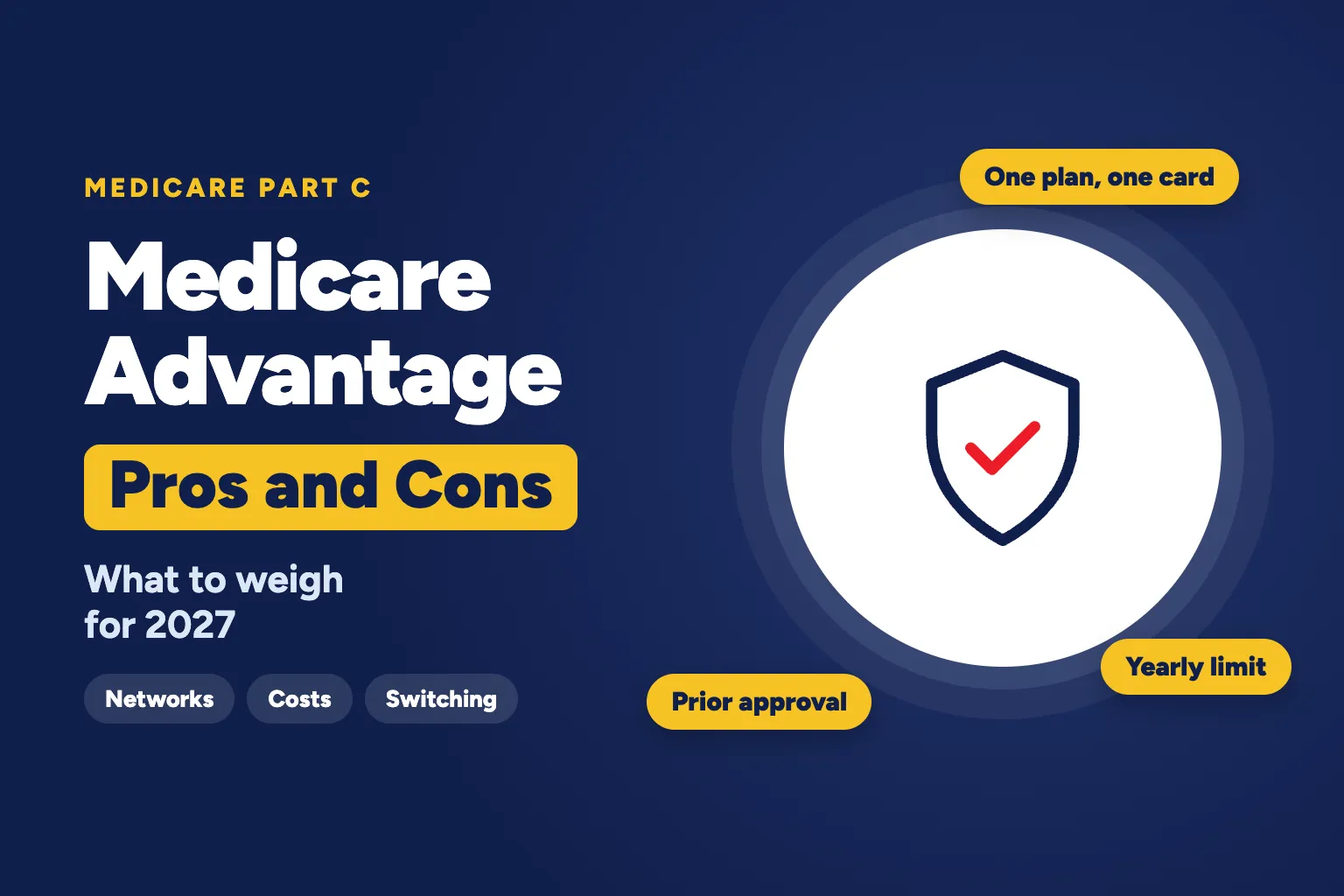
The pros and cons of Medicare Advantage plans are a set of trade-offs. A feature that suits one person can be a problem for another. This guide lists each one the way Medicare.gov and the Medicare & You 2027 handbook describe it. The dollar figures for 2026 and 2027 come from the Centers for Medicare & Medicaid Services (CMS).
Some people hear only complaints about these plans. Others hear only praise from a neighbor. Both are reacting to the same plan rules. This guide explains those rules. It doesn't tell you which kind of coverage to pick.
What is Medicare Advantage, and who can join?
Medicare Advantage, also called Part C, is another way to get your Medicare Part A and Part B coverage. Private companies that contract with Medicare offer the plans, and most include drug coverage (Part D). Our guide What is Medicare Advantage? explains it step by step.
To join, you need Part A and Part B, and you must live in the plan's service area. You must also meet Medicare's citizenship or lawful-presence rule.
The handbook lists five types of plans. The two this guide compares are the Health Maintenance Organization (HMO) and the Preferred Provider Organization (PPO). A Special Needs Plan serves a specific group, for example people who have both Medicare and Medi-Cal. Our HMO vs PPO guide compares these two types.
Pros and cons of Medicare Advantage plans: what the plans offer
Medicare.gov and the Medicare & You handbook describe four features of these plans. Each one is a Medicare rule or a common plan design, not a promise about any single plan.
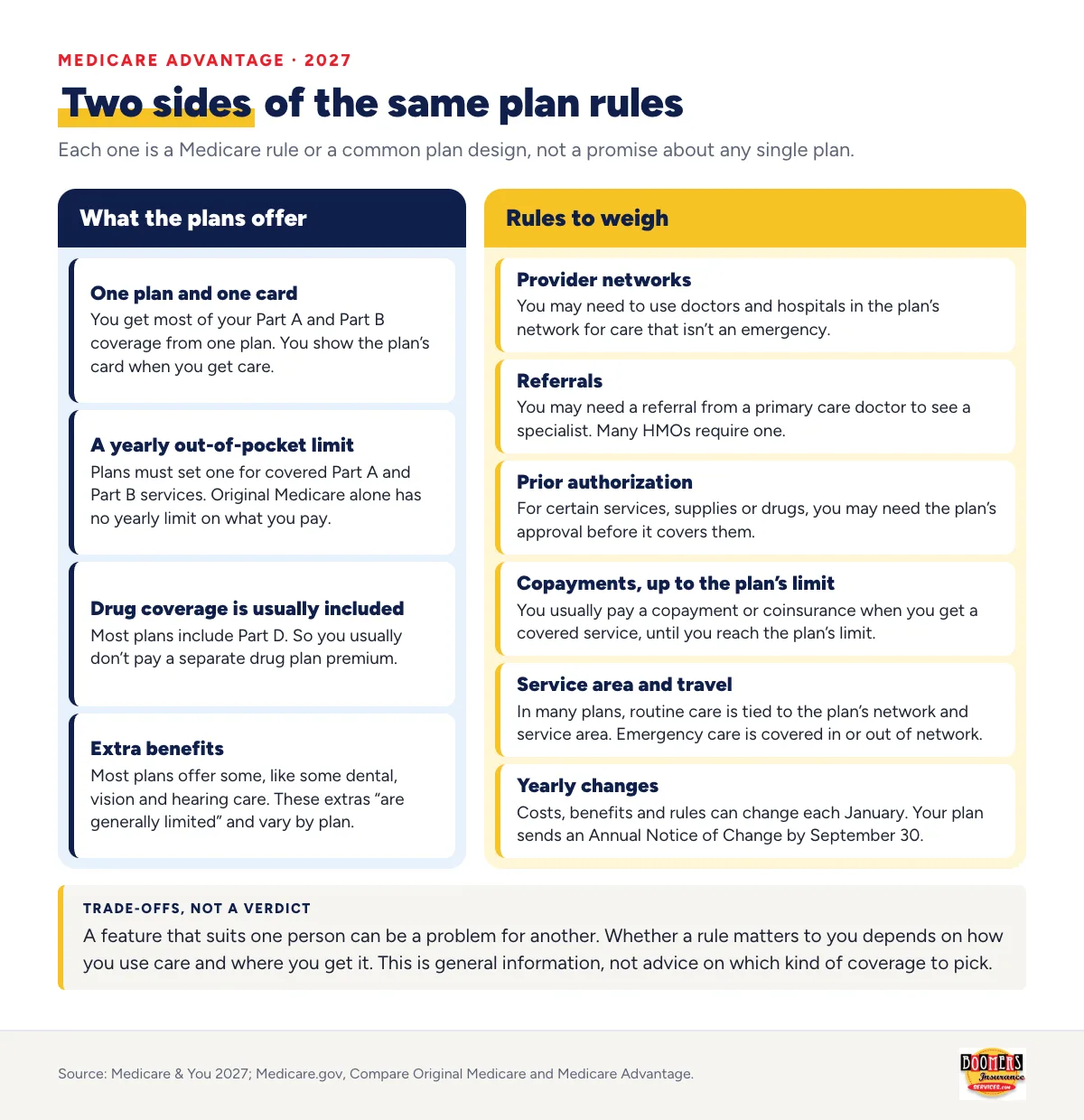
- One plan and one card. You get most of your Part A and Part B coverage from one plan. You show the plan's card when you get care.
- A yearly out-of-pocket limit. Original Medicare alone has no yearly limit on what you pay. Medicare Advantage plans must set one for covered Part A and Part B services. Once you reach it, you pay nothing for those services for the rest of the year.
- Drug coverage is usually included. Medicare & You 2027 says most plans include Part D. So you usually don't pay a separate drug plan premium.
- Extra benefits. Most plans offer some benefits Original Medicare doesn't cover, like some dental, vision and hearing care. The handbook says these extras "are generally limited." They vary by plan. See what Medicare covers for dental, vision and hearing.
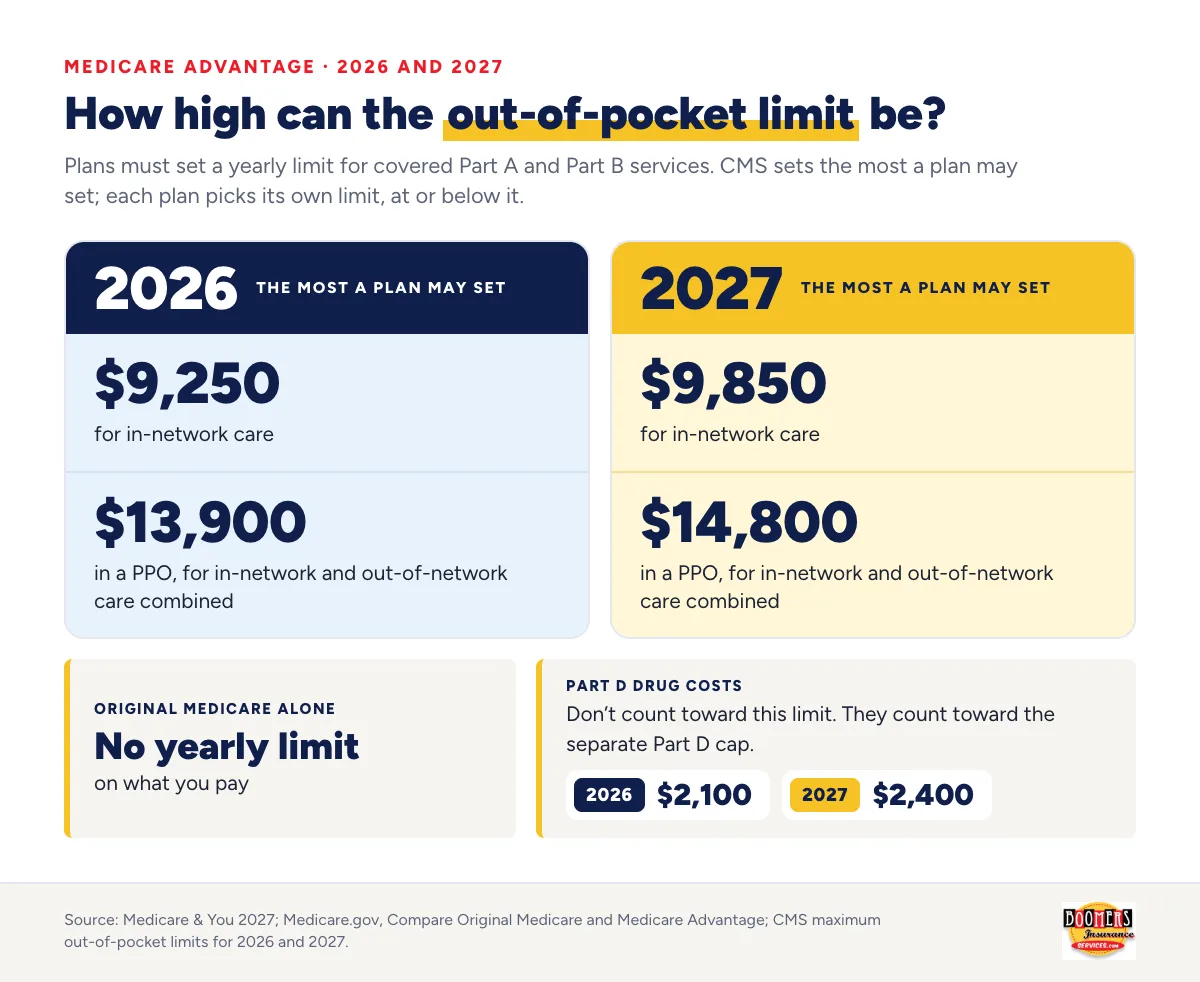
How high can the out-of-pocket limit be?
CMS sets the highest limit a plan may use. Each plan picks its own limit, at or below that maximum. For 2026, the maximum is $9,250 for in-network care. In a PPO, it is $13,900 for in-network and out-of-network care combined. For 2027, the maximums are $9,850 and $14,800.
Part D drug costs don't count toward this limit. They count toward the separate Part D cap, which is $2,100 in 2026 and $2,400 in 2027.
What are the disadvantages of Medicare Advantage plans, and when do they apply?
The other side of the trade-off is plan rules too. Medicare.gov and the handbook describe each one, and each comes with conditions. Whether a rule matters to you depends on how you use care and where you get it.
Rules about how you get care
- Provider networks. You may need to use doctors and hospitals in the plan's network for care that isn't an emergency. An HMO generally covers network care only, apart from emergencies and urgent care or short-term dialysis outside the service area. A PPO generally covers out-of-network care if the provider agrees to treat you and hasn't opted out of Medicare, usually at a higher cost.
- Referrals. You may need a referral from a primary care doctor to see a specialist. Many HMOs require one. In Original Medicare, in most cases, you don't need one.
- Prior authorization. For certain services, supplies or drugs, you may need the plan's approval before it covers them. Without approval, you may have to pay the full cost. If a plan denies coverage, it must tell you in writing, and you have the right to appeal. In Original Medicare, in most cases, you don't need prior approval.
Costs, travel and yearly changes
- Costs when you use a lot of care. You usually pay a copayment or coinsurance when you get a covered service, until you reach the plan's limit. In a year with a hospital stay or long treatment, those amounts can add up. You can't buy a Medigap policy to pay them.
- Service area and travel. In many plans, routine care is tied to the plan's network and service area. Emergency care is covered in or out of network. Plans generally don't cover care outside the U.S., though some add an emergency benefit for travel abroad. If you move out of the plan's service area for good, the plan must end your membership, unless it offers a way to stay enrolled. A move also gives you a Special Enrollment Period.
- Changes each year. Costs, benefits and rules can change each January. Your plan sends an Annual Notice of Change by September 30. Doctors can also leave a network during the year, and you usually can't change plans because of that. A plan can leave Medicare too; see what to do when a plan is ending.
- Going back later. If you leave for Original Medicare, a Medigap insurer may ask about your health. The switching section below explains when it can't.
Medicare Advantage vs Original Medicare with Medigap: costs and rules side by side
The table sets the two paths side by side. One is Original Medicare with a Medigap policy and a separate Part D drug plan. The other is a Medicare Advantage plan. It is a general guide, because costs and benefits differ by plan.
| Original Medicare + Medigap + Part D | Medicare Advantage | |
|---|---|---|
| Doctors and hospitals | Any doctor or hospital in the U.S. that takes Medicare | Often the plan's network; some plans cover out-of-network care, usually at a higher cost |
| Referrals and prior authorization | In most cases, not needed | May be needed, depending on the plan and the service |
| Monthly premiums | Part B, plus a Medigap premium and a drug plan premium | Part B, plus the plan's premium if it charges one |
| Costs when you get care | The Medigap policy pays some or most of your share, depending on its plan letter | Usually a copayment or coinsurance for covered services, up to the plan's limit |
| Yearly out-of-pocket limit | None in Original Medicare itself | Yes, set by the plan within the CMS maximum |
| Drug coverage | A separate Part D plan | Usually included |
| Extra benefits | Routine dental, vision and hearing generally aren't covered | Most plans offer some; generally limited |
| Travel in the U.S. | The same coverage anywhere a provider takes Medicare | Emergency care in or out of network; routine care depends on the plan's network |
| Your health when you join | In your 6-month Medigap open enrollment, an insurer can't turn you down or charge more because of your health; later, it may | You can join even with a pre-existing condition |
What do both paths have in common?
In both paths, you generally keep paying the Part B premium. For 2026, CMS set the standard premium at $202.90 a month. The 2027 amount had not been announced when this was written. For the Medicare Advantage pros and cons set against Medigap alone, read Medicare Advantage vs Medigap in California. New to Medigap? Start with Medicare vs Medigap.
Medicare Advantage plan pros and cons: which questions should you ask yourself?
There is no single right answer. These questions show which trade-offs matter most in your own case.
- Are your doctors and hospitals in the plan's network for 2027?
- Are your prescriptions on the plan's drug list?
- How do you prefer to pay: more in monthly premiums, or more when you get care? Costs depend on the plan.
- Could you pay the plan's out-of-pocket limit in a year of heavy care?
- Do you travel often, or live part of the year in another state?
- How do you feel about needing a referral or prior approval for some care?
- Might you want a Medigap policy later, if your health changes?
Mistakes to avoid when you compare
- Choosing by the premium alone. Add the copayments you expect and the out-of-pocket limit.
- Choosing by the extras alone. Check the limits on each extra benefit first.
- Skipping the network check. Call your doctor's office and ask about the exact plan.
- Ignoring quality. Medicare's Star Ratings score plans from 1 to 5 stars on quality and performance.
When can you switch if a plan doesn't fit?
You can leave a Medicare Advantage plan only at certain times. Medicare & You 2027 says that outside these times you generally keep your plan for the rest of the year.
- Open Enrollment, October 15 to December 7. You can join, switch or drop a plan. The change starts January 1. See our Annual Enrollment guide.
- Medicare Advantage Open Enrollment Period, January 1 to March 31. If you're already in a plan, you can make one change. You can pick another plan, or return to Original Medicare and join a drug plan. Our guide to this period has the details.
- A Special Enrollment Period. A move or another life event may let you change at other times. See Special Enrollment Periods.
Can you buy Medigap after leaving?
Sometimes without health questions, and sometimes not. Federal rules give you a 12-month "trial right" to buy Medigap when you return to Original Medicare in two cases:
- You joined a Medicare Advantage plan when you were first eligible for Part A at 65, and you switch to Original Medicare within the first year.
- You dropped a Medigap policy to join a Medicare Advantage plan for the first time, and you have been in the plan less than a year.
In these cases, an insurer must sell you certain Medigap policies. You can apply up to 60 days before your plan coverage ends, and no later than 63 days after. Other protections apply if your plan leaves Medicare or you move out of its service area.
What if you are outside those protected cases?
Outside your Medigap open enrollment and these protected cases, Medicare & You 2027 says you may not be able to buy a Medigap policy, or it may cost more. State law can add rights. In California, if you already have a Medigap policy, you get an annual window of at least 60 days beginning on your birthday. In it, you can switch to another Medigap plan with equal or lesser benefits without answering medical questions. The rule applies only if you already have a Medigap policy. Our guide on leaving a Medicare Advantage plan covers each step.
Next steps
The pros and cons of Medicare Advantage plans only mean something next to your own facts. Start there, then compare plans. You can also get help that isn't tied to any plan.
- List your doctors, hospitals, pharmacy and prescriptions.
- Compare plans at Medicare.gov, or call 1-800-MEDICARE (1-800-633-4227, TTY 1-877-486-2048), 24 hours a day, 7 days a week.
- Call HICAP, California's Health Insurance Counseling & Advocacy Program, at 1-800-434-0222 for one-on-one counseling.
- Read the plan's Evidence of Coverage before you join.
Talk with a licensed Boomers agent
A licensed Boomers agent can go over the Medicare plans we represent in your area and check them against your doctors and prescriptions.
Find a licensed agent near you · See upcoming Medicare events
Or call 1-800-815-1943 (TTY 711), Monday – Friday, 9 AM – 5 PM Pacific.
Frequently asked questions
What are the drawbacks of Medicare Advantage plans?
A plan may require you to use its network, get a referral to see a specialist, or get prior authorization for some care. You usually pay a copayment or coinsurance for covered services until you reach the plan's yearly limit. If you leave a plan later, the handbook says you may not be able to buy a Medigap policy, or it may cost more, depending on your state's rules and your situation. Each rule has conditions. The same plans offer one card, a yearly limit and, in most plans, built-in drug coverage.
Do Medicare Advantage plans cover what Original Medicare covers?
Largely, yes. Medicare & You 2027 says plans provide almost all medically necessary services that Original Medicare covers. Original Medicare still pays for hospice care, kidney transplant costs and some clinical research costs. Plans can set their own rules, such as networks and prior authorization.
Are the pros and cons of Medicare Advantage plans the same for everyone?
No. They depend on your doctors, your prescriptions, your health, how much you travel and how you like to pay for care. Plans also differ by where you live. A rule that is a drawback for one person may not matter to another.
Sources
- Compare Original Medicare and Medicare Advantage (Medicare.gov)
- Medicare & You 2027 handbook (Medicare.gov)
- Understanding Medicare Advantage Plans, April 2026 (Medicare.gov)
- Medicare Advantage Rates & Statistics: MOOP limit calculations for 2026 and 2027 (CMS.gov)
- 2026 Medicare Parts A & B premiums and deductibles (CMS.gov, November 14, 2025)
- Choosing a Medigap Policy, March 2026 (Medicare.gov)
- Joining a plan (Medicare.gov)
- Medicare Supplement Insurance "Medigap" (California Department of Insurance)
- Medicare Counseling (HICAP) (California Department of Aging)
Talk with a licensed Boomers agent
A licensed agent can go over the Medicare plans we represent in your area, check them against your doctors and prescriptions, and answer your questions. There is no cost to you and no obligation to enroll.
Monday – Friday, 9 AM – 5 PM PT