

Medicare Cost in 2027: What You Pay Now and What's Confirmed
How much Medicare costs depends on which parts you have. In 2026 the standard Part B premium is $202.90 a month and the Part A hospital deductible is $1,736. CMS has not yet announced the 2027 Part A and Part B amounts, while the 2027 Part D cap and a few other figures are confirmed. Here is your Me

How much does Medicare cost? It depends on which parts you have: Part A (hospital), Part B (medical), Part D (drugs), and whether you add a Medigap policy or join a Medicare Advantage plan. For 2026, CMS set the standard Part B premium at $202.90 a month, the Part B deductible at $283 and the Part A hospital deductible at $1,736 per benefit period. Most people pay Part A without a premium.
For 2027, CMS has not yet announced the Part A and Part B premiums and deductibles. It usually does that in November. The 2027 Part D figures and one Medigap figure are already confirmed, and they are listed below. We will update this page when CMS publishes the rest.
Medicare costs at a glance (2026)
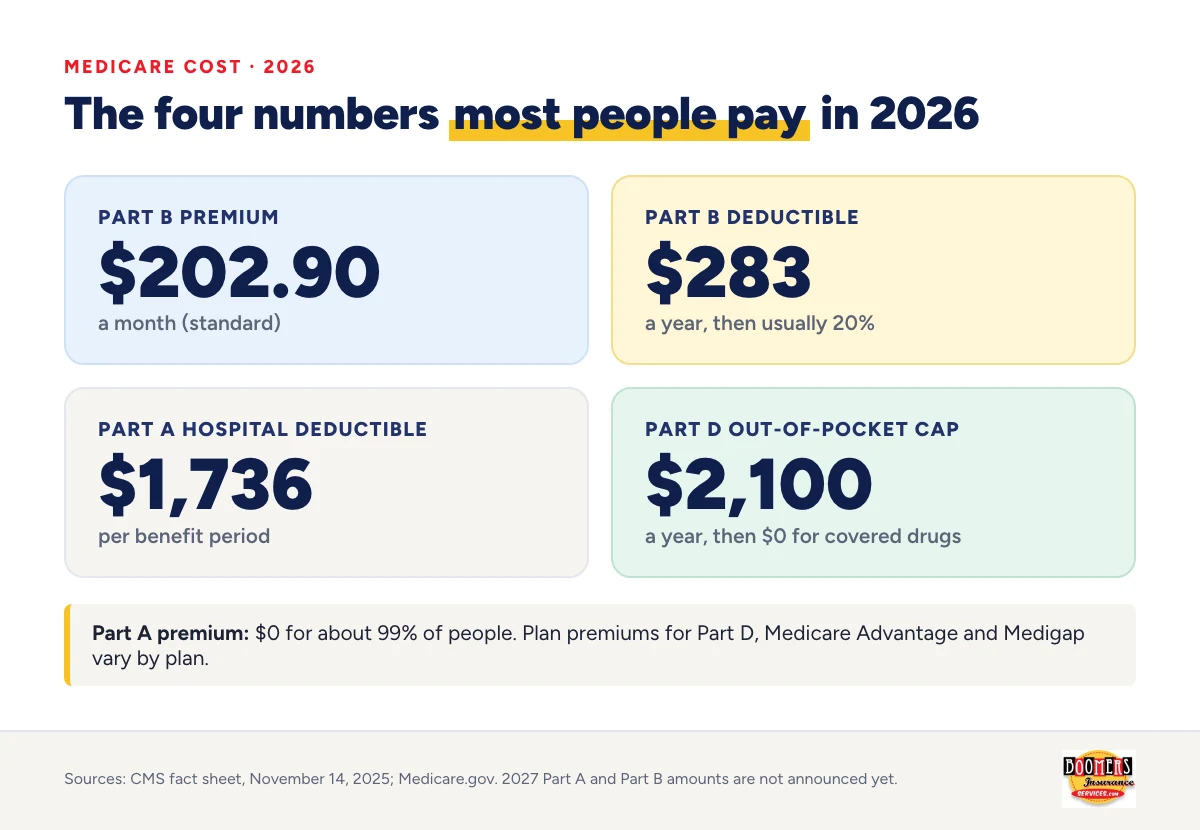
| Cost | 2026 amount | Who sets it |
|---|---|---|
| Part A premium | $0 for most people; $311 or $565 a month if you buy it | CMS |
| Part A hospital deductible | $1,736 per benefit period | CMS |
| Part B standard premium | $202.90 a month | CMS |
| Part B deductible | $283 a year | CMS |
| Part B coinsurance | Usually 20% after the deductible | Medicare |
| Part D out-of-pocket cap | $2,100 a year | Medicare |
| Part D premium | Varies by plan | Each plan |
| Medicare Advantage premium | Varies by plan; you still pay Part B | Each plan |
| Medigap premium | Varies by policy and where you live | Each insurer |
Sources: CMS fact sheet (November 14, 2025) and Medicare.gov. Plan premiums and copays are set by private companies that contract with Medicare, so we never list them here.
What does Medicare Part A cost?
Part A covers hospital stays, skilled nursing facility care, hospice and some home health care. According to CMS, about 99% of people pay no monthly premium for Part A because they or a spouse paid Medicare taxes for at least 40 quarters (about 10 years). If you or your spouse have 30 to 39 quarters, you can buy Part A for $311 a month in 2026; with fewer than 30 quarters it is $565 a month. Medicare.gov says you also need Part B to buy Part A.
What you pay when you use Part A in 2026:
- Hospital deductible: $1,736 for each benefit period, which covers days 1 to 60.
- Days 61 to 90: $434 a day.
- Lifetime reserve days (91 to 150): $868 a day, up to 60 days over your lifetime.
- Skilled nursing facility, days 21 to 100: $217 a day. Days 1 to 20 are $0.
A benefit period ends after 60 days in a row without inpatient or skilled nursing care, and you pay the deductible again if a new one starts.
What does Medicare Part B cost?
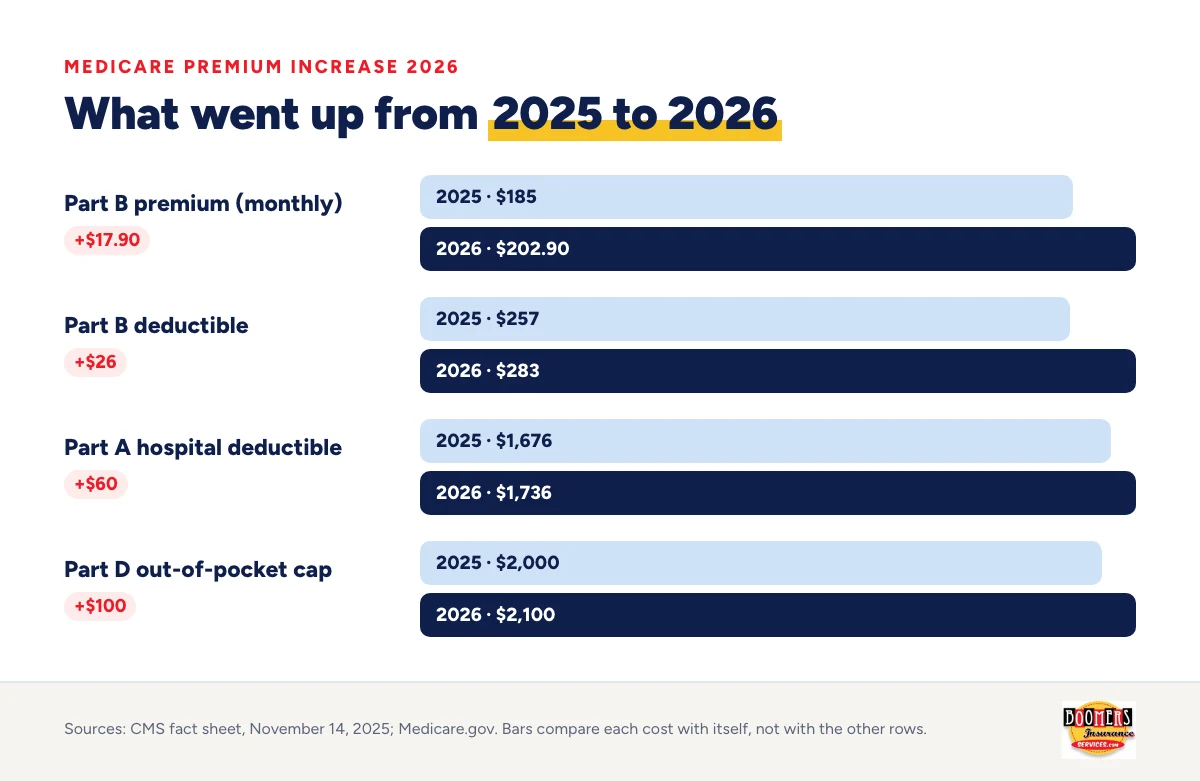
Part B covers doctor visits, outpatient care, lab tests and medical equipment. In 2026 the standard premium is $202.90 a month. That was the Medicare premium increase for 2026: up $17.90 from $185 in 2025. The yearly deductible rose from $257 to $283.
After you meet the deductible, you usually pay 20% coinsurance for covered services when your provider accepts Medicare's payment terms. Original Medicare has no yearly limit on what you pay out of pocket unless you have other coverage, such as a Medigap policy.
If your income is above a set level, you pay the standard premium plus a surcharge. Social Security calls it the income-related monthly adjustment amount, or IRMAA. The brackets are in the IRMAA section below.
What does Medicare Part D cost?
Part D is drug coverage from a stand-alone plan or built into a Medicare Advantage plan. Premiums, deductibles and copays vary by plan. Medicare.gov sets two limits for every year:
- Deductible: no plan can charge more than $615 in 2026 or $700 in 2027. Some plans charge less, or none.
- Out-of-pocket cap: $2,100 in 2026 and $2,400 in 2027. After you reach it, you pay $0 for covered Part D drugs for the rest of the year.
The national base beneficiary premium is $38.99 in 2026 and $41.33 in 2027 (CMS, July 28, 2026). This is not what you pay. It is the benchmark used to figure the Part D late enrollment penalty and the Part D income surcharge. CMS also said its Part D premium stabilization demonstration ends after 2026, so stand-alone drug plan premiums may change more than usual for 2027. Our guide to the Part D out-of-pocket cap and the Medicare Prescription Payment Plan explains how the cap works.
Medicare Advantage and Medigap costs
Medicare Advantage (Part C) plans are offered by private companies that contract with Medicare. Monthly plan premiums vary, and some plans have a $0 plan premium. Either way, Medicare.gov says you must keep paying your Part B premium to stay in the plan. Each plan sets its own copays and has a yearly limit on what you pay out of pocket for covered services. Once you reach it, the plan pays 100% for the rest of the calendar year. The limit varies by plan.
Medigap (Medicare Supplement) policies help pay the Part A and Part B deductibles and coinsurance. Medicare.gov says premiums vary by policy, by where you live and by other factors, and they can change each year. You pay the Medigap premium on top of your Part B premium. The high-deductible versions of Plans F and G have a yearly deductible set by CMS: $2,950 in 2026 and $3,050 in 2027.
Our Medicare Advantage vs. Medigap in California article compares the two.
What is IRMAA, the income-related monthly adjustment amount?
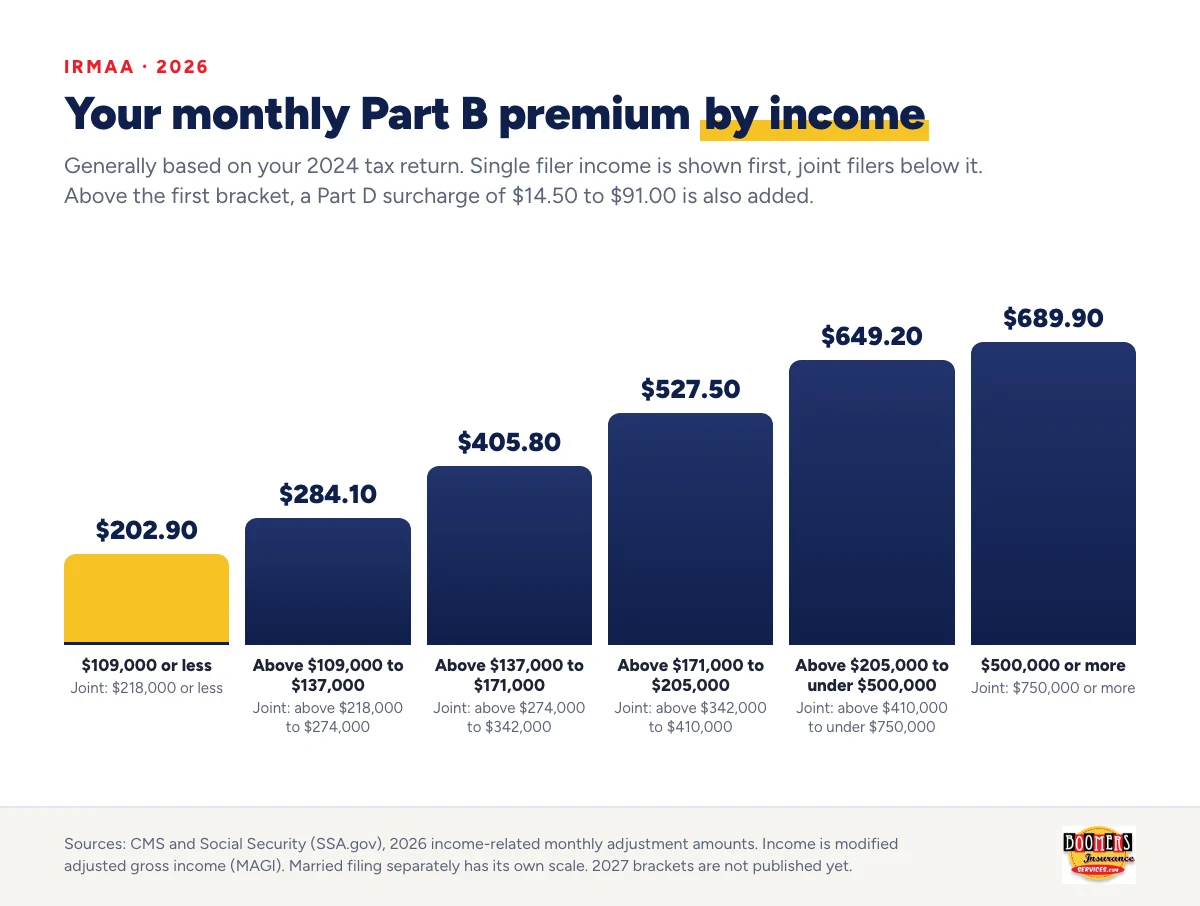
If your modified adjusted gross income (MAGI) is above a set level, you pay more for Part B and Part D. For 2026 the first bracket starts above $109,000 for a single filer and above $218,000 for a married couple filing jointly.
2026 IRMAA brackets for Part B and Part D
Here are the 2026 brackets from CMS and Social Security:
| Single filer MAGI | Joint filers MAGI | Part B surcharge | Total Part B premium | Part D surcharge |
|---|---|---|---|---|
| $109,000 or less | $218,000 or less | $0 | $202.90 | $0 |
| Above $109,000 to $137,000 | Above $218,000 to $274,000 | $81.20 | $284.10 | $14.50 |
| Above $137,000 to $171,000 | Above $274,000 to $342,000 | $202.90 | $405.80 | $37.50 |
| Above $171,000 to $205,000 | Above $342,000 to $410,000 | $324.60 | $527.50 | $60.40 |
| Above $205,000 to under $500,000 | Above $410,000 to under $750,000 | $446.30 | $649.20 | $83.30 |
| $500,000 or more | $750,000 or more | $487.00 | $689.90 | $91.00 |
Married people who lived together but file separately have their own two-step scale: a $446.30 Part B surcharge above $109,000 and $487.00 at $391,000 or more. The Part D surcharge is added to whatever your plan charges.
How IRMAA is decided, appealed and billed
Three things people often miss:
- It looks back two years. Social Security uses the latest tax return the IRS sends it. For 2026 that is generally the return filed in 2025 for tax year 2024. Your income this year sets your premiums two years from now.
- You can ask for a new decision after a life-changing event. If you married, divorced or lost a spouse, or you or your spouse stopped working or cut your hours, lost income-producing property, or lost pension income, Social Security may use your more recent income instead. File Form SSA-44 with proof of the event. A one-time gain, such as selling a house, is not on Social Security's list.
- Social Security bills it, not your plan. The Part B surcharge comes out of your Social Security payment, or Medicare bills you every three months. The Part D surcharge is also deducted from your Social Security payment, no matter how you pay your drug plan. If you get no Social Security payment, Medicare bills it monthly.
The 2027 IRMAA brackets have not been published yet. They normally arrive with the Part B premium in November.
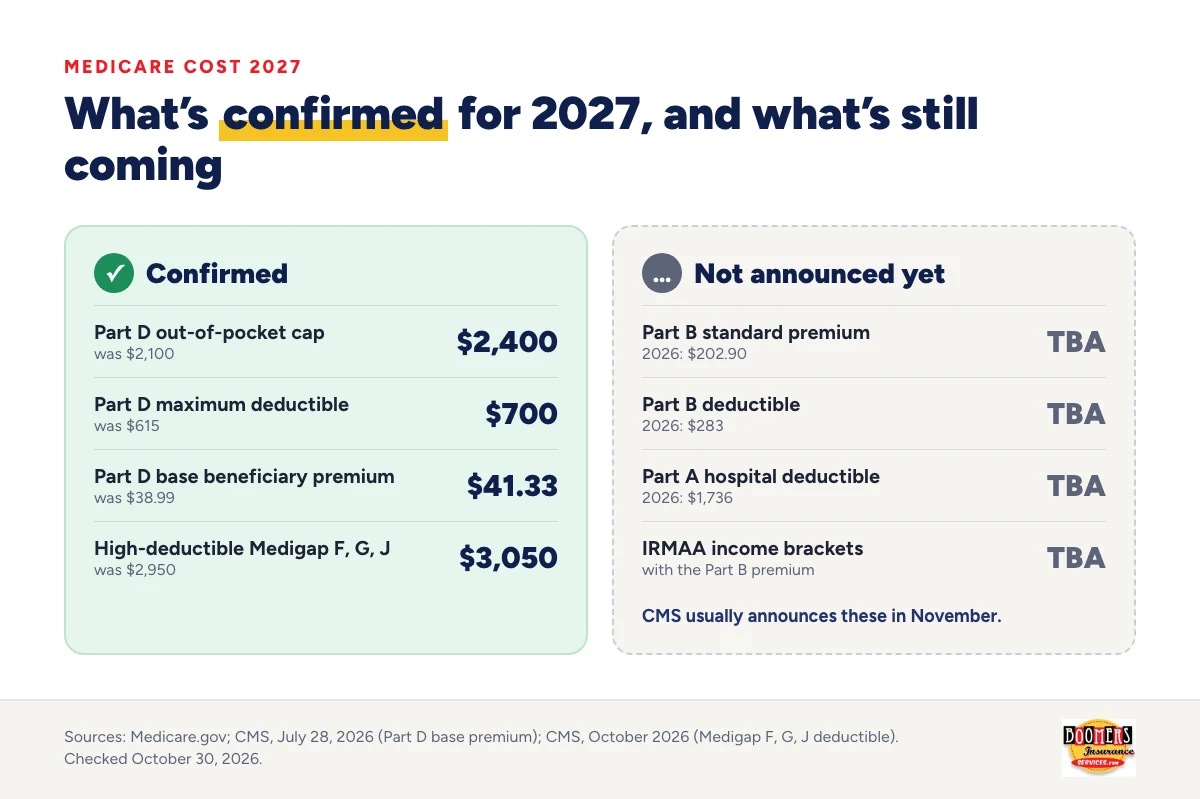
What is confirmed for 2027, and what is still coming?
| Figure | 2026 | 2027 | Status |
|---|---|---|---|
| Part B standard premium | $202.90 | Not announced yet | CMS usually announces in November |
| Part B deductible | $283 | Not announced yet | CMS usually announces in November |
| Part A hospital deductible | $1,736 | Not announced yet | CMS usually announces in November |
| IRMAA brackets | See table above | Not announced yet | Published with the Part B premium |
| Part D out-of-pocket cap | $2,100 | $2,400 | Confirmed (Medicare.gov) |
| Part D maximum deductible | $615 | $700 | Confirmed (Medicare.gov) |
| Part D national base beneficiary premium | $38.99 | $41.33 | Confirmed (CMS, July 28, 2026) |
| High-deductible Medigap Plans F, G and J deductible | $2,950 | $3,050 | Confirmed (CMS, October 2026) |
We checked this page on October 30, 2026. Anything you see elsewhere about a 2027 Part B premium is a projection, not a CMS figure.
Late enrollment penalties
Signing up late can add to your Medicare cost for years. Medicare.gov describes three penalties:
- Part A (only if you buy it): your premium may go up 10%, and you pay the higher amount for twice the number of years you waited.
- Part B: an extra 10% of the standard premium for each full 12-month period you could have had Part B but didn't. You pay it for as long as you have Part B.
- Part D: 1% of the national base beneficiary premium for each month you went without Part D or other creditable drug coverage, rounded to the nearest 10 cents and added to your premium for as long as you have drug coverage.
You generally avoid the Part B penalty if you qualify for a Special Enrollment Period, for example because you had job-based coverage. You don't pay the Part D penalty while you get Extra Help. Our turning 65 checklist walks through the sign-up dates.
Ways to lower your Medicare cost
- Medicare Savings Programs (QMB, SLMB and QI) help pay the Part B premium if your income and resources are limited. QMB also helps with deductibles and copays. In California you apply through Medi-Cal at your county office.
- Extra Help lowers Part D premiums, deductibles and copays. You apply through Social Security.
- Medi-Cal may cover some costs Medicare doesn't. California's Medi-Cal asset limit is $130,000 for one person through June 30, 2027, and drops to $21,000 for one person and $31,000 for two on July 1, 2027.
- Check your plan every fall. Premiums, drug lists and copays change each year, and Annual Enrollment (October 15 to December 7) is when you can switch. See our Annual Enrollment 2027 guide.
Our article on Extra Help and the Medicare Savings Programs explains who may qualify and how to apply. For counseling at no charge, call HICAP, California's Health Insurance Counseling & Advocacy Program, at 1-800-434-0222.
Frequently asked questions
How much does Medicare cost per month?
In 2026 most people pay the standard Part B premium of $202.90 a month and have Part A without a premium. Add your Part D plan premium or Medicare Advantage plan premium, if any, and a Medigap premium if you have one. People with higher incomes pay an IRMAA surcharge on top.
What is IRMAA?
IRMAA is the income-related monthly adjustment amount, a surcharge on Part B and Part D premiums for people whose income is above a set level. In 2026 it starts above $109,000 for a single filer and $218,000 for a joint return. Social Security decides it from your tax return from two years ago and bills it separately from your plan.
Will Medicare premiums go up in 2027?
CMS has not announced the 2027 Part B premium or deductible yet; it usually does in November. The 2027 Part D cap ($2,400) and the Part D base premium ($41.33) are confirmed and both are higher than in 2026. We will update this page when the rest is published.
Does Medicare Advantage cost extra?
It can. Some plans have a $0 plan premium and others charge one, and you keep paying your Part B premium either way. You also pay the plan's copays and coinsurance until you reach its yearly out-of-pocket limit, which varies by plan.
What were the Medicare costs for 2026 compared with 2025?
The Part B premium went from $185 to $202.90 a month, the Part B deductible from $257 to $283, and the Part A hospital deductible from $1,676 to $1,736. The Part D out-of-pocket cap rose from $2,000 to $2,100.
Can I lower my IRMAA if my income dropped?
You may. If a life-changing event such as retirement, divorce or the death of a spouse lowered your income, file Form SSA-44 with Social Security and ask for a new decision based on your more recent income. Social Security needs documents that show the event.
Talk with a licensed Boomers agent
A licensed Boomers agent can go over the Medicare plans we represent in your area and check them against your doctors and prescriptions. Annual Enrollment runs October 15 to December 7, so this is the time to review what your coverage will cost in 2027. Our help is at no cost to you.
Find a licensed agent near you · See upcoming Medicare events
Or call 1-800-815-1943 (TTY 711), Monday – Friday, 9 AM – 5 PM Pacific.
Sources
- 2026 Medicare Parts A & B premiums and deductibles (CMS.gov, November 14, 2025)
- Medicare costs (Medicare.gov)
- Costs for Medicare drug coverage (Medicare.gov)
- Avoid late enrollment penalties (Medicare.gov)
- Pay your Medicare premiums (Medicare.gov)
- Medicare Part D 2027 national average monthly bid amount information (CMS.gov, July 28, 2026)
- F, G & J deductible announcements (CMS.gov)
- Medicare premiums: rules for higher-income beneficiaries (SSA.gov)
- Medi-Cal asset limit (California Department of Health Care Services)
- Medicare counseling: HICAP (California Department of Aging)
Talk with a licensed Boomers agent
A licensed agent can go over the Medicare plans we represent in your area, check them against your doctors and prescriptions, and answer your questions. There is no cost to you and no obligation to enroll.
Monday – Friday, 9 AM – 5 PM PT