
When Should I Apply for Social Security? How Medicare Fits In
When should I apply for Social Security, and what happens to Medicare if I wait? The two programs have separate ages. Medicare generally starts at 65. Retirement benefits can start as early as 62, and full retirement age is between 66 and 67. You can sign up for just Medicare at 65.
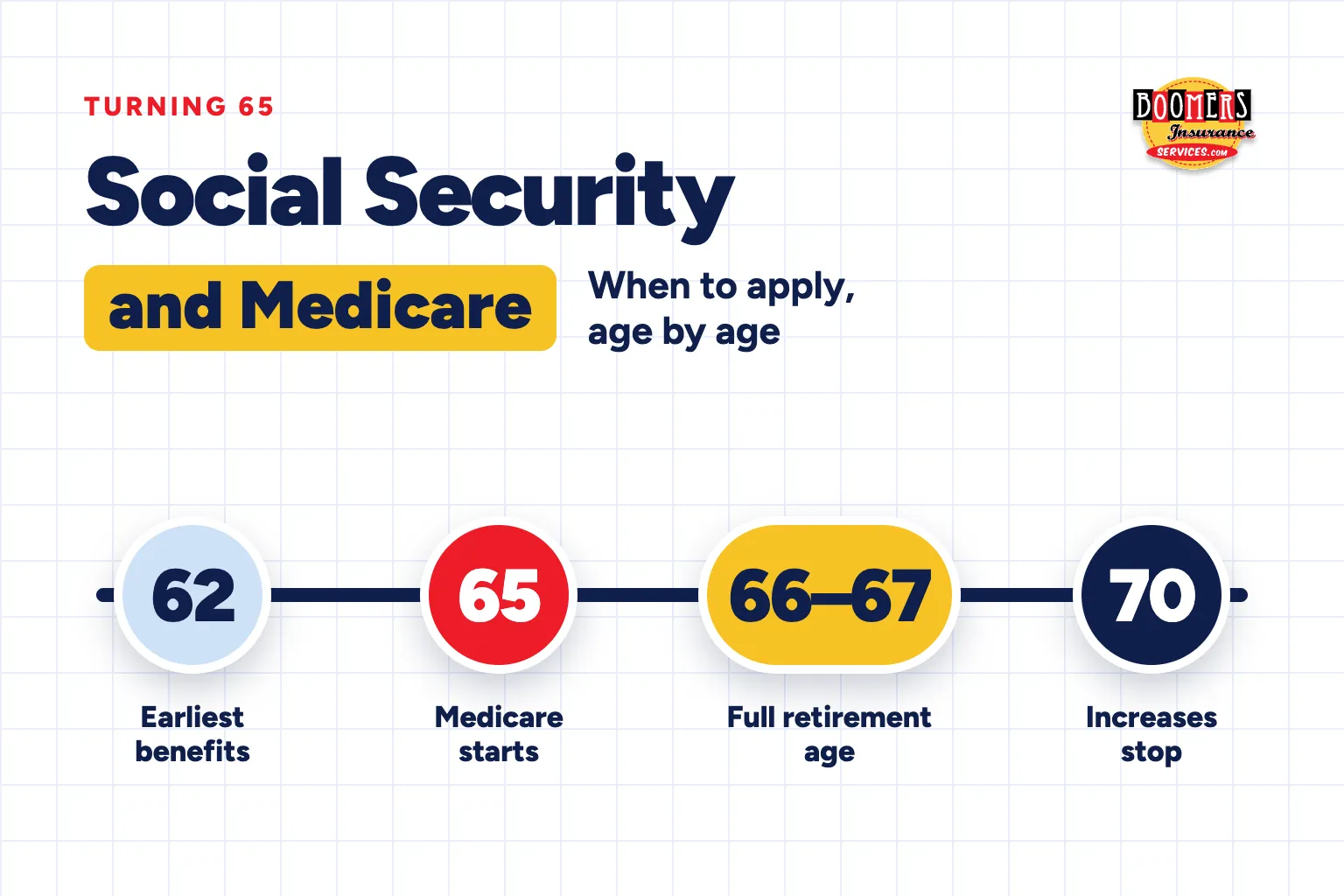
"When should I apply for Social Security?" is a question many people ask as 65 gets close, because Medicare starts around the same time. The two programs are linked, but they have separate ages and separate rules. Social Security handles enrollment in Medicare Part A and Part B. It also takes most people's Part B premium out of their monthly benefit.
This article shows how Medicare and Social Security work together in 2026 and 2027. It covers who gets Medicare without signing up, how to sign up for Medicare alone, full retirement age, premiums and notices about higher income. The rules come from Social Security, Medicare.gov and the Centers for Medicare & Medicaid Services (CMS). This isn't financial advice. When to start your benefits is your own choice. The tools at ssa.gov can show your own numbers.
How do Medicare and Social Security work together?
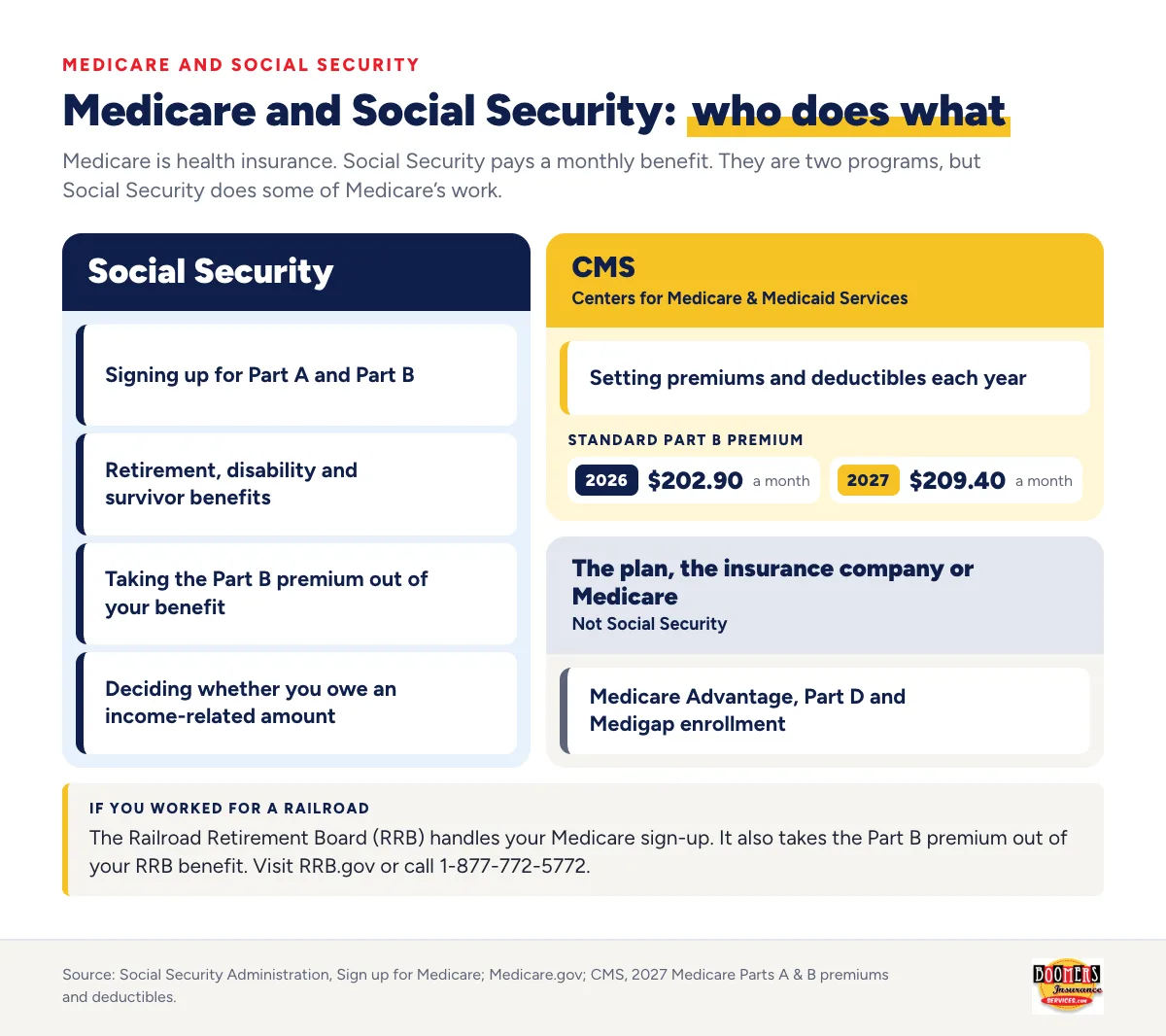
Medicare is health insurance. Social Security pays a monthly benefit. They are two programs, but Social Security does some of Medicare's work. The Social Security Administration (SSA) says you sign up for Part A and Part B through Social Security. Here is who does what:
| Task | Who handles it |
|---|---|
| Signing up for Part A and Part B | Social Security |
| Retirement, disability and survivor benefits | Social Security |
| Taking the Part B premium out of your benefit | Social Security |
| Deciding whether you owe an income-related amount | Social Security |
| Setting premiums and deductibles each year | CMS |
| Medicare Advantage, Part D and Medigap enrollment | The plan, the insurance company or Medicare, not Social Security |
If you worked for a railroad, the Railroad Retirement Board (RRB) handles your Medicare sign-up. It also takes the Part B premium out of your RRB benefit. Visit RRB.gov or call 1-877-772-5772.
When should I apply for Social Security if Medicare starts at 65?
The two dates don't have to match. Medicare generally starts at 65. Social Security says you can typically get retirement benefits starting at age 62, and your payment will be higher the longer you wait to apply, up to age 70.
Here are the rules on timing:
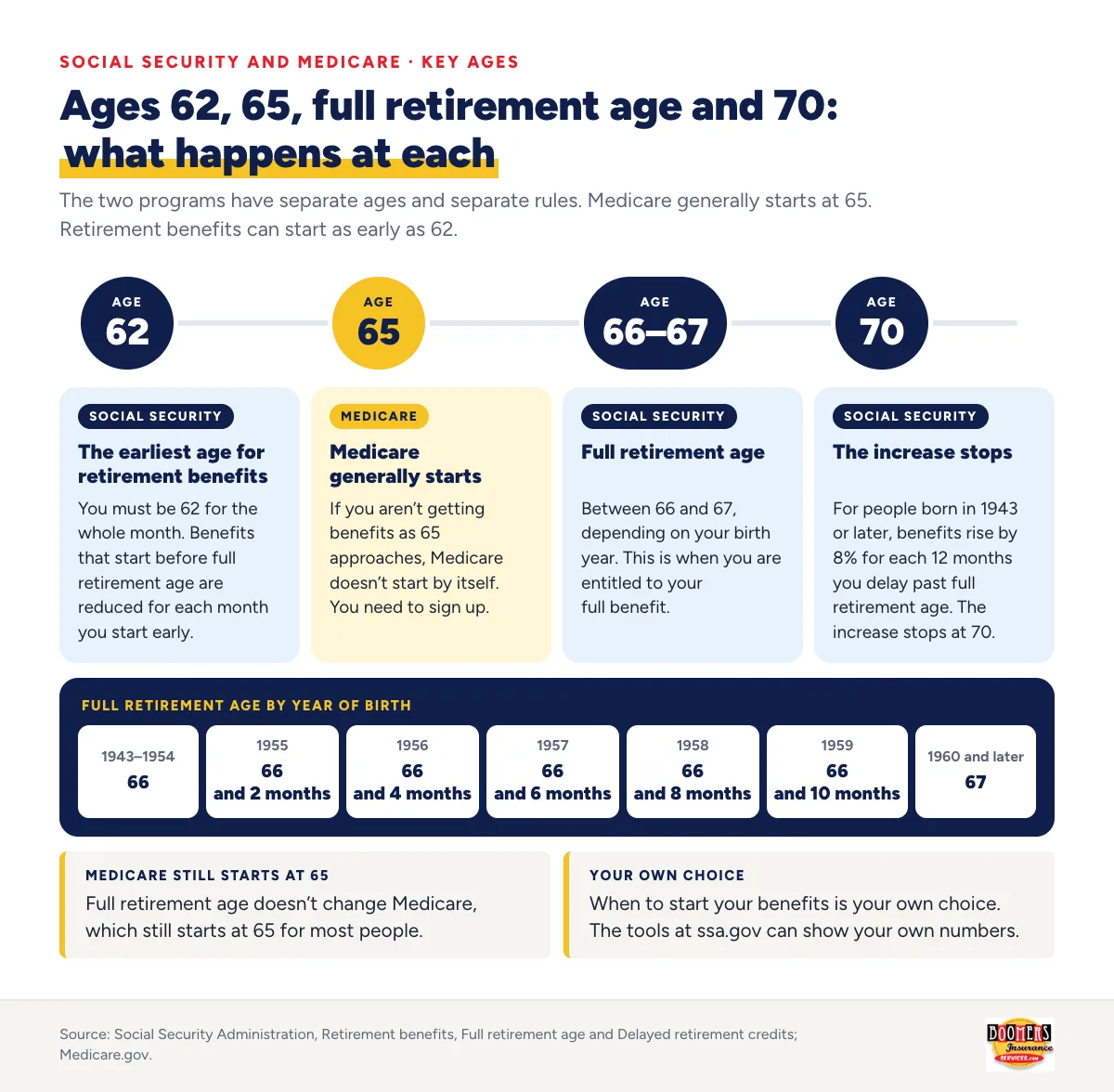
- Age 62: the earliest age for retirement benefits. You must be 62 for the whole month. Benefits that start before full retirement age are reduced for each month you start early.
- Full retirement age: between 66 and 67, depending on your birth year. This is when you are entitled to your full benefit.
- Up to age 70: for people born in 1943 or later, benefits rise by 8% for each 12 months you delay past full retirement age. The increase stops at 70.
- Applying: you can apply up to 4 months before the month you want benefits to begin. The first payment arrives the month after the month you choose.
Social Security says starting early has good and bad sides, and that each person's case is different. We don't advise on that choice. The tools at ssa.gov use your own work record to show what you would get.
What is full retirement age?
Full retirement age is the age at which Social Security pays your full retirement benefit. It depends on the year you were born.
| Year of birth | Full retirement age |
|---|---|
| 1943–1954 | 66 |
| 1955 | 66 and 2 months |
| 1956 | 66 and 4 months |
| 1957 | 66 and 6 months |
| 1958 | 66 and 8 months |
| 1959 | 66 and 10 months |
| 1960 and later | 67 |
If you were born on the 1st of a month, Social Security uses the month before. For January 1, that means the year before. Full retirement age doesn't change Medicare, which still starts at 65 for most people. Our article on Medicare eligibility and age explains who can get Medicare.
Is Medicare automatic if you already get Social Security?
Usually, yes. Medicare & You 2027 says that if you already get benefits from Social Security or the RRB, you get Part A and Part B without signing up. They start the first day of the month you turn 65. If your birthday is on the 1st, they start the month before. Medicare.gov's sign-up tool says this of people whose benefits began at least 4 months before they turn 65. This is often called automatic enrollment.
- Your card. It arrives in the mail 3 months before your 65th birthday.
- Part B is a choice. Most people keep Part B. If you don't want it, tell Medicare before the coverage start date on your card. If you do nothing, you keep Part B and pay its premium through your benefits.
- Puerto Rico. People who live there get Part A automatically but must sign up for Part B.
- Disability benefits. Under 65, Part A and Part B generally start automatically after 24 months of disability benefits.
If you turn down Part B, you may have to wait to get it later and pay a late enrollment penalty. If you have coverage from a job you still work at, read our article on Medicare and employer insurance first.
Can you sign up for just Medicare at 65 and delay Social Security?
Yes. You can sign up for Medicare and leave your benefits for later. Social Security's page on waiting past full retirement age says: if you decide to delay your retirement, be sure to sign up for just Medicare at age 65.
If you aren't getting benefits as 65 approaches, Medicare doesn't start by itself. You need to sign up:
- Know your window. Your Initial Enrollment Period lasts 7 months. It starts 3 months before the month you turn 65 and ends 3 months after it. If your birthday is on the 1st of the month, the window starts 4 months before the month you turn 65 and ends 2 months after it.
- Apply at ssa.gov/medicare/sign-up, or contact Social Security 3 months before you turn 65 to set up an appointment.
- Choose Medicare only. Social Security's sign-up page lets you enroll online in Part A and Part B, or in Part A only.
Social Security warns that if you don't sign up at 65, in some circumstances your Medicare coverage may be delayed and cost more. Our guide on how to sign up for Medicare walks through each step.
What happens to Medicare when you start benefits after 65?
Social Security says that if you are 65 or older and get its benefits, you will be enrolled in Part A. Social Security also says Part A can start up to 6 months before the month you apply. Medicare.gov adds that it can't start earlier than the month you turned 65. That look-back matters if you have a Health Savings Account (HSA). Social Security says that paying into an HSA after Medicare starts may lead to extra taxes.
Is Medicare deducted from Social Security?
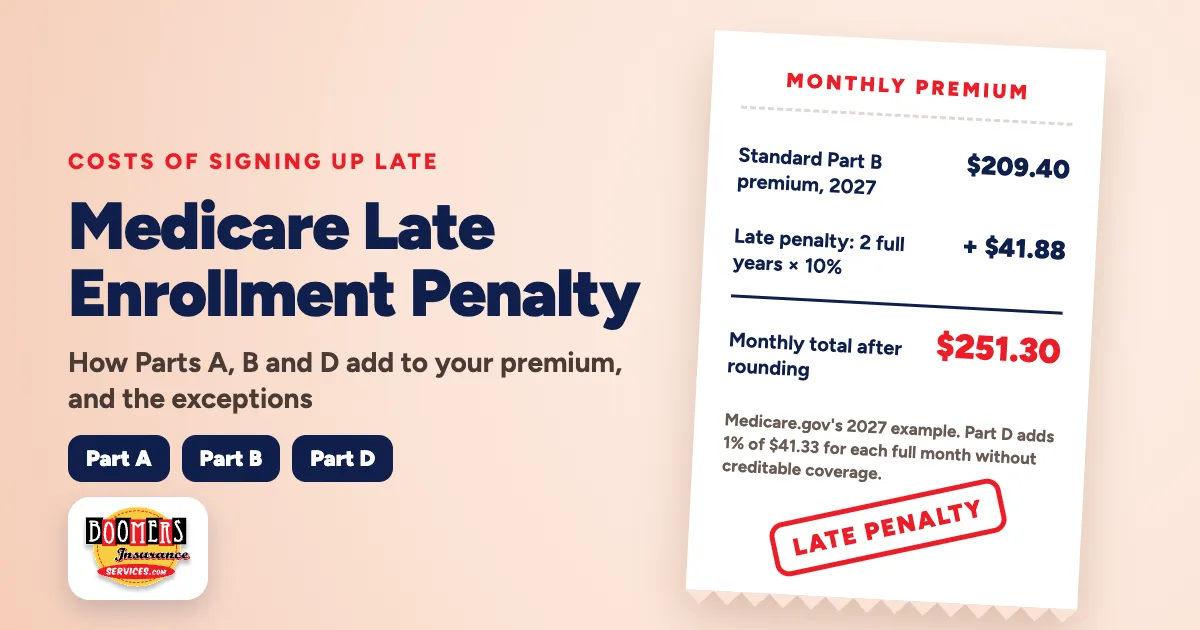
Yes, for most people. Medicare.gov says most people have their Part B premium taken out of their Social Security payment each month. CMS set the standard Part B premium at $202.90 a month for 2026 and $209.40 a month for 2027.
- If you get benefits: the Part B premium comes out of your monthly payment.
- If you don't get benefits yet: Medicare sends you a bill. For Part B only, the bill typically comes every 3 months. It comes monthly if you also pay a Part A premium or a Part D income-related amount, or if you use Medicare Easy Pay.
- Drug plan (Part D) premiums: these aren't deducted unless you ask. Contact your plan, not Social Security. Medicare.gov says it may take up to 3 months to start.
Most people pay nothing each month for Part A. CMS says about 99% of people with Medicare don't have a Part A premium, because they have at least 40 quarters of Medicare-covered work. Our article on what Medicare Part B is covers the premium and deductible in full.
What is the hold harmless rule for the Part B premium?
The hold harmless rule limits how much the Part B premium can rise for some people. It applies in a year when the premium goes up by more than their cost-of-living increase, so that their Social Security payment doesn't go down for that reason. It is in federal regulations at 42 CFR 408.20(e). Under that rule, a person can pay a lower, nonstandard premium only if all of these are true:
- They were entitled to Social Security benefits for November and December, and received the benefit payments for those months.
- The increase in the standard premium is greater than their cost-of-living increase.
- They don't have to pay an income-related monthly adjustment amount.
Social Security's rules add that the Part B premium must be taken out of those benefits. So the rule does not protect these groups:
- People who are new to Part B that year.
- People who get a bill instead of having the premium taken from their benefit.
- People whose state pays their Part B premium.
- People who pay an income-related amount.
A late enrollment penalty is still added on top.
For 2027, Social Security set a 3.6% cost-of-living increase. CMS raised the standard Part B premium by $6.50 a month. Whether the rule applies to you depends on the size of your own benefit. Social Security works that out. Check your yearly notice from Social Security, or call, to see what will come out of your payment.
Who sends IRMAA notices, Medicare or Social Security?
Social Security does. The income-related monthly adjustment amount (IRMAA) is an extra amount that people with higher incomes pay for Part B and Part D. Social Security decides if you owe it. It uses the tax return data it gets from the IRS. Then it mails you a letter with the amounts.
For 2027, CMS says the extra amount applies when modified adjusted gross income is above $112,000 on an individual tax return or $224,000 on a joint return. Social Security generally uses the tax return from 2 years earlier, so 2027 amounts are generally based on 2025 income.
If your income has dropped because of a life-changing event, you can ask Social Security to lower the amount. Social Security lists marriage, divorce, the death of a spouse, loss of income and an employer settlement payment as examples. The request uses Form SSA-44. Our article on the IRMAA brackets for 2027 has the full tables.
Next steps
Start by writing down two dates: the month you turn 65 and your full retirement age. Then work through these steps.
- Find your Medicare window. It runs from 3 months before your 65th birthday month to 3 months after (one month earlier if your birthday is on the 1st).
- Check whether Medicare will be automatic. It generally is if your benefits start at least 4 months before you turn 65.
- Look up your own benefit estimates in your account at ssa.gov. Social Security's phone number is 1-800-772-1213 (TTY 1-800-325-0778).
- Still working? Ask your benefits office how your job coverage works with Medicare before you delay Part B.
- Plan how you'll pay premiums if you won't be getting benefits yet.
- Choose how you'll get your coverage. Our Turning 65 checklist lists each step. In California, HICAP, the Health Insurance Counseling & Advocacy Program, answers Medicare questions at 1-800-434-0222.
Talk with a licensed Boomers agent
A licensed Boomers agent can go over the Medicare plans we represent in your area and check them against your doctors and prescriptions. We don't advise on when to start your benefits.
Find a licensed agent near you · See upcoming Medicare events
Or call 1-800-815-1943 (TTY 711), Monday – Friday, 9 AM – 5 PM Pacific.
Frequently asked questions
Do I have to take Social Security to get Medicare?
No. You can sign up for Medicare at 65 and start your benefits later. Social Security says that if you delay your retirement, be sure to sign up for just Medicare at age 65.
When should I apply for Social Security to have Medicare start on time?
Medicare doesn't wait for you to claim benefits. If you don't get benefits yet, sign up for Medicare in your Initial Enrollment Period. For the benefits themselves, you can apply up to 4 months before the month you want them to begin.
Do full retirement age and Medicare eligibility match?
No. Medicare generally starts at 65. Full retirement age is between 66 and 67, depending on your birth year. Retirement benefits can start as early as 62, but Medicare doesn't start early with them.
How do I pay the Part B premium if I haven't started benefits?
Medicare sends a bill. For Part B alone it comes every 3 months in most cases. You can pay online through your Medicare account or set up Medicare Easy Pay, among other ways. Once your benefits start, the premium comes out of them.
Who do I tell when I move?
Medicare & You 2027 says that if you get Social Security benefits, you change your address at ssa.gov. If you get RRB benefits, go to RRB.gov.
Sources
- Sign up for Medicare (Social Security Administration)
- When to sign up for Medicare (Social Security Administration)
- Retirement benefits (Social Security Administration)
- Full retirement age (Social Security Administration)
- Starting your retirement benefits early (Social Security Administration)
- Delayed retirement credits (Social Security Administration)
- Timing your first payment (Social Security Administration)
- Cost-of-living adjustment information for 2027 (Social Security Administration)
- Request to lower an IRMAA (Social Security Administration)
- How do I sign up for Medicare? (Medicare.gov)
- When does Medicare coverage start? (Medicare.gov)
- How to pay Part A and Part B premiums (Medicare.gov)
- How much does Medicare drug coverage cost? (Medicare.gov)
- Medicare & You 2027 handbook, pages 15–24 (Medicare.gov)
- 2027 Medicare Parts A & B premiums and deductibles (CMS.gov, November 17, 2026)
- 42 CFR 408.20, monthly premiums (eCFR)
- POMS HI 01001.004, the variable Part B premium (Social Security Administration)
- Medicare counseling: HICAP (California Department of Aging)
Talk with a licensed Boomers agent
A licensed agent can go over the Medicare plans we represent in your area, check them against your doctors and prescriptions, and answer your questions. There is no cost to you and no obligation to enroll.
Monday – Friday, 9 AM – 5 PM PT