
Medicare Eligibility: Age 65, Work Credits and Who Qualifies
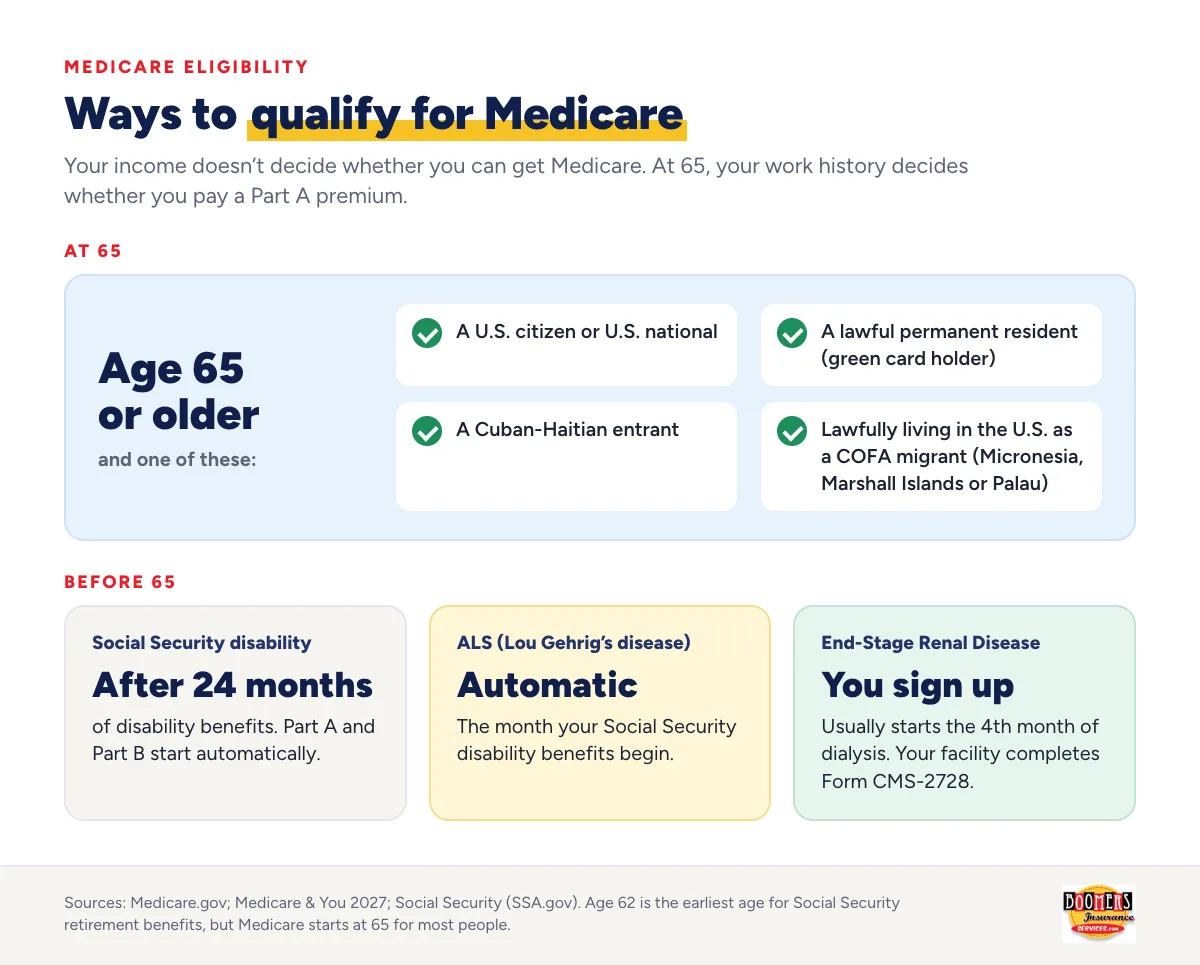
Medicare eligibility generally starts at age 65 for people who meet citizenship or residency requirements. Some people get Medicare sooner: after 24 months of Social Security disability benefits, or with ALS or End-Stage Renal Disease.

Medicare eligibility generally starts at age 65. You must also meet citizenship or residency requirements. Some people get Medicare sooner: after 24 months of Social Security disability benefits, or with ALS or End-Stage Renal Disease (ESRD). At 65, your work history doesn’t decide whether you can get Medicare. It decides whether you pay a premium for Part A.
Below, we explain who is eligible for Medicare in 2026, when you can sign up and what the rules mean for spouses. We also answer a common question: can you get Medicare at 62?
Medicare eligibility at a glance
Most people qualify for Medicare at 65, and some qualify sooner through a disability, ALS or ESRD. The table shows each route, whether you can get Medicare and when coverage usually starts:
| Your situation | Can you get Medicare? | When it usually starts |
|---|---|---|
| 65 or older, meeting citizenship or residency rules | Yes | The 1st of your birthday month (the month before if your birthday is on the 1st) if you already get Social Security; otherwise it depends on when you sign up |
| Under 65 with Social Security disability benefits | Yes, after a wait | After 24 months of disability benefits |
| ALS (Lou Gehrig’s disease) | Yes | The month your disability benefits start |
| End-Stage Renal Disease | Yes, if you sign up | Usually the 4th month of dialysis |
| 62 to 64, retired, no disability or ESRD | Generally no | At 65 |
What is the Medicare age?
The Medicare age is 65. That hasn’t changed, even though the full retirement age for Social Security is now later than 65. If you don’t already get benefits, Social Security says to contact it about three months before your 65th birthday.
So the basic Medicare qualifications are your age (or a disability) and your citizenship or residency status. Your income doesn’t matter for getting Medicare. It can raise what you pay for Part B and Part D, though.
Citizenship and residency rules
Medicare & You 2027 lists a new rule. To get Part A and Part B, or to join a Medicare health or drug plan, you must be one of these:
- a U.S. citizen or U.S. national
- a lawful permanent resident (green card holder)
- a Cuban-Haitian entrant
- lawfully living in the U.S. as a COFA migrant (from the Federated States of Micronesia, the Marshall Islands or Palau)
If you aren’t sure how this applies to you, ask Social Security before you sign up.
Can you get Medicare at 62?
Generally, no. Age 62 is the earliest age for Social Security retirement benefits, but Medicare starts at 65 for most people. Before 65, you can get Medicare only through a disability, ALS or ESRD.
If you retire at 62, you will need other health coverage until 65. Options may include a retiree or COBRA plan, the Health Insurance Marketplace (Covered California if you live in California), or Medicaid (Medi-Cal) if your income is low enough. Medicare & You 2027 says to sign up for Medicare when you’re first eligible even if you have Marketplace coverage. End the Marketplace plan before Medicare starts, so you aren’t paying for both.
Who qualifies for Medicare before 65?
Three groups can get Medicare before the Medicare age: people who have had Social Security disability benefits for 24 months, people with ALS, and people with ESRD. How you get Medicare differs for each:
- Social Security disability benefits: you get Part A and Part B automatically after 24 months of disability benefits. The same applies to certain Railroad Retirement disability benefits.
- ALS: you get Part A and Part B automatically the month your Social Security disability benefits begin.
- ESRD: you must sign up. Your dialysis facility completes a form from the Centers for Medicare & Medicaid Services (CMS-2728), asks you to sign it and sends it to Social Security.
Most people who get Medicare before 65 don’t pay a Part A premium. Some people with a disability who return to work may later have to buy Part A. Our guide to Medicare under 65 covers each route and the California Medigap rules.
Work credits and what Medicare costs
You earn work credits by working and paying Social Security and Medicare taxes. In 2026, you get one credit for each $1,890 you earn, up to four a year. Credits don’t decide whether you can get Medicare at 65, but they decide whether you pay a premium for Part A.
Do you need work credits to get Medicare?
At 65, no, but work credits decide what Part A costs. Before 65, the disability routes depend on a work record. Most people pay no Part A premium because they or a spouse paid Medicare taxes long enough while working. Medicare.gov says that is generally at least 10 years. CMS says about 99% of people with Medicare have no Part A premium, because they have at least 40 quarters of work.
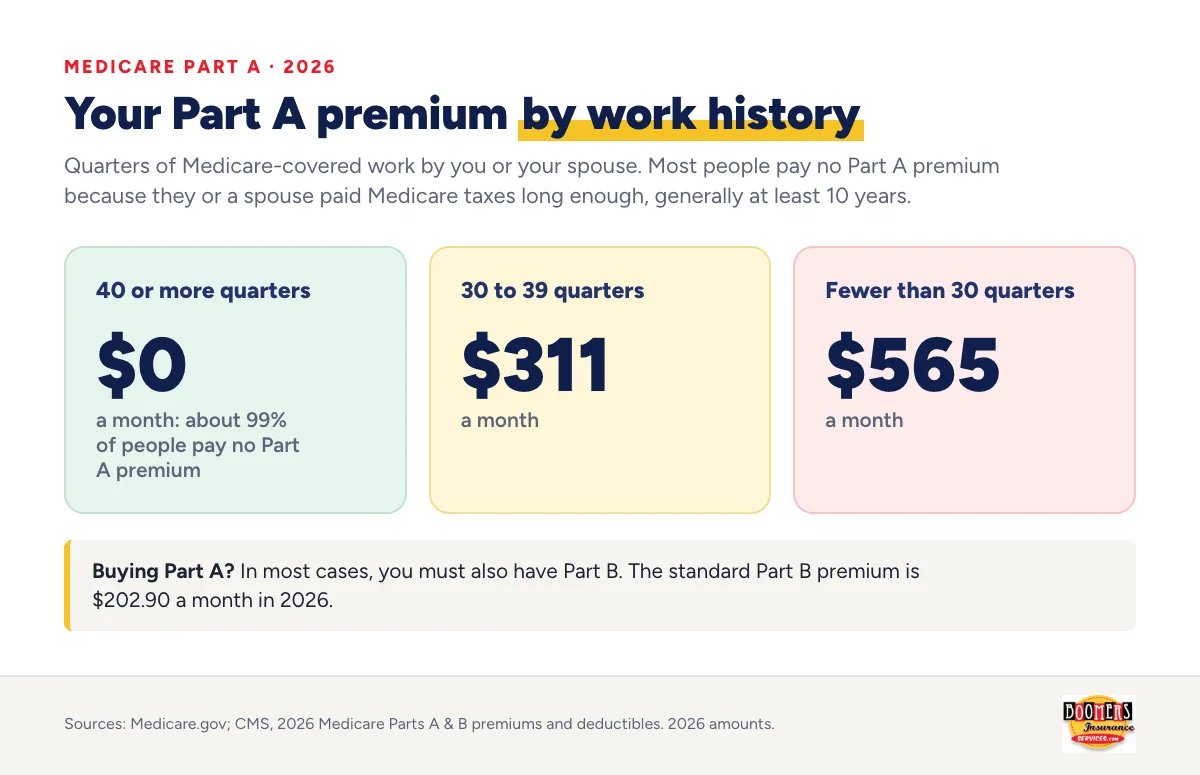
If you don’t have enough work, you may be able to buy Part A. In 2026, the monthly premium depends on how long you or your spouse paid Medicare taxes:
| Quarters of Medicare-covered work (you or your spouse) | Part A premium in 2026 |
|---|---|
| 40 or more | You don’t pay a Part A premium |
| 30 to 39 | $311 a month |
| Fewer than 30 | $565 a month |
In most cases, to buy Part A you must also have Part B. You can buy Part B alone, though. The standard Part B premium is $202.90 a month in 2026, and people with higher incomes pay more. Our Medicare costs guide lists the 2026 amounts and the 2027 ones announced so far.
When can you sign up for Medicare?
If you already get Social Security or Railroad Retirement benefits, you are enrolled in Part A and Part B automatically. Coverage starts the 1st of the month you turn 65 (or the month before, if your birthday is on the 1st). Your Medicare card arrives about 3 months before your birthday. Everyone else signs up during one of these windows:
- Initial Enrollment Period: 7 months. It starts 3 months before the month you turn 65 and ends 3 months after it. Sign up in the first 3 months, and coverage usually starts your birthday month. Sign up later, and it starts the month after you sign up.
- Special Enrollment Period: if you have job-based coverage from your own or your spouse’s current work, you can sign up while you have it. You also get 8 months, starting the month after the job or the coverage ends (whichever comes first). COBRA, retiree plans and VA coverage don’t count as job-based coverage.
- General Enrollment Period: January 1 to March 31 each year, if you missed the other windows. Coverage starts the month after you sign up.
If your birthday is on the 1st, your 7-month window and start date move one month earlier. Signing up late can bring a Part B penalty of 10% for each full 12-month period you could have had Part B but didn’t sign up. You usually pay it for as long as you have Part B.
To sign up, visit SSA.gov/medicare/sign-up or call Social Security at 1-800-772-1213 (TTY 1-800-325-0778). Railroad workers call the RRB at 1-877-772-5772. Our Turning 65 checklist puts the steps in order. Still working? Read Medicare and employer insurance and our guide to Medicare Special Enrollment Periods.
Choosing your coverage once you’re eligible
Being eligible is the first step. Next, you choose how to get your coverage: Original Medicare (Part A and Part B), usually with a drug plan and sometimes a Medigap policy, or a Medicare Advantage plan from a private company that contracts with Medicare.
- Drug coverage: if you don’t have creditable coverage, meaning drug coverage expected to pay at least as much as Medicare’s standard drug coverage, join a drug plan when you’re first eligible to avoid the Part D late penalty.
- Medigap: your Medigap Open Enrollment Period is the 6 months that start the month you’re 65 or older and have Part B. Insurers can’t turn you down or charge more for health problems then.
- Medicare Advantage: you need Part A and Part B and must live in the plan’s service area.
Our article on Medicare Advantage vs Medigap compares the two paths.
Medicare eligibility for spouses
Medicare covers one person at a time. There is no family plan, so each spouse qualifies on their own. A younger spouse can’t join your Medicare. They get Medicare when they reach 65, or sooner through a disability, ALS or ESRD.
Your work can still help your spouse, though. Social Security says you can get Part A without a premium at 65 if your spouse receives, or is eligible to receive, Social Security benefits. That includes a spouse who has died and, in some cases, a former spouse. Social Security can tell you whether a former spouse’s record counts for you.
If your spouse is on your job’s health plan, plan ahead before you retire. Their coverage may end when yours does, and they may need their own plan until 65.
Mistakes to avoid as 65 gets close
Medicare’s late penalties come from timing: being eligible and not signing up when you should have. Watch for these:
- Treating COBRA or retiree coverage as job coverage. Neither one lets you delay Part B without a penalty.
- Paying into a Health Savings Account (HSA) after Medicare starts. Part A can start up to 6 months back when you sign up after 65, so stop contributions about 6 months before you sign up.
- Going without drug coverage. After 63 days or more without creditable coverage, a Part D penalty may apply.
Next steps
A few steps in the year before you turn 65 make signing up easier. Start with these:
- Mark your 7-month window. It opens 3 months before the month you turn 65.
- Check your work record. Your Social Security statement at SSA.gov/myaccount shows your earnings history.
- Still working at 65? Ask your employer how its plan works with Medicare.
- Retiring before 65? Line up coverage until Medicare starts, for you and your spouse.
- In California, HICAP offers one-on-one Medicare counseling at 1-800-434-0222.
Talk with a licensed Boomers agent
A licensed Boomers agent can go over the Medicare plans we represent in your area and check them against your doctors and prescriptions. We can also walk you through your sign-up dates before your window opens.
Find a licensed agent near you · See upcoming Medicare events
Or call 1-800-815-1943 (TTY 711), Monday – Friday, 9 AM – 5 PM Pacific.
Frequently asked questions
How old do you have to be to get Medicare?
Most people get Medicare at 65. You can get it sooner after 24 months of Social Security disability benefits, or if you have ALS or ESRD. Taking Social Security early doesn’t start Medicare early.
Who is eligible for Medicare if they never worked?
You may still be able to get Medicare at 65 if you meet the citizenship or residency rules. You may get Part A without a premium through a spouse’s work record. If not, you may be able to buy Part A and Part B (if you aren’t a U.S. citizen, ask Social Security whether you meet the residency rules), and a state Medicare Savings Program may help pay the premiums if your income is limited.
Do I have to sign up for Medicare at 65 if I’m still working?
Not always. If you have health coverage from your own or your spouse’s current job, you may be able to wait for Part B without a penalty. Ask your employer how its plan works with Medicare first.
Is Medicare eligibility based on income?
No. Medicare eligibility depends on age or disability and on citizenship or residency, not income. Income can raise your Part B and Part D premiums. It also matters for programs that help pay Medicare costs, such as Medicaid and Extra Help.
Sources
- Get started with Medicare (Medicare.gov)
- Medicare & You 2027 handbook (Medicare.gov)
- When can I sign up for Medicare? (Medicare.gov)
- Medicare costs (Medicare.gov)
- Avoid late enrollment penalties (Medicare.gov)
- 2026 Medicare Parts A & B premiums and deductibles (CMS.gov)
- Medicare, publication EN-05-10043 (SSA.gov)
- Retirement Benefits, publication EN-05-10035 (SSA.gov)
- Sign up for Medicare (SSA.gov)
- Medicare counseling: HICAP (California Department of Aging)
Talk with a licensed Boomers agent
A licensed agent can go over the Medicare plans we represent in your area, check them against your doctors and prescriptions, and answer your questions. There is no cost to you and no obligation to enroll.
Monday – Friday, 9 AM – 5 PM PT