
Medicare Late Enrollment Penalties: Part D Penalty Calculator Steps
Looking for a Part D penalty calculator? You can do the math yourself: 1% of the national base beneficiary premium ($38.99 in 2026, $41.33 in 2027) for each full month without Part D or other creditable drug coverage, rounded to the nearest $0.10. Here is each step, plus the Part A and B penalties.
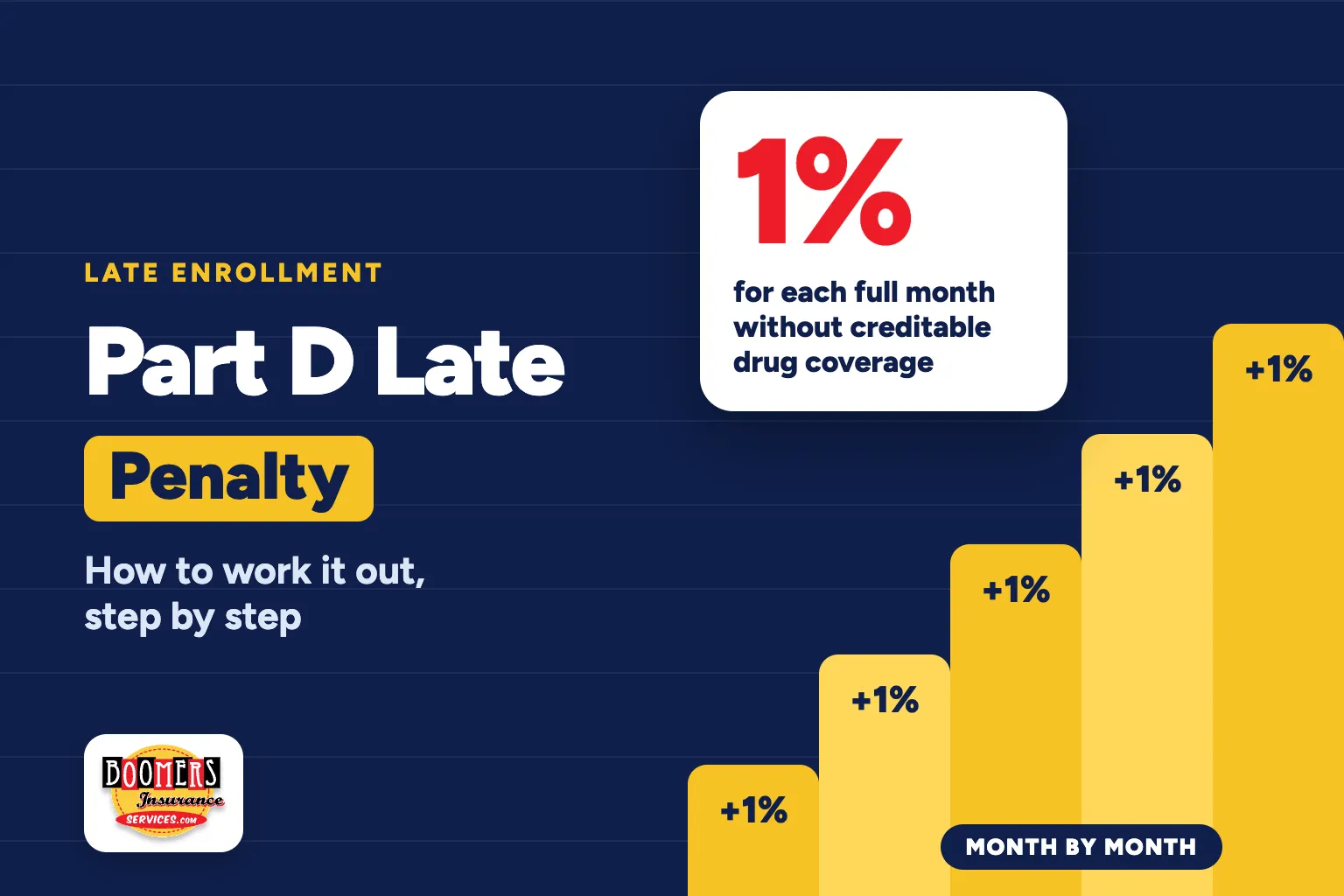
People search for a Part D penalty calculator because they want one number: how much a late start adds to a monthly premium. This page is not an online tool. It gives you Medicare's own formula, step by step, with the 2026 and 2027 figures, so you can work the number out on paper.
It also covers the other two Medicare late enrollment penalties, for Part A and Part B. The rules come from Medicare.gov, the Medicare & You 2027 handbook and the Centers for Medicare & Medicaid Services (CMS).
What is a Medicare late enrollment penalty?
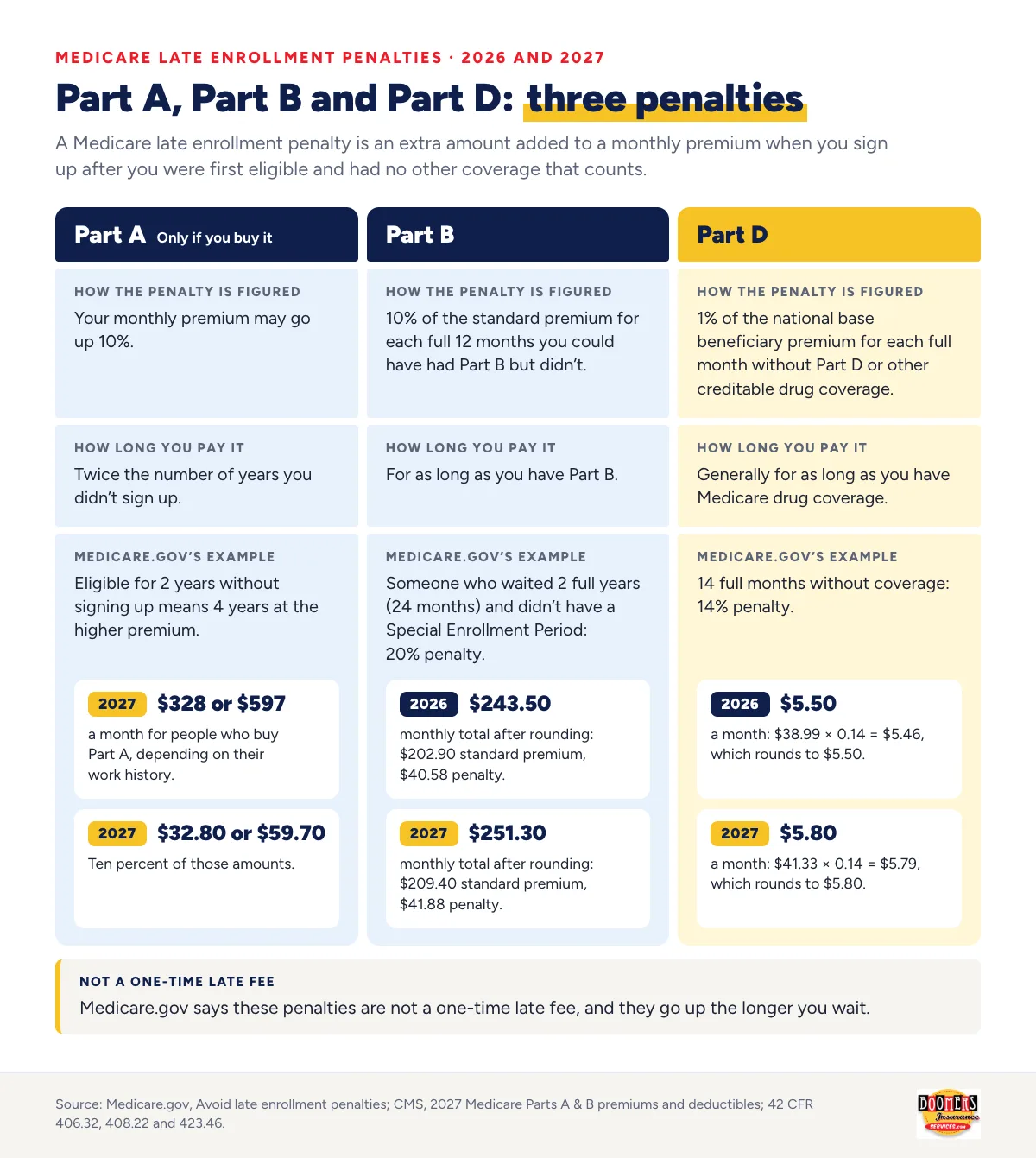
A Medicare late enrollment penalty is an extra amount added to a monthly premium when you sign up after you were first eligible and had no other coverage that counts. Medicare.gov says these penalties are not a one-time late fee, and they go up the longer you wait. Our Medicare late enrollment penalty guide explains why they exist and the exceptions.
| Part | How the penalty is figured | How long you pay it |
|---|---|---|
| Part A (only if you buy it) | Your monthly premium may go up 10% | Twice the number of years you didn't sign up |
| Part B | 10% of the standard premium for each full 12 months you could have had Part B but didn't | For as long as you have Part B |
| Part D | 1% of the national base beneficiary premium for each full month without Part D or other creditable drug coverage | Generally for as long as you have Medicare drug coverage |
Your first chance to sign up is your Initial Enrollment Period (IEP). It lasts 7 months around the month you turn 65. Our guide on how to sign up for Medicare walks through it.
Part D penalty calculator: how does the math work?
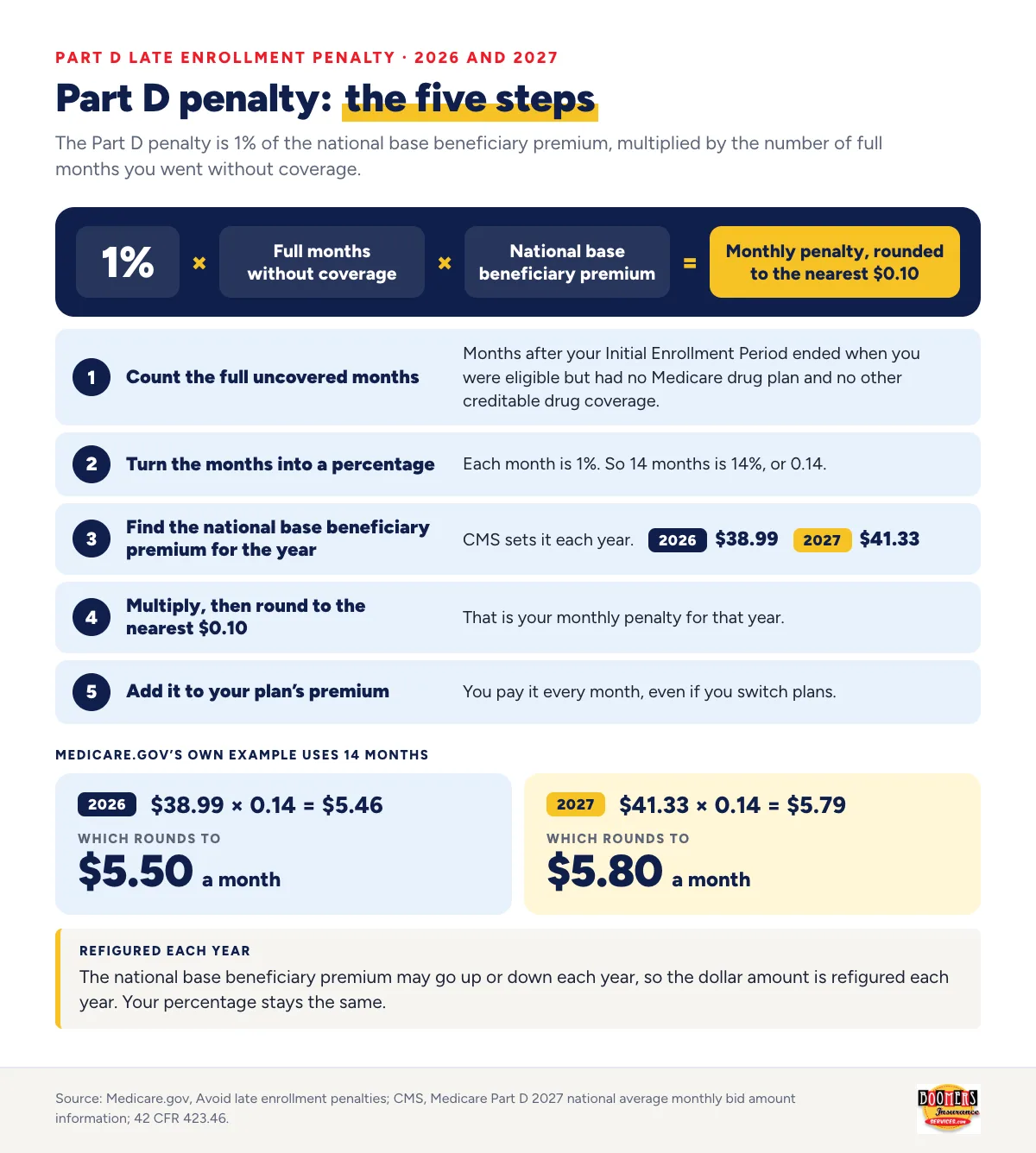
The Part D penalty is 1% of the national base beneficiary premium, multiplied by the number of full months you went without coverage. Medicare rounds the result to the nearest $0.10 and adds it to your plan's monthly premium. You can do it in five steps.
- Count the full uncovered months. These are months after your Initial Enrollment Period ended when you were eligible but had no Medicare drug plan and no other creditable drug coverage.
- Turn the months into a percentage. Each month is 1%. So 14 months is 14%, or 0.14.
- Find the national base beneficiary premium for the year. CMS sets it each year. It is $38.99 in 2026 and $41.33 in 2027.
- Multiply, then round to the nearest $0.10. That is your monthly penalty for that year.
- Add it to your plan's premium. You pay it every month, even if you switch plans.
Medicare.gov's own example uses 14 months. In 2026, $38.99 × 0.14 = $5.46, which rounds to $5.50 a month. In 2027, $41.33 × 0.14 = $5.79, which rounds to $5.80 a month.
Part D penalty examples for 2026 and 2027
The table below applies the same formula to other gaps. The 14-month row is Medicare.gov's example. The other rows are our own arithmetic with Medicare's formula, so treat them as estimates.
| Full months without coverage | Penalty | Monthly amount in 2026 ($38.99) | Monthly amount in 2027 ($41.33) |
|---|---|---|---|
| 12 | 12% | $4.70 | $5.00 |
| 14 | 14% | $5.50 | $5.80 |
| 24 | 24% | $9.40 | $9.90 |
| 36 | 36% | $14.00 | $14.90 |
| 60 | 60% | $23.40 | $24.80 |
The national base beneficiary premium may go up or down each year, so the dollar amount is refigured each year. Your percentage stays the same. Any Part D penalty calculator should follow this same formula. If one gives a different answer, trust the formula and ask your plan. Your plan tells you the actual amount after you join.
Who can owe the Medicare Part D penalty?
You may owe the Medicare Part D penalty if, after your Initial Enrollment Period ends, you go 63 days or more in a row without Medicare drug coverage or other creditable drug coverage. People who get Extra Help don't pay it.
Creditable drug coverage is coverage expected to pay, on average, at least as much as Medicare drug coverage. Medicare.gov says you might already have it from:
- a current or former employer or union
- TRICARE or the Department of Veterans Affairs (VA)
- the Indian Health Service
Your plan must tell you each year whether its drug coverage is creditable. Keep those notices. Doctor samples, discount cards and drug discount websites aren't drug coverage.
When you join a Medicare drug plan, the plan may send a letter asking about your earlier coverage. Medicare.gov says you must complete the form and return it by the deadline. If you don't, you may be charged a penalty. Our guide to what Medicare Part D is explains the coverage itself.
How much does the Part B penalty cost?
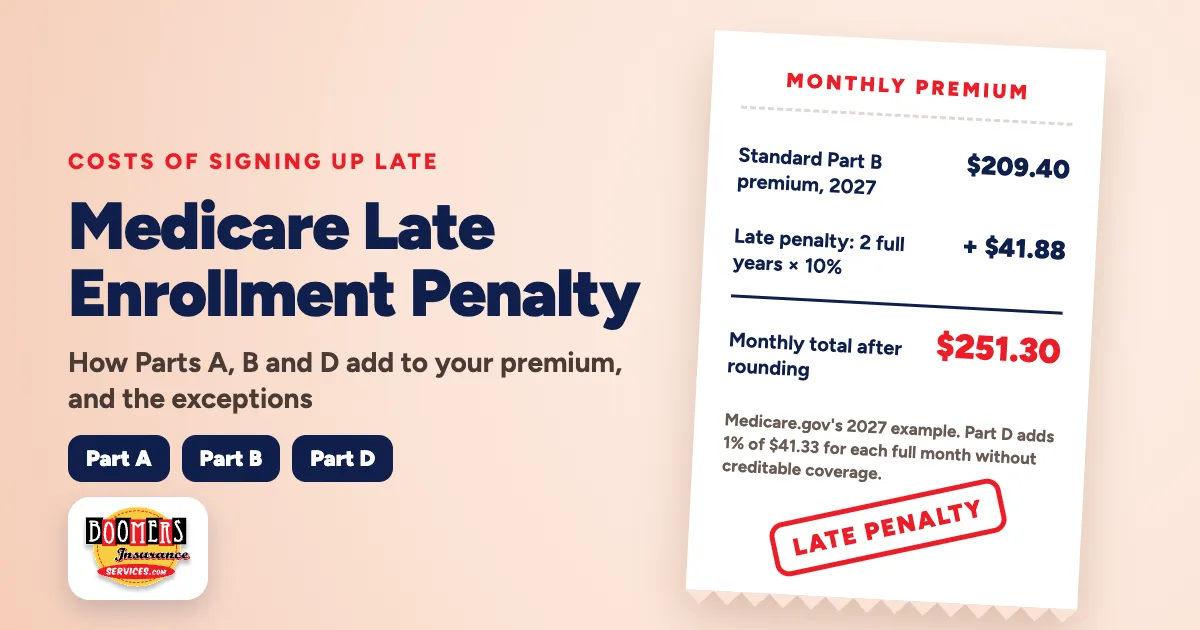
The Part B penalty adds 10% of the standard premium for each full 12-month period you could have had Part B but didn't sign up. You pay it on top of the standard premium, for as long as you have Part B.
Medicare.gov gives this example for someone who waited 2 full years (24 months) and didn't have a Special Enrollment Period (SEP):
| Year | Standard Part B premium | 20% penalty | Monthly total after rounding |
|---|---|---|---|
| 2026 | $202.90 | $40.58 | $243.50 |
| 2027 | $209.40 | $41.88 | $251.30 |
Only full 12-month periods count. The total is rounded to the nearest $0.10. People with higher incomes may also pay an Income-Related Monthly Adjustment Amount (IRMAA), which is a separate charge. See our guide to what Medicare Part B is for what the premium buys.
How does the Part A late enrollment penalty work?
The Part A late enrollment penalty applies only to people who have to buy Part A. Most people get Part A without a premium because they or a spouse paid Medicare taxes long enough. If you have to buy it and don't when you're first eligible, your monthly premium may go up 10%.
You pay the higher premium for twice the number of years you didn't sign up. Medicare.gov's example: eligible for 2 years without signing up means 4 years at the higher premium. In 2027, people who buy Part A pay $328 or $597 a month, depending on their work history. Ten percent of those amounts is $32.80 or $59.70.
How do people avoid late enrollment penalties?
There are three main ways to avoid a penalty: sign up during your Initial Enrollment Period, have coverage that counts while you wait, or get help that waives the penalty. Check each one against your own dates.
The Special Enrollment Period for job coverage
If you or your spouse are still working and you have group health plan coverage from that job, you can generally delay Part B. Your Special Enrollment Period ends 8 months after the coverage or the employment ends, whichever happens first. Generally, you won't pay a Part B penalty if you sign up in that window.
COBRA and retiree coverage don't count as coverage from a current job for Part B. Drug coverage follows its own rule. What matters is whether it is creditable, and whether you go 63 days or more in a row without it after it ends. Our guides on Medicare and employer insurance and Medicare Special Enrollment Periods give the details.
Extra Help and Medicare Savings Programs
Extra Help is a Medicare program that helps people with limited income and resources pay Part D costs. You won't pay a Part D late enrollment penalty while you get Extra Help. Generally, you also won't pay a Part B penalty if you enroll in a Medicare Savings Program (MSP). You may qualify for one or both. Our guide to Extra Help and Medicare Savings Programs explains how to apply.
How do you choose a drug plan: stand-alone or Medicare Advantage?
Once the timing is settled, compare drug plans on the drugs you take. You can get Part D through a stand-alone Medicare drug plan or through a Medicare Advantage plan with drug coverage. The penalty, if you owe one, is the same either way.
Look at these points for each plan:
- The formulary, the plan's list of covered drugs, and the tier each of your drugs is on.
- The deductible. No plan's deductible may be more than $615 in 2026 or $700 in 2027.
- The pharmacies in the plan's network.
- The yearly out-of-pocket cap on covered drugs: $2,100 in 2026 and $2,400 in 2027.
The Medicare Plan Finder at Medicare.gov shows the plans in your area with your drugs entered. A plan's listed premium may not include a late enrollment penalty. After you join, the plan tells you if you owe one and what your premium will be.
How do you ask for a review of a penalty?
You can ask for a review, and the route depends on which penalty it is. Part D has a formal process called reconsideration. Part A and Part B penalties are handled by Social Security.
Part D reconsideration
Your drug plan sends a letter saying you owe a penalty, along with a reconsideration request form. Medicare.gov describes the process this way:
- A Medicare contractor that isn't connected with the drug plan does the review.
- Send the form no later than 60 days from the date on the letter. If you are late, you must explain why.
- Include proof of creditable coverage, like a copy of your drug card or a notice from an employer or union plan.
- In general, the contractor decides within 90 days. It may take up to 14 more days for good cause.
- You must keep paying the penalty while you wait. A plan can disenroll members who don't pay their premiums, including the penalty part.
If the contractor finds the penalty is wrong, your plan removes or reduces it. The plan's letter also tells you whether you'll get a refund.
Equitable relief for Part A and Part B
Equitable relief is a remedy in federal rules for a specific problem. It applies when you didn't enroll, or enrolled late, because of an error, misrepresentation or inaction by a federal employee or someone acting for the federal government. Under 42 CFR 407.32 (Part B) and 406.38 (Part A you pay a premium for), Social Security or CMS may then take action, which can include adjusting premiums.
Social Security's policy manual lists what must be present: a government error, harm to your enrollment rights, and evidence of the error. Equitable relief covers errors by the federal government. Wrong information from an employer or an insurance company counts for equitable relief only if they were passing on what a federal employee or agent told them.
Medicare.gov lists a separate Special Enrollment Period for people who missed signing up because their employer or health plan gave them inaccurate information on or after January 1, 2023. It starts the day you tell Social Security and lasts 6 months. If this fits your case, contact Social Security at 1-800-772-1213 (TTY 1-800-325-0778). Have your dates, and any letters or notes about what you were told.
Next steps
Start with your dates, because every penalty is counted in months. This short list puts the work in order.
- Write down the month your Initial Enrollment Period ended.
- List the coverage you had after that, and find the creditable coverage notices.
- Use the five steps above to estimate a Part D penalty.
- Check whether a Special Enrollment Period, Extra Help or a Medicare Savings Program applies to you.
- Turning 65 soon? Our Turning 65 checklist lists each step in order.
For one-on-one counseling in California, call HICAP, the Health Insurance Counseling & Advocacy Program, at 1-800-434-0222. For Medicare questions, call 1-800-MEDICARE (1-800-633-4227, TTY 1-877-486-2048).
Talk with a licensed Boomers agent
A licensed Boomers agent can go over the Medicare plans we represent in your area and check them against your doctors and prescriptions. We can't remove a penalty, but we can show you where the review forms go.
Find a licensed agent near you · See upcoming Medicare events
Or call 1-800-815-1943 (TTY 711), Monday – Friday, 9 AM – 5 PM Pacific.
Frequently asked questions
Is there a Part D penalty calculator on Medicare.gov?
Medicare.gov publishes the formula and a worked example for 2026 and 2027, which this page follows. Your drug plan tells you the actual penalty after you join. If your estimate and the plan's figure differ, ask the plan how many uncovered months it counted.
Does the Medicare Part D penalty ever go away?
Generally, no. Medicare.gov says the penalty is added for as long as you have Medicare drug coverage, even if you switch plans. You don't pay it while you get Extra Help.
Is there a Part B penalty for less than 12 months?
The Part B penalty is 10% for each full 12-month period you could have had Part B but didn't sign up. Medicare counts only full 12-month periods. Ask Social Security how it counted your months if your notice shows a penalty you didn't expect.
Does creditable drug coverage from a job stop the penalty?
It can. Months with creditable drug coverage don't count toward the Part D penalty. After that coverage ends, you may owe a penalty if you go 63 days or more in a row without Medicare drug coverage or other creditable coverage.
Who decides whether I owe a late enrollment penalty?
For Part D, your plan collects your coverage history and reports it to Medicare, and the plan tells you if you owe a penalty and how much. For Part A and Part B, Social Security handles enrollment and premiums. An insurance agent doesn't set or remove a penalty.
Sources
- Avoid late enrollment penalties (Medicare.gov)
- Creditable prescription drug coverage (Medicare.gov)
- Help with drug costs: Extra Help (Medicare.gov)
- When does Medicare coverage start? (Medicare.gov)
- Medicare & You 2027 handbook (Medicare.gov)
- Medicare Part D 2027 national average monthly bid amount information (CMS.gov, July 28, 2026)
- 2027 Medicare Parts A & B premiums and deductibles (CMS.gov, November 17, 2026)
- 42 CFR 408.22, increased premiums for late enrollment (eCFR)
- 42 CFR 406.32, Part A premiums and late enrollment (eCFR)
- 42 CFR 423.46, Part D late enrollment penalty (eCFR)
- 42 CFR 407.32, relief for government error (eCFR)
- 42 CFR 406.38, relief for government error, premium Part A (eCFR)
- POMS HI 00805.170, Conditions for Providing Equitable Relief (Social Security)
- Medicare counseling: HICAP (California Department of Aging)
Talk with a licensed Boomers agent
A licensed agent can go over the Medicare plans we represent in your area, check them against your doctors and prescriptions, and answer your questions. There is no cost to you and no obligation to enroll.
Monday – Friday, 9 AM – 5 PM PT