
Form CMS-L564: How to Fill Out the Request for Employment Information
Form CMS-L564, which many people still look up as form HCFA L564, is the Request for Employment Information. It shows Social Security that you had group health coverage from a current job, so you may be able to sign up for Medicare Part B in a Special Enrollment Period.
Form CMS-L564 is the Medicare Request for Employment Information. It shows Social Security that you had group health plan coverage based on a current job, yours or your spouse’s. With that proof, you may be able to sign up for Medicare Part B in a Special Enrollment Period (SEP) without a late penalty. You fill in Section A. Your employer fills in Section B.
This guide walks through the form as it reads in 2026 (the version marked “Revised 03/2025”), the proof Social Security accepts, and where to send it.
What is the Request for Employment Information?
It is a one-page form, with a page of instructions, from the Centers for Medicare & Medicaid Services (CMS). The form says it is used “to show proof of group health plan coverage based on current employment so you can enroll in Medicare.” CMS estimates it takes about 15 minutes to complete.
The Social Security Administration (SSA) handles Part B sign-ups, so the form goes to Social Security, not to CMS. It travels with your Part B application. You can download it from the CMS form page listed under Sources.
Is form HCFA L564 the same form?
People still search for “form HCFA L564,” but the number printed on the form today is CMS-L564. HCFA stands for the Health Care Financing Administration, the earlier name of the agency now called CMS. A 2001 Federal Register notice lists HCFA’s Request for Employment Information under OMB number 0938-0787, the same number printed on today’s CMS-L564. Use the current version from CMS.gov.
Who needs this form?
You usually need it when you sign up for Part B after your first sign-up window because you had coverage from a current job. Medicare.gov says the form gives Social Security proof that you may sign up for Part B if:
- you’re still working
- you retired within the last 8 months
- you lost job-based health coverage within the last 8 months
The form itself states the rule. You must have had group health plan coverage through your or your spouse’s current employment since the first month you were eligible for Part B. That coverage must not have ended more than 8 months ago.
People who have Medicare because of a disability follow a slightly different rule. The form says they need large group health plan coverage based on their own, a spouse’s or a family member’s current employment. Medicare.gov adds that the large-plan requirement applies when the coverage comes from a family member other than your spouse. Our guide to Medicare and employer insurance explains when delaying Part B makes sense.
How to fill out Form CMS-L564, section by section
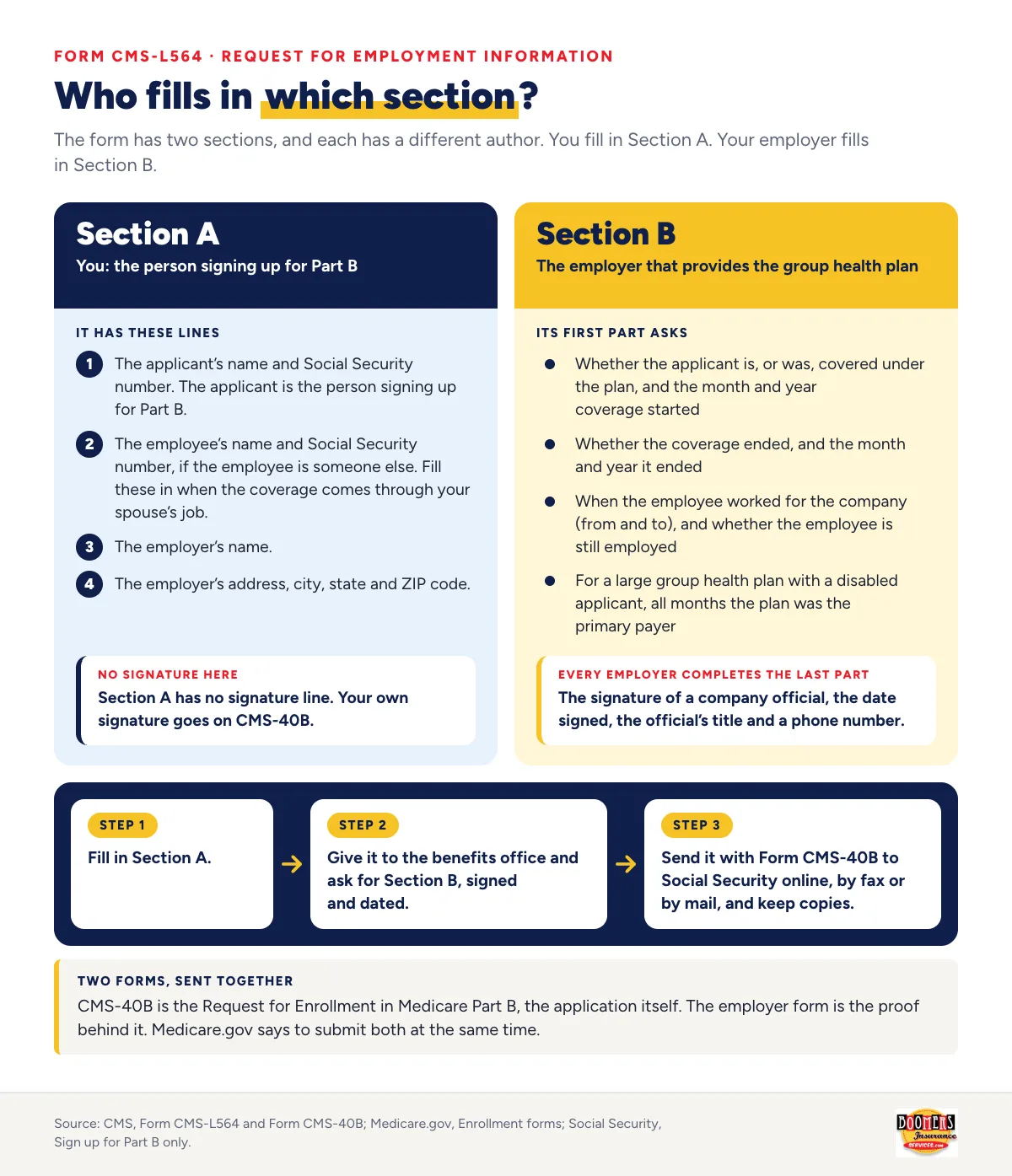
The form has two sections, and each has a different author. The form’s own instruction is short: “You complete Section A of this form, then ask your employer to fill out Section B.”
| Section | Who completes it | What it asks |
|---|---|---|
| Section A | The person signing up for Part B | Names, Social Security numbers, and the employer’s name and address |
| Section B | The employer | Coverage dates, employment dates, and a company official’s signature |
Section A: the applicant
Section A is yours. It has these lines:
- The applicant’s name and Social Security number. The applicant is the person signing up for Part B.
- The employee’s name and Social Security number, if the employee is someone else. Fill these in when the coverage comes through your spouse’s job.
- The employer’s name.
- The employer’s address, city, state and ZIP code.
You give the form to the employer and then to Social Security. We don’t need these numbers to help you compare plans, and you don’t need to share them with an agent.
Section B: the employer
Section B belongs to the employer that provides the group health plan. Its first part, for employer group health plans, asks:
- whether the applicant is, or was, covered under the plan, and the month and year coverage started
- whether the coverage ended, and the month and year it ended
- when the employee worked for the company (from and to), and whether the employee is still employed
- for a large group health plan with a disabled applicant, all months the plan was the primary payer
A second part is marked “For Hours Bank Arrangements ONLY.” Every employer completes the last part: the signature of a company official, the date signed, the official’s title and a phone number. Social Security’s policy manual says the signature doesn’t have to be in ink. An electronic or stamped signature is acceptable.
What if your employer can’t complete Section B?
You still have options. Social Security accepts other proof of employer coverage for Medicare sign-up when the employer or the plan can’t provide it.
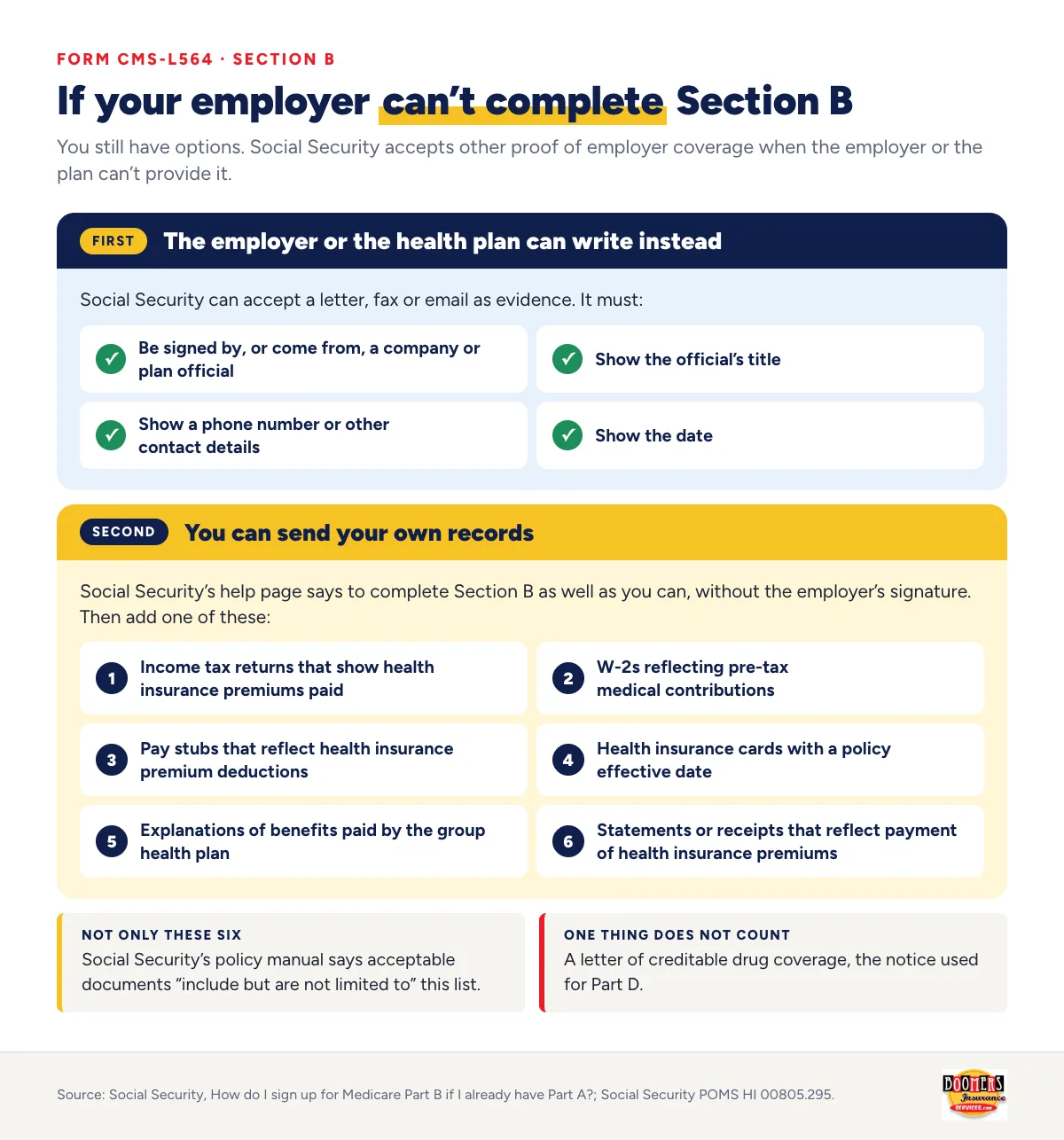
First, the employer or the health plan can write instead. Social Security can accept a letter, fax or email as evidence. It must be signed by, or come from, a company or plan official. It must also show the official’s title, a phone number or other contact details, and the date.
Second, you can send your own records. Social Security’s help page says to complete Section B as well as you can, without the employer’s signature. Then add one of these:
- income tax returns that show health insurance premiums paid
- W-2s reflecting pre-tax medical contributions
- pay stubs that reflect health insurance premium deductions
- health insurance cards with a policy effective date
- explanations of benefits paid by the group health plan
- statements or receipts that reflect payment of health insurance premiums
Social Security’s policy manual says acceptable documents “include but are not limited to” this list. One thing does not count: a letter of creditable drug coverage, the notice used for Part D.
How does Form CMS-L564 go with CMS-40B?
The two forms are a pair. CMS-40B is the Request for Enrollment in Medicare Part B, the application itself. The employer form is the proof behind it. Medicare.gov says to submit both at the same time.
CMS-40B is for people who already have Part A and want to add Part B. It asks for your name, address and the dates of your job and health coverage, and it tells you to have your employer fill out the employment form. If you don’t have Part A yet, the form says not to use it. Contact Social Security to apply for Medicare for the first time. Our guide on how to sign up for Medicare covers that route.
Where do you send the forms?
Send them to Social Security. There are three main ways, and none of them go through an insurance agency or a plan:
- Online. Social Security’s “Sign up for Part B only” page says you can apply online when you’re ending an employer group health plan. Its fact sheet says you complete both forms there and upload your proof.
- By fax. Fax both forms to your local Social Security office.
- By mail. Mail both forms to your local Social Security office. Find it at SSA.gov/locator.
The CMS page for CMS-40B also mentions visiting your local office in person. For questions, call Social Security at 1-800-772-1213 (TTY 1-800-325-0778).
How does the 8-month Special Enrollment Period work?
Timing decides whether this Medicare Special Enrollment Period form helps you. Medicare.gov says the window ends 8 months after the group health plan coverage or the employment ends, whichever happens first. It starts the first month after your Initial Enrollment Period ends, so you can also sign up while you still have the job coverage.
| Question | What Medicare.gov says |
|---|---|
| When does the window end? | 8 months after the coverage or the employment ends, whichever happens first |
| Does COBRA extend it? | No. COBRA isn’t considered group health plan coverage |
| When does Part B start? | The month you enroll or one of the next 3 months, if you sign up while still covered or in the first full month after. Otherwise the month after you sign up |
| Can you pick a later start? | If you sign up while still working, or within the first full month after the coverage ends, you can ask to delay the start up to 3 months |
A Social Security fact sheet adds that retiree coverage, VA coverage and individual coverage, such as a Marketplace plan, don’t count as coverage based on current employment. Medicare.gov also says this window doesn’t apply while you’re still in your Initial Enrollment Period, or if you have Medicare based on End-Stage Renal Disease.
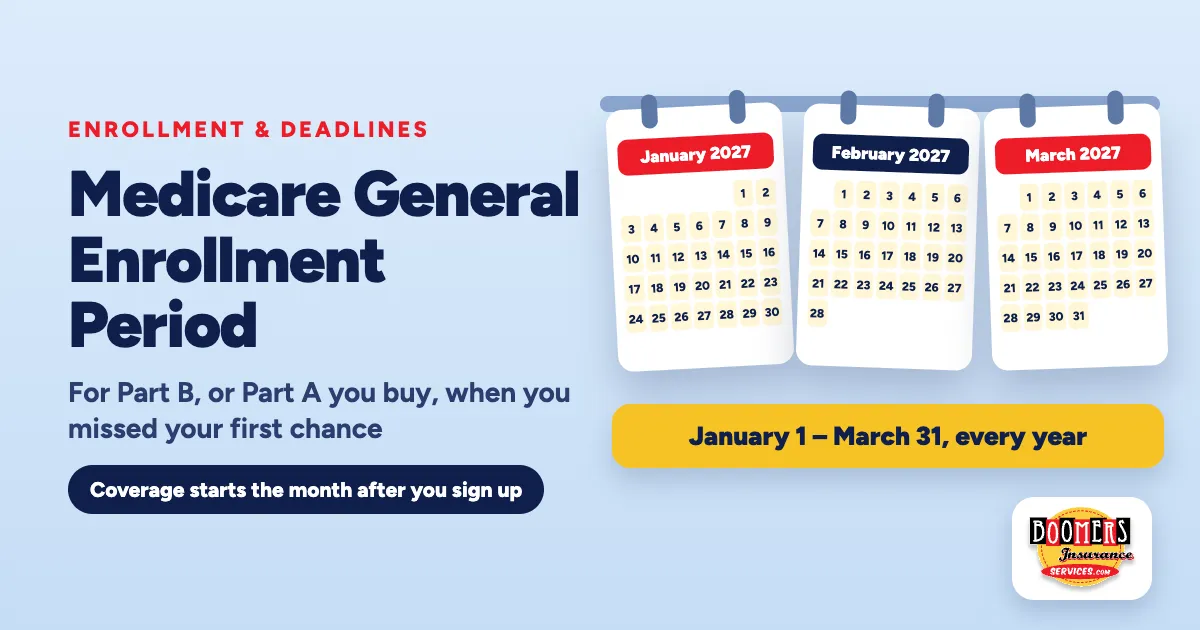
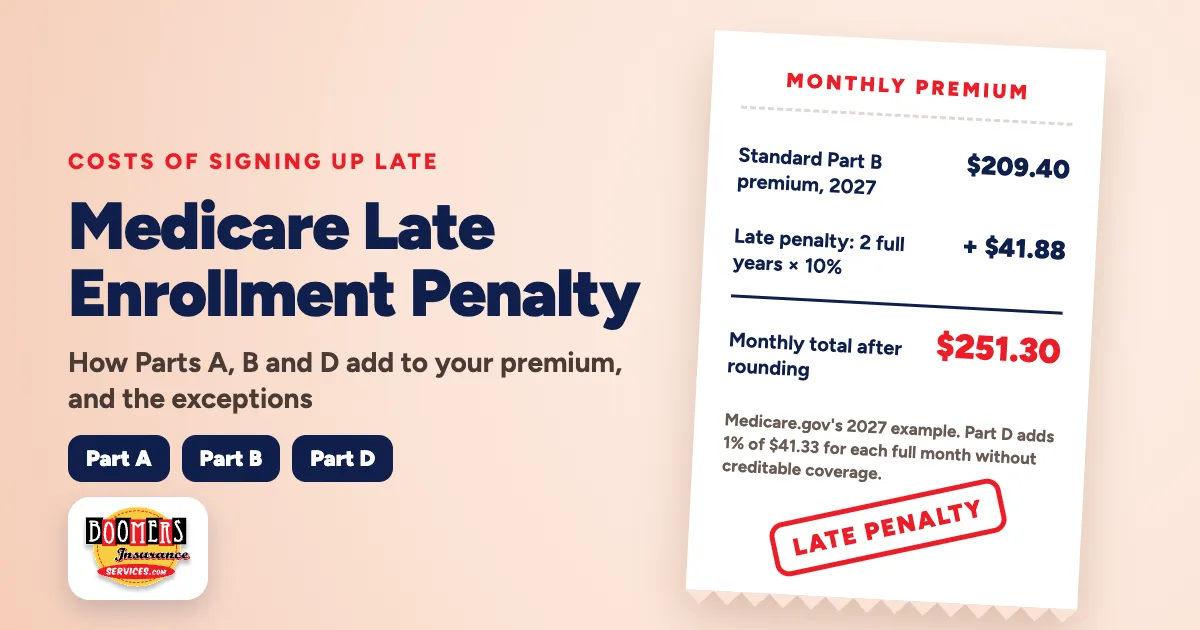
If you miss the 8 months, you generally wait for the General Enrollment Period, January 1 to March 31. A late penalty may apply: 10% of the standard premium for each full 12 months you could have had Part B but didn’t, usually for as long as you have Part B. The standard Part B premium is $202.90 a month in 2026 and $209.40 in 2027. See our overview of Medicare Special Enrollment Periods for other windows. Our General Enrollment Period guide explains it.
Common mistakes with this form
A packet with a missing form, date or signature gives Social Security less to work with. Check yours for these before you send it:
- Sending only one form. The employer form and CMS-40B go in together.
- Leaving the employee lines blank. If the coverage is through your spouse’s job, Section A needs your spouse’s name and number.
- An unsigned Section B. It needs a company official’s signature, title, date and phone number, unless your employer can’t complete it and you send other proof instead.
- Counting on COBRA or retiree coverage. Neither one stretches the 8 months.
- Skipping an employer. If you had job coverage from more than one employer, Social Security’s manual says it needs evidence from each.
- Waiting for the last month. Medicare.gov says that if you want Part B to start when your job-based coverage ends, you need to sign up the month before you or your spouse plan to retire.
Next steps
Start early, because the employer’s section is out of your hands. This short list keeps the paperwork in order:
- Download the current form from CMS.gov and fill in Section A.
- Give it to the benefits office and ask for Section B, signed and dated.
- Complete CMS-40B and choose your Part B start date.
- Send both forms to Social Security online, by fax or by mail, and keep copies.
Turning 65 soon and still working? Our Turning 65 checklist covers the decisions that come before this form. For one-on-one counseling in California, call HICAP, the Health Insurance Counseling & Advocacy Program, at 1-800-434-0222.
Talk with a licensed Boomers agent
A licensed Boomers agent can go over the Medicare plans we represent in your area and check them against your doctors and prescriptions. We can’t file the form for you, but we can show you where it goes.
Find a licensed agent near you · See upcoming Medicare events
Or call 1-800-815-1943 (TTY 711), Monday – Friday, 9 AM – 5 PM Pacific.
Frequently asked questions
Who signs Form CMS-L564?
A company official signs Section B and adds a title, the date and a phone number. The applicant fills in Section A, which has no signature line. Your own signature goes on CMS-40B.
Can I fill out Section B myself?
Only when the employer can’t. Social Security’s help page says to complete it as well as you can, without the employer’s signature. You then add other proof, such as pay stubs showing health insurance premium deductions.
Do I need the Request for Employment Information if I am still working?
Usually, yes, if you sign up for Part B after your Initial Enrollment Period based on that job coverage. It is the standard proof, though Social Security can also accept a signed letter from the employer or plan. Medicare.gov lists “You’re still working” as one of the situations the form is for. Your employer marks that the coverage has not ended.
What if I had more than one employer after 65?
Social Security’s policy manual says the rules apply to each employer. Plan on a separate form, or other evidence, from each employer whose plan covered you. Ask Social Security what it needs for your dates.
Is there a fee to file the form?
Neither form lists a fee. You get them from CMS.gov or Social Security and send them to Social Security yourself.
Sources
- Form CMS-L564, Medicare Request for Employment Information (CMS.gov PDF)
- CMS L564 form page (CMS.gov)
- Form CMS-40B, Request for Enrollment in Medicare Part B (CMS.gov PDF)
- CMS 40B form page (CMS.gov)
- Enrollment forms (Medicare.gov)
- When does Medicare coverage start? (Medicare.gov)
- When can I sign up for Medicare? (Medicare.gov)
- Avoid late enrollment penalties (Medicare.gov)
- Sign up for Part B only (Social Security)
- How do I sign up for Medicare Part B if I already have Part A? (Social Security)
- How to Apply for Medicare Part B During Your Special Enrollment Period (Social Security)
- POMS HI 00805.295, Evidence of GHP or LGHP Coverage Based on Current Employment Status (Social Security)
- 2001 notice on the Request for Employment Information, Health Care Financing Administration (Federal Register)
- 2001 notice renaming the Health Care Financing Administration as CMS (GovInfo)
- 42 CFR 406.24, special enrollment period (eCFR)
- 2026 Medicare Parts A & B premiums and deductibles (CMS.gov)
- 2027 Medicare Parts A & B premiums and deductibles (CMS.gov)
Talk with a licensed Boomers agent
A licensed agent can go over the Medicare plans we represent in your area, check them against your doctors and prescriptions, and answer your questions. There is no cost to you and no obligation to enroll.
Monday – Friday, 9 AM – 5 PM PT