
Medicare GLP-1 Bridge Program: Who Qualifies, Cost and Part D
The Medicare GLP-1 bridge program gives certain people with Medicare drug coverage access to some GLP-1 weight loss drugs for a $50 copayment a month. It began July 1, 2026 and is set to run through December 31, 2027. You don’t enroll yourself: your doctor and pharmacy handle it.
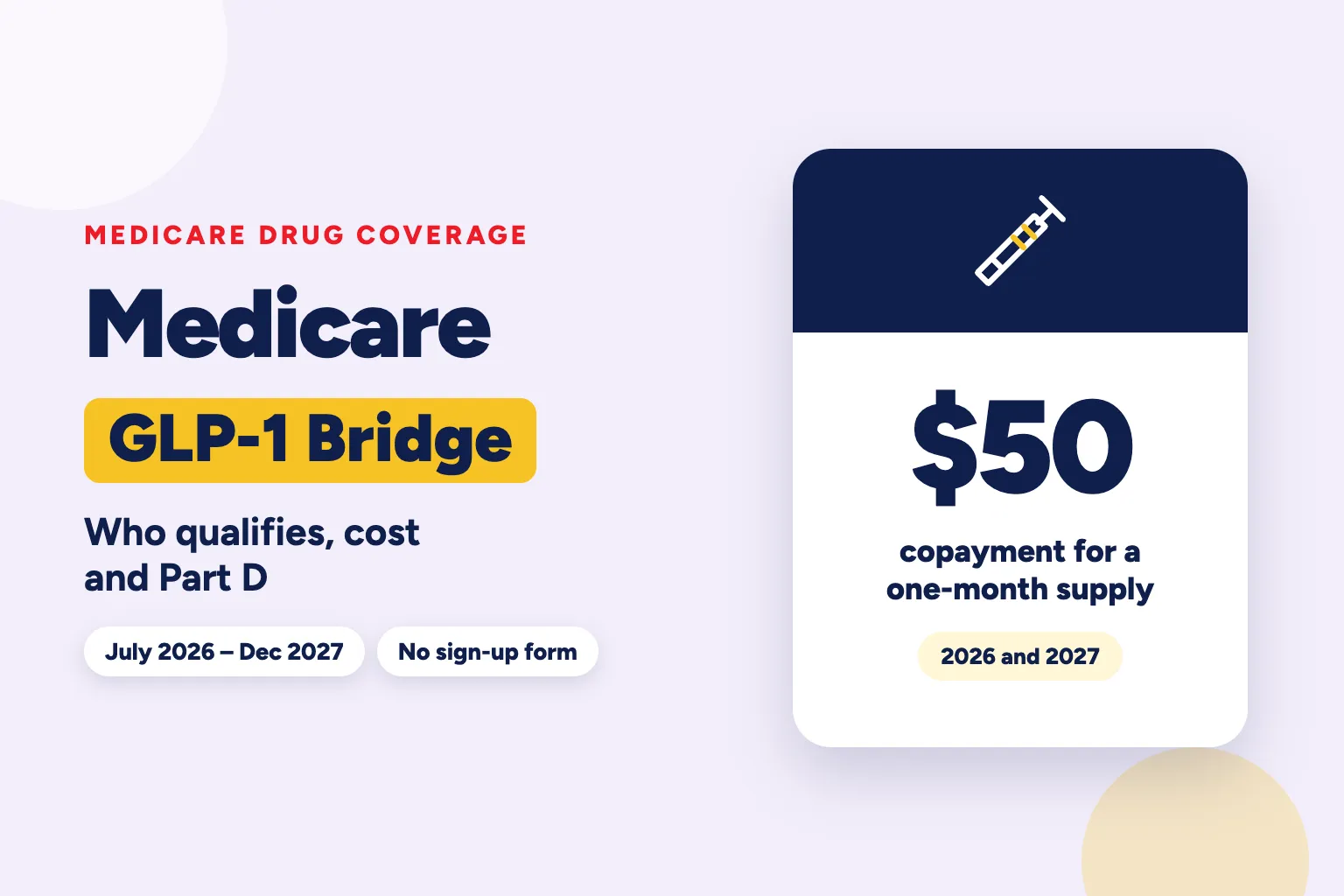
The Medicare GLP-1 bridge program lets certain people with Medicare drug coverage get some GLP-1 weight loss drugs for a $50 copayment a month. Its official name is the Medicare GLP-1 Bridge. The Centers for Medicare & Medicaid Services (CMS) runs it as a short-term demonstration, which CMS has also called a pilot program. It started on July 1, 2026 and is set to run through December 31, 2027.
You don’t sign up for it yourself. Your doctor and your pharmacy do the paperwork, and Medicare mails you a letter with the decision. This article explains who it is for, what it costs in 2026 and 2027, how it sits beside Part D, and what CMS hasn’t decided yet. We checked the CMS and Medicare.gov pages on November 13, 2026.
What is the Medicare GLP-1 bridge program?
It is a temporary Medicare program that pays for certain GLP-1 (glucagon-like peptide-1) drugs when a doctor prescribes them for weight management. CMS runs it in every state and U.S. territory. It works outside the regular Part D benefit.
| Question | What CMS and Medicare.gov say |
|---|---|
| Official name | Medicare GLP-1 Bridge |
| Who runs it | CMS, as a short-term demonstration |
| Dates | July 1, 2026 through December 31, 2027 |
| Who it is for | Certain people with Medicare drug coverage (Part D) who meet weight and health conditions |
| What you pay | A $50 copayment for a one-month supply |
| How you get in | Your doctor sends a prescription and completes a prior authorization |
| Where to check | Medicare.gov/glp1bridge or 1-800-MEDICARE (TTY 1-877-486-2048) |
Why did Medicare start it?
CMS says Medicare generally doesn’t cover GLP-1 drugs when they are used only for weight loss. The Bridge is a separate, short-term way to give access to them. CMS also has a model called BALANCE, which Part D plans could choose to join. CMS has said BALANCE won’t launch in Medicare in 2027, so it extended the Bridge through December 31, 2027.
Which drugs does it cover?
Medicare.gov lists three drugs as of July 1, 2026:
- Foundayo (tablet)
- Wegovy (injection or tablet)
- Zepbound (KwikPen only; single-dose vials and pens aren’t covered)
CMS says this list may be updated, and that pen needles aren’t covered. Whether any of these drugs is right for you is a question for your doctor.
Who qualifies for the Medicare bridge program?
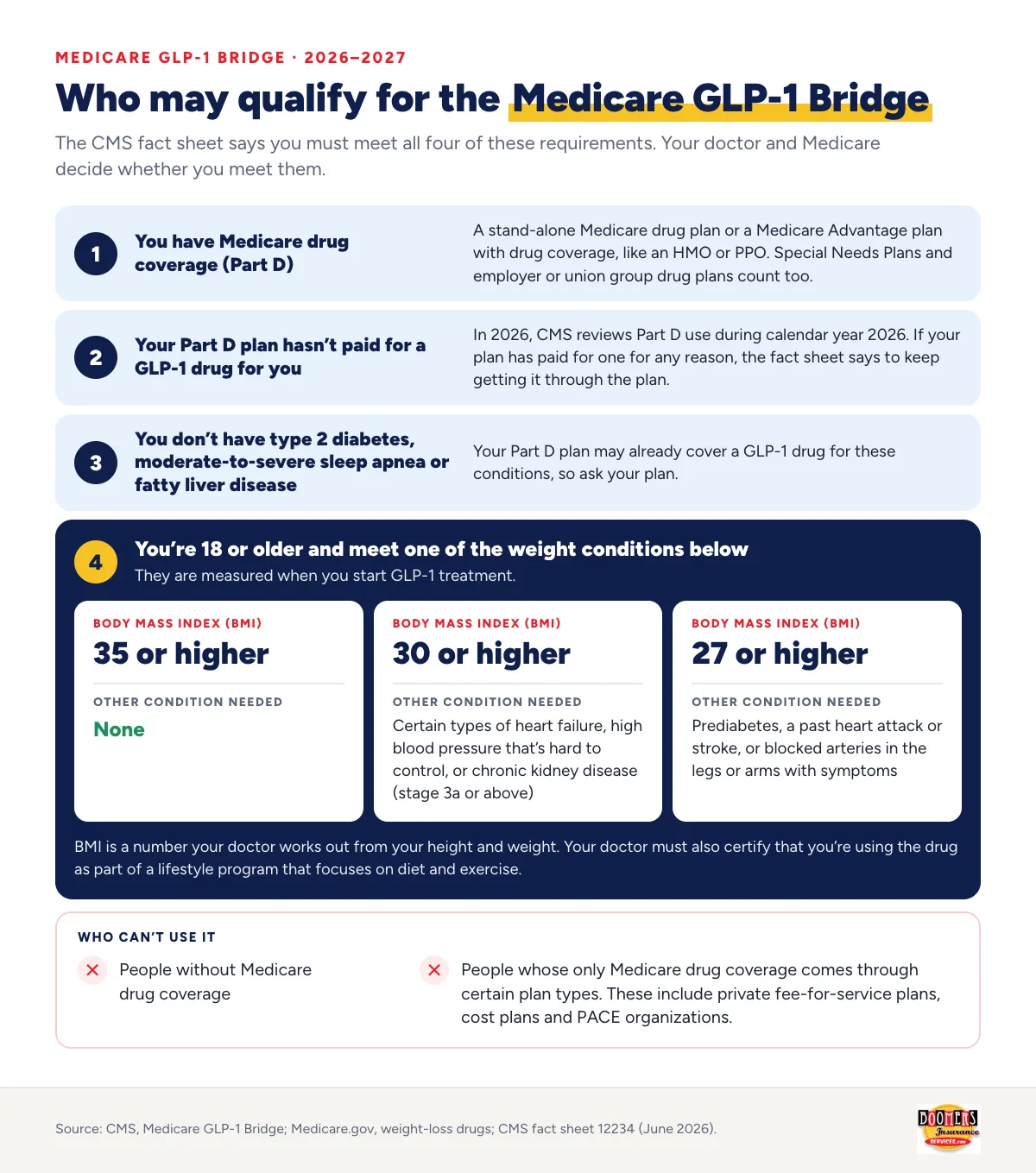
You may qualify if you have Medicare drug coverage, your Part D plan hasn’t paid for a GLP-1 drug for you, and you meet the program’s age, weight and health conditions. The CMS fact sheet says you must meet all four of these requirements:
- You have Medicare drug coverage (Part D). This can be a stand-alone Medicare drug plan or a Medicare Advantage plan with drug coverage, like an HMO or PPO. Special Needs Plans and employer or union group drug plans count too.
- Your Part D plan hasn’t paid for a GLP-1 drug for you. In 2026, CMS reviews Part D use during calendar year 2026, so a GLP-1 fill through your plan earlier in 2026 counts. If your plan has paid for one for any reason, the fact sheet says to keep getting it through the plan.
- You don’t have type 2 diabetes, moderate-to-severe sleep apnea or fatty liver disease. Your Part D plan may already cover a GLP-1 drug for these conditions, so ask your plan.
- You’re 18 or older and meet one of the weight conditions below. They are measured when you start GLP-1 treatment.
| Body mass index (BMI) | Other condition needed |
|---|---|
| 35 or higher | None |
| 30 or higher | Certain types of heart failure, high blood pressure that’s hard to control, or chronic kidney disease (stage 3a or above) |
| 27 or higher | Prediabetes, a past heart attack or stroke, or blocked arteries in the legs or arms with symptoms |
BMI is a number your doctor works out from your height and weight. Your doctor must also certify that you’re using the drug as part of a lifestyle program that focuses on diet and exercise.
Who can’t use it?
People without Medicare drug coverage can’t use the Bridge. CMS also leaves out people whose only Medicare drug coverage comes through certain plan types. These include private fee-for-service plans, cost plans and PACE (Program of All-Inclusive Care for the Elderly) organizations. If you aren’t sure what type of plan you have, call 1-800-MEDICARE.
CMS says people with both Medicare and Medicaid (Medi-Cal in California) can use the Bridge. They must be in an eligible plan type and meet the same conditions.
What does the bridge program cost?
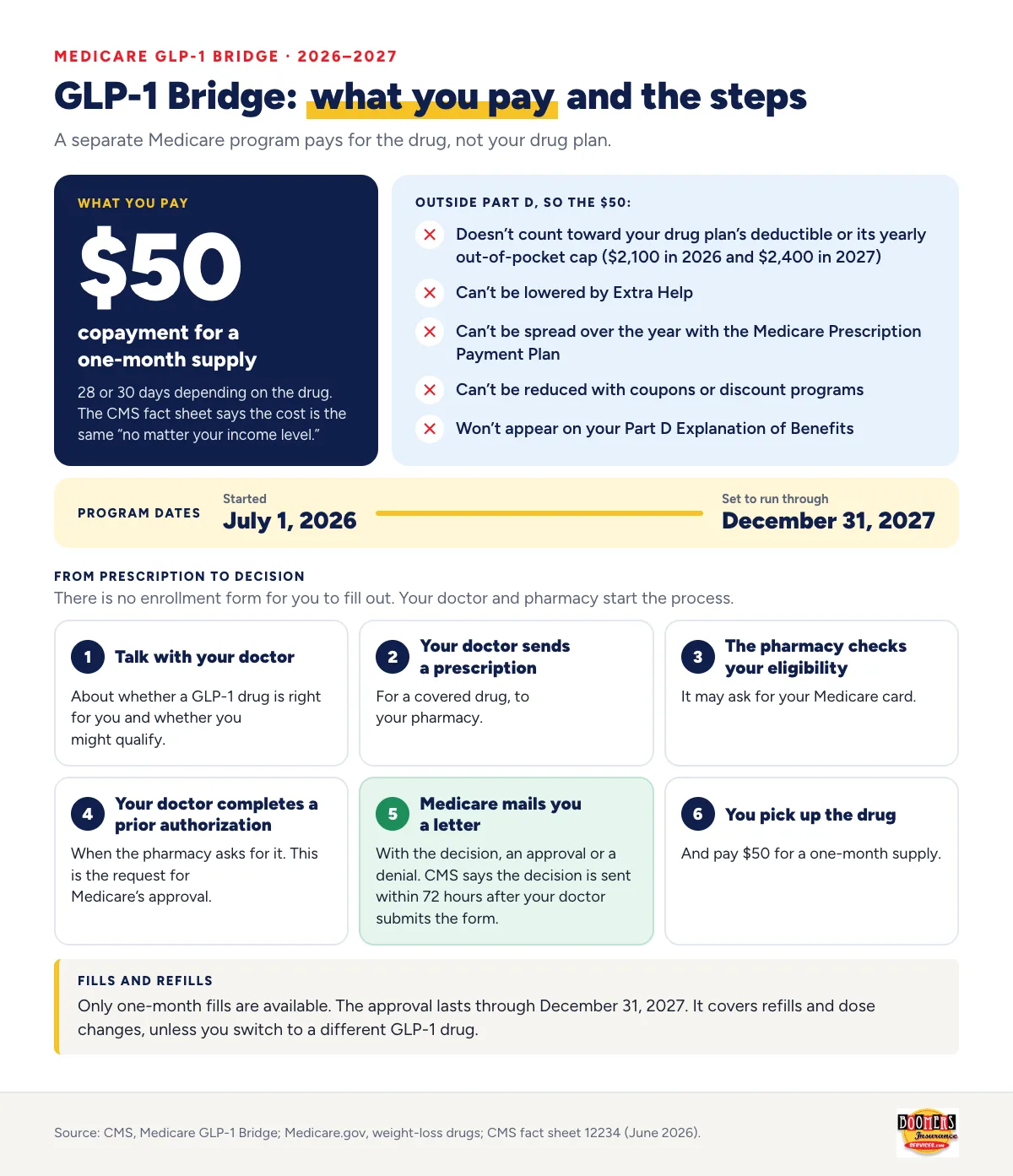
You pay a $50 copayment at the pharmacy for a one-month supply, which is 28 or 30 days depending on the drug. The CMS fact sheet says the cost is the same “no matter your income level.” A separate Medicare program pays for the drug, not your drug plan. So the $50:
- Doesn’t count toward your drug plan’s deductible or its yearly out-of-pocket cap ($2,100 in 2026 and $2,400 in 2027)
- Can’t be lowered by Extra Help
- Can’t be spread over the year with the Medicare Prescription Payment Plan
- Can’t be reduced with coupons or discount programs
- Won’t appear on your Part D Explanation of Benefits
Only one-month fills are available. CMS says there are no 60-day or 90-day supplies. Our articles on the Part D out-of-pocket cap and payment plan and Extra Help explain those programs.
How to enroll in the Medicare GLP-1 bridge program
There is no enrollment form for you to fill out, and your drug plan doesn’t have to opt in. Your doctor and pharmacy start the process. The CMS fact sheet and CMS’s page for providers describe these steps:
- Talk with your doctor about whether a GLP-1 drug is right for you and whether you might qualify.
- Your doctor sends a prescription for a covered drug to your pharmacy.
- The pharmacy checks your eligibility. It may ask for your Medicare card.
- Your doctor completes a prior authorization when the pharmacy asks for it. This is the request for Medicare’s approval.
- Medicare mails you a letter with the decision, an approval or a denial. CMS says the decision is sent within 72 hours after your doctor submits the form.
- You pick up the drug and pay $50 for a one-month supply.
The approval lasts through December 31, 2027. It covers refills and dose changes, unless you switch to a different GLP-1 drug.
These steps run through your own doctor and pharmacies. If someone you don’t know contacts you and offers to enroll you, be careful with your Medicare card. To report suspected fraud, call 1-800-MEDICARE.
Bridge program vs Part D: how do they fit together?
The Bridge is separate from Part D, but you need Part D to use it. CMS says the Bridge is not a drug plan, so it doesn’t replace one. Your other prescriptions still go through your plan, under its formulary (drug list), tiers and deductible. Keep these rules in mind:
- A Part D use stays with Part D. If a GLP-1 drug is prescribed for a condition Part D covers, like type 2 diabetes, it goes through your plan and the plan’s costs.
- Filling through your plan ends Bridge eligibility. CMS says a person who later fills a GLP-1 prescription through their Part D plan can no longer use the Bridge.
- A change of plan type can end it. If you move to a plan type that isn’t eligible, the pharmacy can’t refill the drug through the Bridge.
- There is no appeals process for the Bridge. Your doctor may send the form again with corrected or new information. Your appeal rights with your Part D plan don’t change.
- Keep your drug coverage. Going without Part D or other creditable drug coverage can lead to a late enrollment penalty. See what Medicare Part D is.
Does it change how you choose a drug plan for 2027?
Plans don’t have to opt in, so the Bridge works the same way with any eligible plan type. When you compare plans on the Medicare Plan Finder, check two things. First, the plan type must be one the Bridge accepts. Second, your other drugs should be on the plan’s formulary. Our Medicare Annual Enrollment guide explains what you can change each fall.
What isn’t known yet?
CMS has left a few points open. As of November 13, 2026, we found no answer to these on CMS.gov or Medicare.gov, and we won’t guess:
- What happens after December 31, 2027. CMS speaks only of a “potential implementation of BALANCE in Part D.” It gives no date.
- The 2027 look-back. In 2026, CMS checks whether a Part D plan paid for a GLP-1 drug for you during 2026. CMS says it “has not yet determined” the look-back period it will apply during 2027.
- The drug list. CMS says the covered products may be updated during the program.
Next steps
If you think the Bridge might fit you, start with Medicare’s own tools and your doctor. These steps follow the order CMS describes:
- Answer the questions at Medicare.gov/glp1bridge to see whether you might qualify.
- Ask your doctor whether a covered GLP-1 drug is right for you.
- Check your plan type. Call 1-800-MEDICARE if you aren’t sure.
- Ask your Part D plan what it covers if you have type 2 diabetes, sleep apnea or fatty liver disease.
- Review your drug coverage each fall for your other prescriptions.
Talk with a licensed Boomers agent
A licensed Boomers agent can go over the Medicare plans we represent in your area and check them against your doctors and prescriptions. We can’t tell you whether a drug is right for you or whether you meet the Bridge’s conditions. Your doctor and Medicare decide that.
Find a licensed agent near you · See upcoming Medicare events
Or call 1-800-815-1943 (TTY 711), Monday – Friday, 9 AM – 5 PM Pacific.
Frequently asked questions
Is the GLP-1 Medicare pilot program the same as the Medicare GLP-1 Bridge?
Yes. CMS calls the Medicare GLP-1 Bridge a short-term demonstration, and it has also described it as a pilot program. Some people search for it as the bridge program Medicare offers for weight loss drugs. All of these names mean the same thing.
Do I have to enroll in the Medicare bridge program myself?
No. There is no form for you to fill out. Your doctor sends the prescription and completes the prior authorization, and your pharmacy submits the claim. Medicare then mails you a letter about the decision.
Can I use the Bridge with a Medicare Advantage plan?
You may be able to, if you meet the other conditions. The plan must include drug coverage and be a coordinated care plan, like an HMO or PPO, or a Special Needs Plan. Private fee-for-service plans, cost plans and PACE organizations aren’t eligible plan types. Call 1-800-MEDICARE if you aren’t sure which type you have.
Does the $50 copayment count toward my Part D out-of-pocket cap?
No. The Bridge pays for the drug outside of Part D. The $50 doesn’t count toward your plan’s deductible or its out-of-pocket cap, and Extra Help can’t lower it.
Will Medicare cover GLP-1 drugs for weight loss after 2027?
That isn’t known yet. The Bridge is set to end on December 31, 2027. CMS has mentioned a possible start of its BALANCE model in Part D, but it hasn’t given a date.
Sources
- Medicare GLP-1 Bridge (CMS.gov)
- Weight loss drugs (Medicare.gov)
- Medicare GLP-1 Bridge: GLP-1 Drugs for $50 a Month, fact sheet 12234 (Medicare.gov)
- Medicare GLP-1 Bridge: Information for Providers (CMS.gov)
- Medicare GLP-1 Bridge: Information for Pharmacies (CMS.gov)
- Medicare GLP-1 Bridge: Information for Part D Plans (CMS.gov)
- BALANCE Model (CMS.gov)
- CMS Launches Medicare GLP-1 Bridge, press release, July 1, 2026 (CMS.gov)
- Medicare & You 2027 handbook (Medicare.gov)
Talk with a licensed Boomers agent
A licensed agent can go over the Medicare plans we represent in your area, check them against your doctors and prescriptions, and answer your questions. There is no cost to you and no obligation to enroll.
Monday – Friday, 9 AM – 5 PM PT