
Does Medicare Cover Memory Care? What It Pays and What It Doesn’t
Does Medicare cover memory care? Not the room, meals and daily supervision in a memory care unit: that is custodial care, which Medicare doesn’t pay for. Medicare does pay for medical care for dementia, like a cognitive assessment visit, short skilled nursing stays and hospice.
Does Medicare cover memory care? Not the way most families mean it. A memory care unit gives people with dementia a room, meals, help with daily tasks and a secure place to live. Medicare calls that custodial care, and it doesn’t pay for it. Medicare does pay for medical care for dementia, such as doctor visits, a cognitive assessment, short skilled nursing stays, home health and hospice.
So the cost of memory care itself usually falls on the family’s own money, long-term care insurance or Medi-Cal. This article explains what Medicare pays in 2026, what it doesn’t, and where California families can look for help. For the bigger picture, see our article on Medicare and long-term care.
Does Medicare cover memory care? The short answer
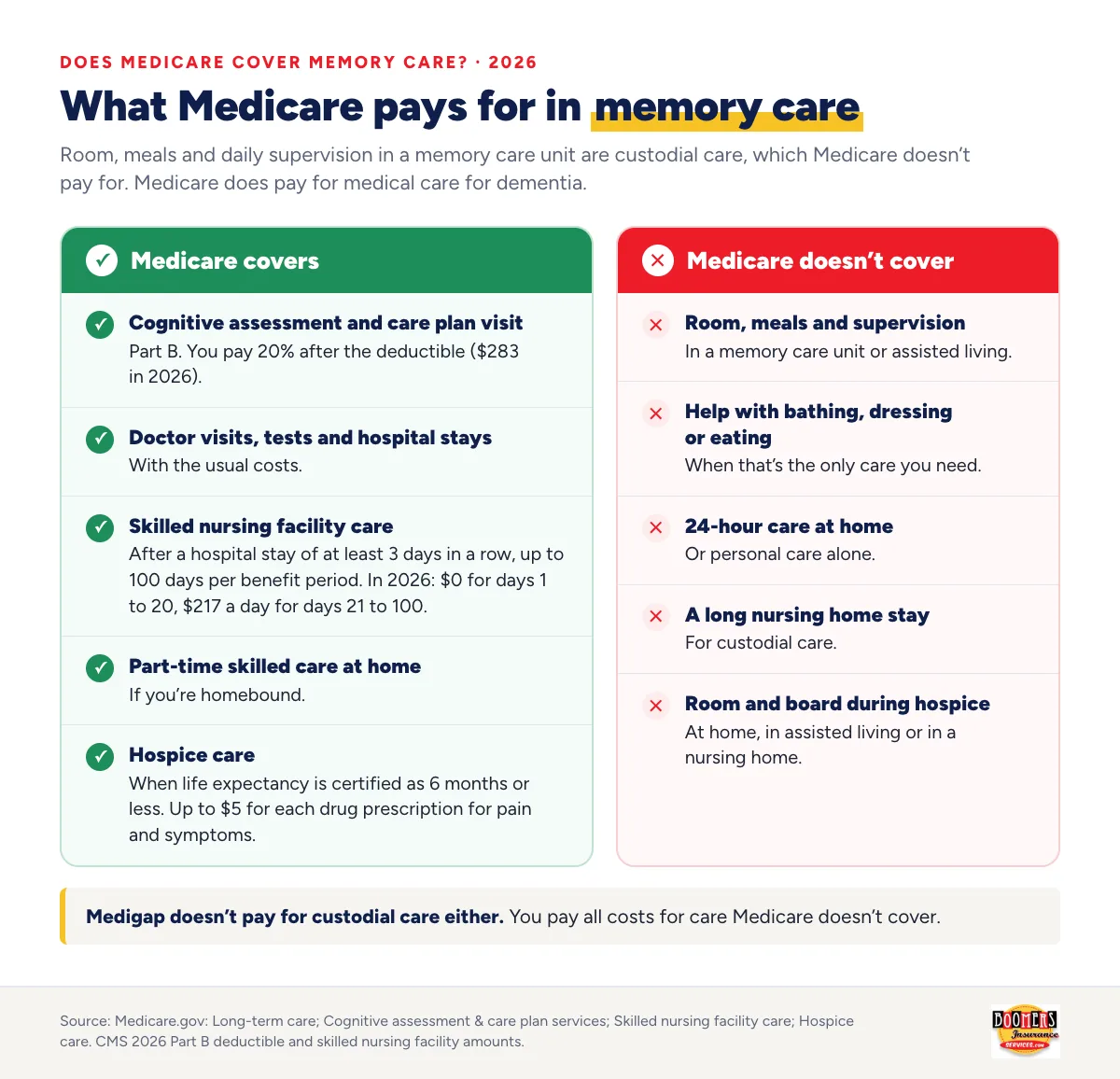
No, not the memory care itself. Original Medicare doesn’t pay for the room, meals and supervision in a memory care unit, but it does pay for medical care for dementia. Here is what it pays for and what it doesn’t:
| Type of care | Does Original Medicare pay? |
|---|---|
| Room, meals and supervision in a memory care unit or assisted living | No |
| Help with bathing, dressing or eating, when that’s the only care you need | No |
| Cognitive assessment and care plan visit | Yes, under Part B; you pay 20% after the deductible |
| Doctor visits, tests and hospital stays | Yes, with the usual costs |
| Skilled nursing facility care after a qualifying hospital stay | Yes, for a short time: up to 100 days per benefit period |
| Part-time skilled care at home, if you’re homebound | Yes |
| Hospice care | Yes, but not room and board |
| Prescription drugs | Through a Part D plan or a Medicare Advantage plan with drug coverage |
Why doesn’t Medicare pay for memory care?
Medicare.gov says plainly: “Medicare doesn’t pay for long-term care.” Long-term care is help with daily living for people with a chronic illness or disability. Medicare.gov calls it custodial care. It includes help with getting dressed, bathing and using the bathroom.
Most of what a memory care community provides is this kind of care. Medicare and most health insurance, including Medigap, don’t pay for it, whether it’s at home, in assisted living or in a nursing home. You pay all costs for care Medicare doesn’t cover.
What does Medicare pay for in dementia care?
Medicare pays for the medical side of dementia: a visit to check memory and plan care, the GUIDE program through doctors who take part, hospital and short skilled nursing stays, home health care and hospice. Each has its own rules and costs.
A cognitive assessment and care plan visit
Your provider may check for signs of dementia during other visits, including your yearly “Wellness” visit. Signs of a problem include trouble remembering, learning new things, concentrating, managing money and making decisions.
Part B also covers a separate visit for a full review of memory and thinking. It can confirm a diagnosis like dementia or Alzheimer’s disease. You can bring a spouse, friend or caregiver. During the visit, the provider may:
- Do an exam, go over your medical history and review your medicines
- Learn who helps you, including what your usual caregiver can do
- Create a care plan to manage symptoms
- Help you make or update an advance care plan
- Refer you to a specialist, if needed
- Point you to community resources, like adult day health programs and support groups
You pay 20% coinsurance after the Part B deductible ($283 in 2026).
The GUIDE dementia program
GUIDE (Guiding an Improved Dementia Experience) is a Medicare program that started on July 1, 2024. The Centers for Medicare & Medicaid Services (CMS) plans to run it for 8 years. It works only through doctors and care teams that take part. According to CMS, it can offer:
- A care navigator, and help by phone 24 hours a day, 7 days a week
- Training and support for unpaid family caregivers
- Respite care for caregivers who qualify, up to a yearly limit
- Help finding local services, like meals and rides
CMS says you may qualify if a GUIDE doctor confirms dementia and Medicare is your main coverage, with Part A and Part B. People in hospice or in PACE (the Program of All-Inclusive Care for the Elderly), or living long term in a nursing home, can’t join. Medicare & You 2027 says some people in GUIDE get this extra support without paying coinsurance. Ask your doctor whether they take part.
Hospital, skilled nursing and home health care
Medicare pays for hospital care and for a short skilled nursing facility stay after a hospital stay of at least 3 days in a row. In 2026, days 1 to 20 cost $0 and days 21 to 100 cost $217 a day. Medicare also pays for part-time skilled care at home if you’re homebound. It doesn’t pay for 24-hour care or for personal care alone. Our long-term care article has all the rules.
Hospice care in the later stages
When a hospice doctor and your regular doctor certify that life expectancy is 6 months or less, Medicare covers hospice. The focus is comfort, not cure. Hospice can come to a home, assisted living or a nursing home, but Medicare doesn’t pay room and board there. You pay up to $5 for each drug prescription for pain and symptoms. Even people in a Medicare Advantage plan get hospice through Original Medicare.
Does Medicare Advantage cover memory care?
Medicare Advantage plans, offered by private companies that contract with Medicare, must cover all medically necessary services that Original Medicare covers. Some add extras, and a few list memory care among them. Medicare & You 2027 says these extra benefits are generally limited, so ask the plan exactly what it pays for before you count on it.
Who qualifies for a Special Needs Plan?
Special Needs Plans are Medicare Advantage plans for people with particular needs. You need Part A and Part B, must live in the plan’s area and must fit the group the plan serves. Two kinds may fit someone with dementia:
- A Chronic Condition Special Needs Plan (C-SNP) serves people with certain severe or disabling chronic conditions, and dementia can be one of them.
- An Institutional Special Needs Plan (I-SNP) serves people who live, or are expected to live, in a facility like a nursing home for at least 90 days, or who need that level of care at home.
What these plans cover differs by plan and area. Read the plan’s Evidence of Coverage, and check its network and rules. Our article on Medicare Advantage HMO vs PPO explains how networks work.
How do California families pay for memory care?
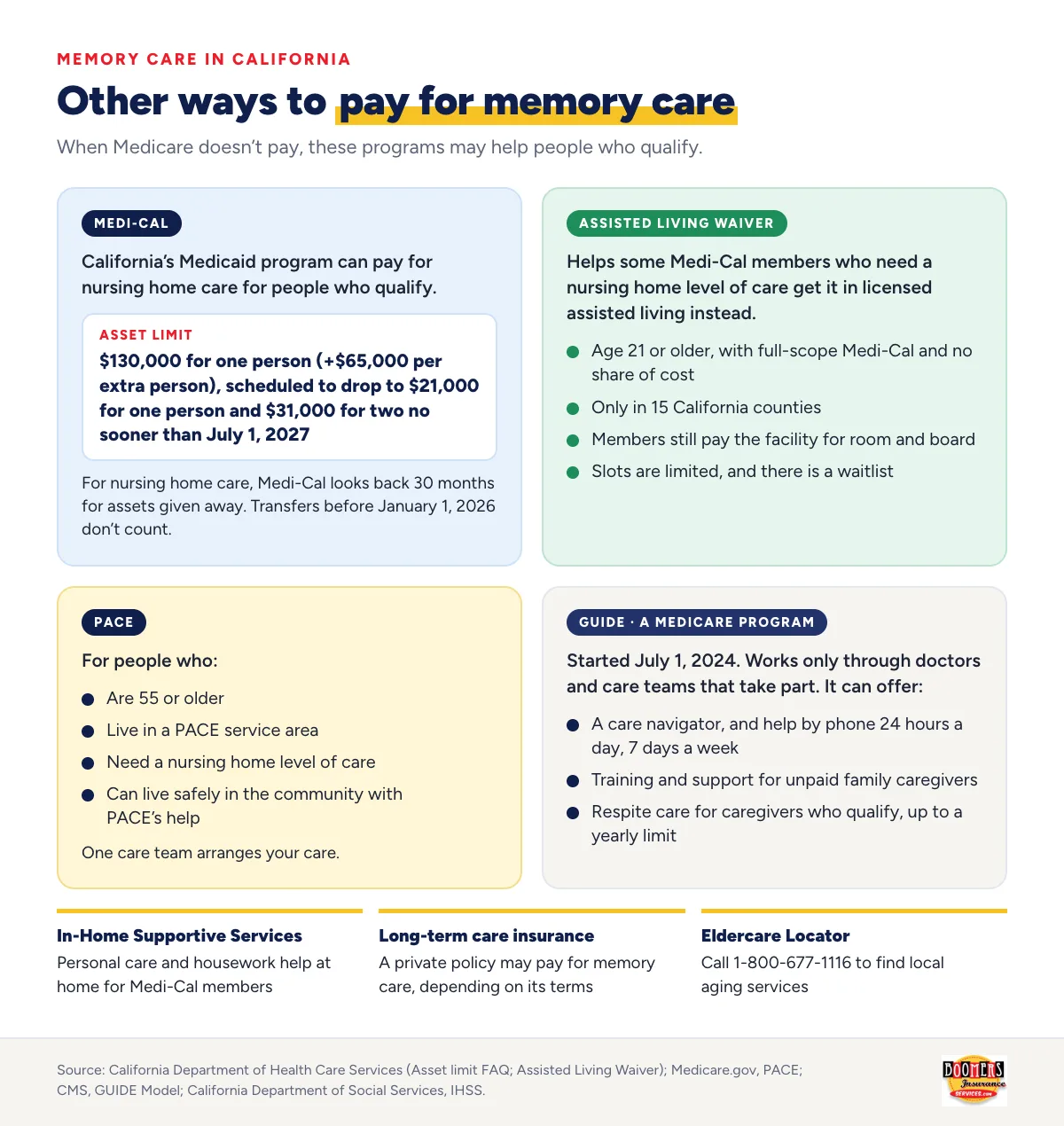
Memory care is usually paid for with the family’s own money, long-term care insurance or Medi-Cal. In California, Medi-Cal, its Assisted Living Waiver, PACE and county programs like In-Home Supportive Services (IHSS) can each help with part of the cost for people who qualify.
Medi-Cal
When the answer to “does Medicare cover memory care?” is no, Medi-Cal is often the next place to look. Medi-Cal, California’s Medicaid program, can pay for nursing home care for people who qualify. Since January 1, 2026, Medi-Cal has an asset limit again:
- January 1, 2026 – June 30, 2027: $130,000 for one person, plus $65,000 for each additional person
- Scheduled for no sooner than July 1, 2027: $21,000 for one person and $31,000 for two, plus $1,550 for each additional person
For nursing home care, Medi-Cal also looks back 30 months for assets given away. Transfers before January 1, 2026 don’t count. Our Medi-Cal asset limit guide explains what counts.
Medi-Cal’s Assisted Living Waiver
The Assisted Living Waiver helps some Medi-Cal members who need a nursing home level of care get it in licensed assisted living instead. DHCS lists these conditions:
- Age 21 or older, with full-scope Medi-Cal and no share of cost
- Care needs like those of Medi-Cal nursing home residents
- Able to live safely in assisted living or public subsidized housing
- Willing to live in one of 15 counties: Alameda, Contra Costa, Fresno, Kern, Los Angeles, Orange, Riverside, Sacramento, San Bernardino, San Diego, San Francisco, San Joaquin, San Mateo, Santa Clara and Sonoma
Members still pay the facility for room and board. Slots are limited, and DHCS says there is a waitlist.
PACE
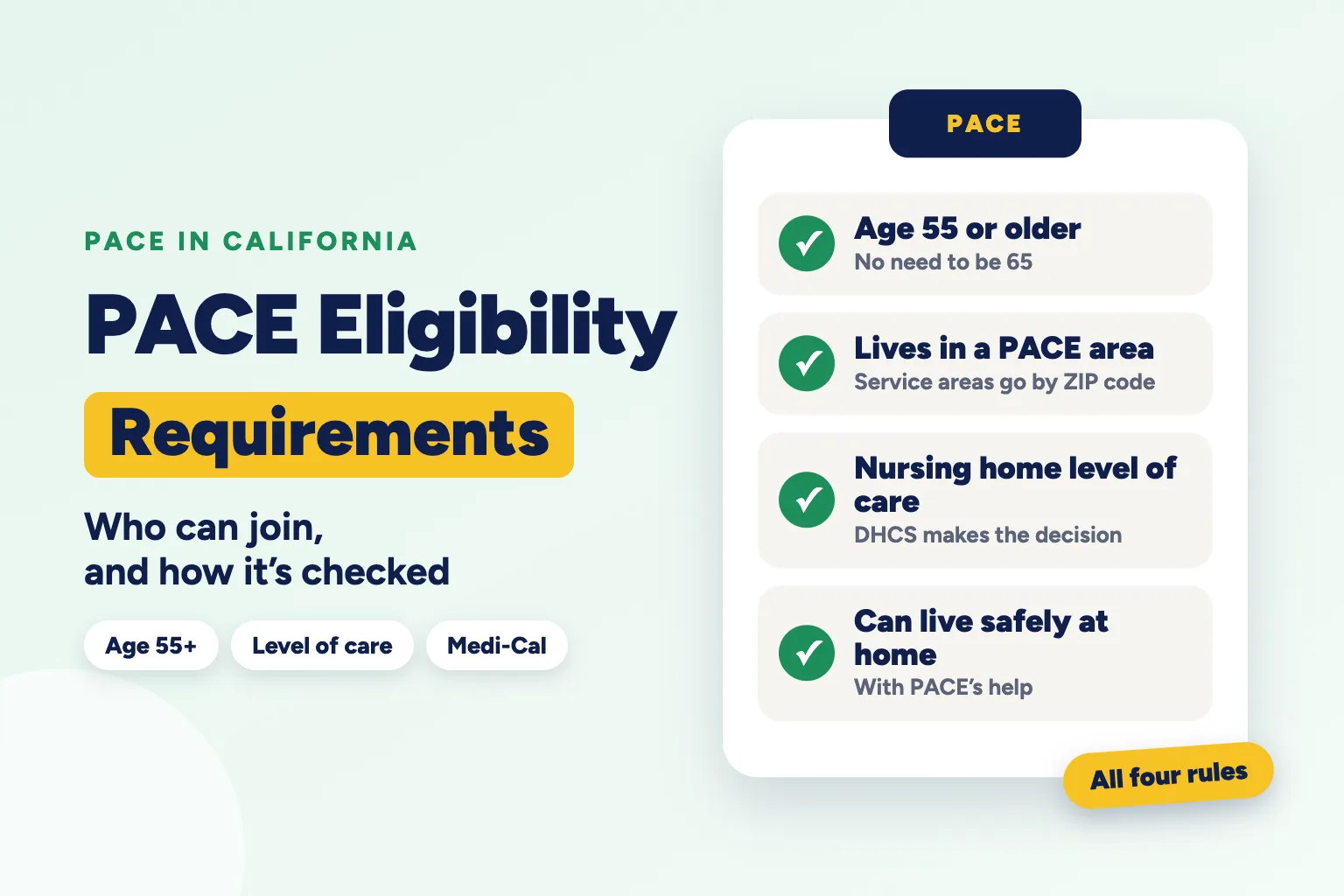
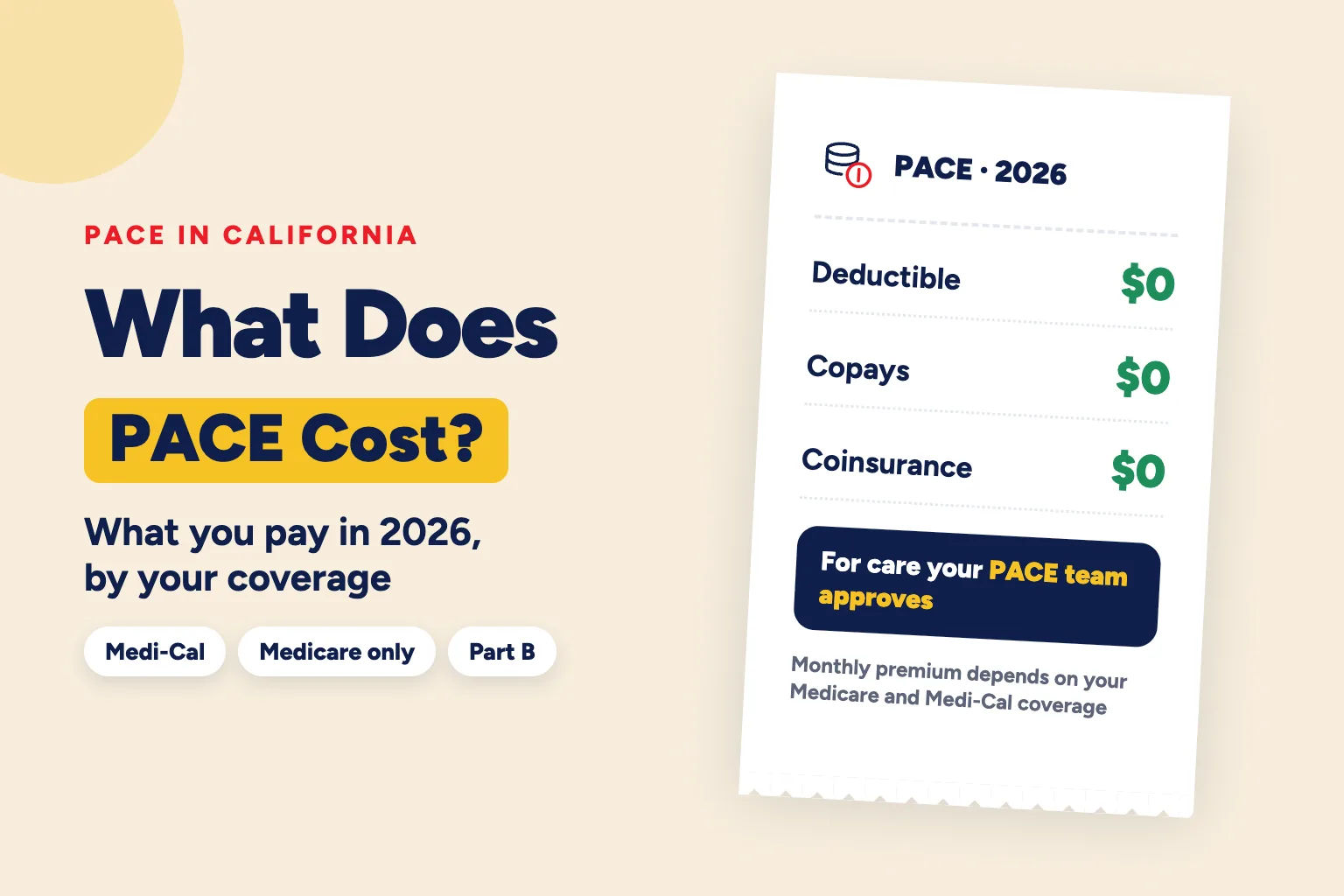
PACE serves people 55 or older who live in a PACE service area, need a nursing home level of care and can live safely in the community with PACE’s help. One care team arranges your care. Medicare.gov says that if you have Medicaid (Medi-Cal in California), you won’t pay a monthly premium for the PACE benefit. See our guide to PACE in California.
Other help
- IHSS: personal care and housework help at home for Medi-Cal members. Apply through your county IHSS office.
- Long-term care insurance: a private policy may pay for memory care, depending on its terms.
- Eldercare Locator: call 1-800-677-1116 to find local aging services, including caregiver support.
Mistakes to avoid when planning for memory care
A few wrong assumptions can cost a family a lot. Check these before a move to memory care, and before any big decision about money or a home:
- Counting on Medicare or Medigap for a long stay. Neither pays for custodial care, and skilled nursing coverage stops when daily skilled care is no longer needed, at 100 days per benefit period at most.
- Giving away savings or a house before checking Medi-Cal. Transfers on or after January 1, 2026 may affect Medi-Cal for nursing home care.
- Counting on a plan’s extra benefit without reading the details. Extras are generally limited and can change from one year to the next.
- Waiting for a crisis to plan. The cognitive assessment visit can include help with an advance care plan, which is easier to make early.
Next steps
You don’t have to sort this out all at once. These steps start with the medical side and then turn to the ways to pay for care:
- Ask the doctor about a cognitive assessment visit if memory problems are new or getting worse.
- Ask whether the doctor takes part in GUIDE, if dementia is confirmed and you’re in Original Medicare.
- Check Medi-Cal early, including the asset limit drop scheduled for no sooner than July 1, 2027, before moving or giving away assets.
- Look into PACE and the Assisted Living Waiver if staying out of a nursing home is the goal.
- Review the Medicare plan each fall for its network, drug list and any extra benefits.
Talk with a licensed Boomers agent
A licensed Boomers agent can go over the Medicare plans we represent in your area and check them against your doctors and prescriptions. We can also explain how PACE and Medi-Medi plans work if your family member has Medi-Cal.
Find a licensed agent near you · See upcoming Medicare events
Or call 1-800-815-1943 (TTY 711), Monday – Friday, 9 AM – 5 PM Pacific.
Frequently asked questions
Does Medicare pay for dementia care?
Medicare pays for the medical side of dementia care: doctor visits, a cognitive assessment visit, tests, hospital care, short skilled nursing stays, home health and hospice. It doesn’t pay for long-term custodial care, like supervision and help with daily tasks, at home or in a facility.
Does Medicare cover assisted living for dementia?
No. Medicare doesn’t pay for room, board or personal care in assisted living or a memory care unit. It still covers your Medicare services while you live there. In 15 California counties, Medi-Cal’s Assisted Living Waiver may help eligible members, but they still pay room and board.
Does Medicare pay for a nursing home for someone with dementia?
Only for a short skilled nursing stay after a qualifying hospital stay, up to 100 days per benefit period, while daily skilled care is needed. A long stay for custodial care isn’t covered. Medi-Cal may pay for nursing home care for people who qualify.
Does Medi-Cal pay for memory care?
Medi-Cal can pay for nursing home care, and in some counties the Assisted Living Waiver can pay for care in assisted living, but not room and board. Programs like PACE and IHSS can help someone stay at home. Ask your county Medi-Cal office what applies.
Can someone with dementia get hospice through Medicare?
Yes, when a hospice doctor and the regular doctor certify a life expectancy of 6 months or less. Hospice focuses on comfort and can be provided where the person lives. Medicare doesn’t pay room and board in that setting.
Sources
- Long-term care (Medicare.gov)
- Cognitive assessment & care plan services (Medicare.gov)
- Hospice care (Medicare.gov)
- Skilled nursing facility care (Medicare.gov)
- Medicare & You 2027 handbook (Medicare.gov)
- Guiding an Improved Dementia Experience (GUIDE) Model (CMS.gov)
- GUIDE information for patients and caregivers (CMS.gov)
- Assisted Living Waiver (California Department of Health Care Services)
- Asset limit frequently asked questions (California Department of Health Care Services)
- PACE (Medicare.gov)
- In-Home Supportive Services (California Department of Social Services)
Talk with a licensed Boomers agent
A licensed agent can go over the Medicare plans we represent in your area, check them against your doctors and prescriptions, and answer your questions. There is no cost to you and no obligation to enroll.
Monday – Friday, 9 AM – 5 PM PT