
Dental Insurance for Seniors on Medicare: Your Options Explained
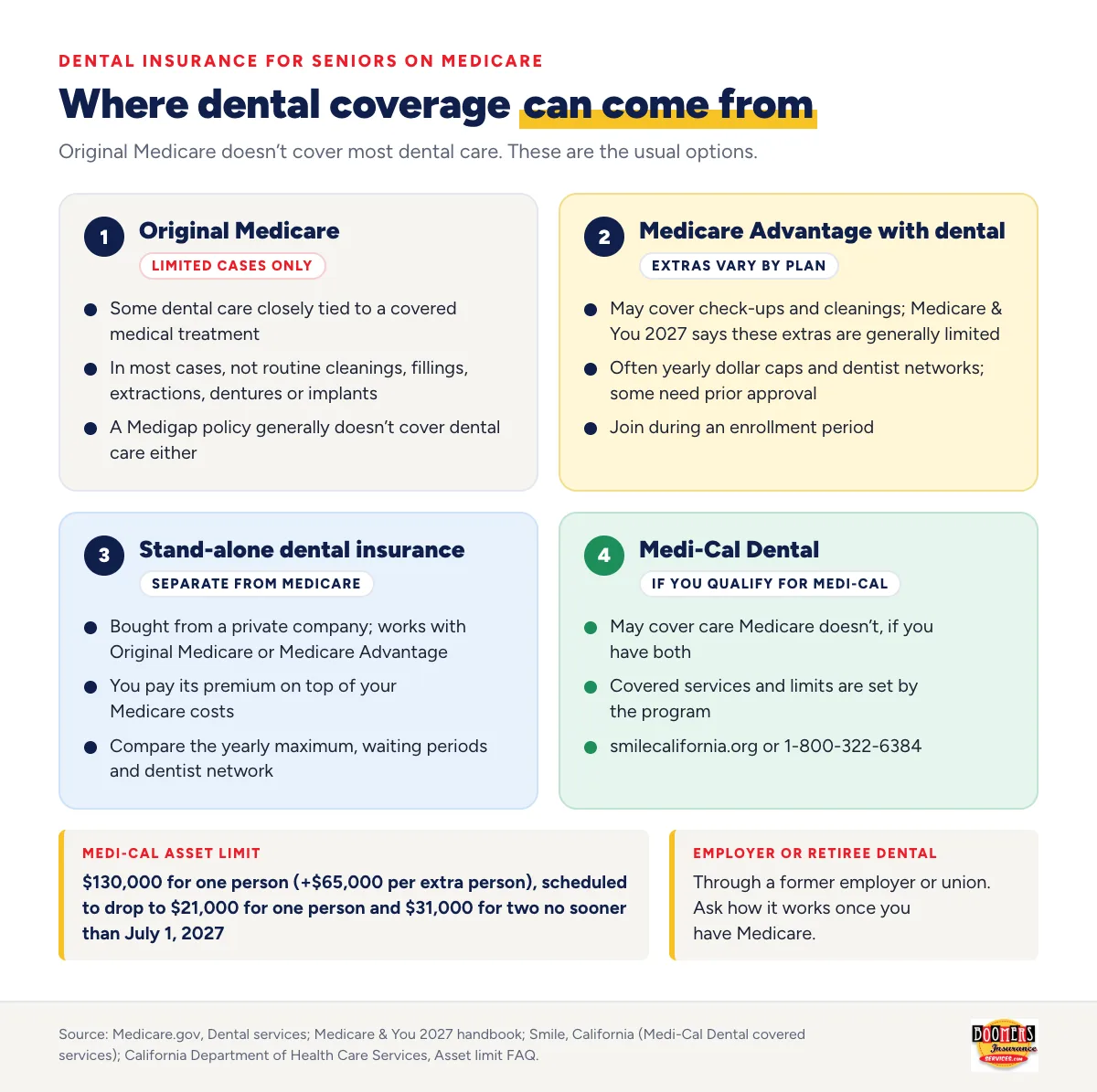
Dental insurance for seniors on Medicare usually comes from a Medicare Advantage plan with dental benefits, a stand-alone dental policy, or Medi-Cal Dental for those who qualify. Original Medicare doesn’t cover most dental care, like cleanings, fillings, extractions or dentures.
Dental insurance for seniors on Medicare usually comes from one of three places: a Medicare Advantage plan with dental benefits, a dental policy you buy on its own, or Medi-Cal Dental if you qualify. Why look at all? Original Medicare (Part A and Part B) doesn’t cover most dental care. That means cleanings, fillings, pulled teeth, dentures and implants.
Below, we explain what Medicare pays for in 2026, how each kind of dental plan works, and what to compare. For dental, vision and hearing in one place, see our overview, Does Medicare cover dental, vision and hearing?
What does Original Medicare cover for dental care?
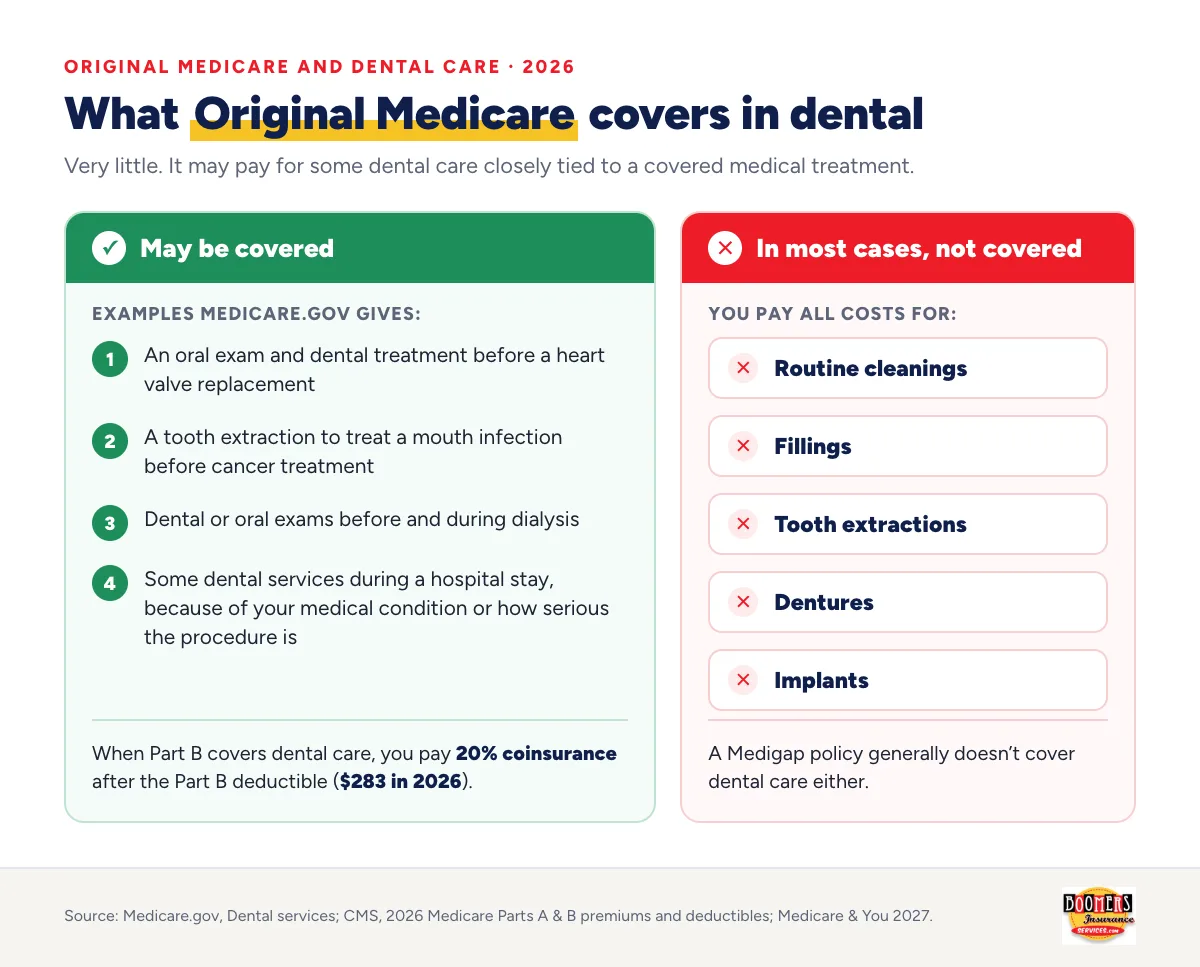
Very little. Medicare.gov says that in most cases Medicare doesn’t cover dental services like routine cleanings, fillings and tooth extractions, or items like dentures and implants. You pay all costs for those services.
Medicare may pay for some dental care that is closely tied to a covered medical treatment. Medicare.gov gives examples such as:
- An oral exam and dental treatment before a heart valve replacement
- A tooth extraction to treat a mouth infection before cancer treatment
- Dental or oral exams before and during dialysis
- Some dental services during a hospital stay, because of your medical condition or how serious the procedure is
When Part B does cover dental care, you pay 20% coinsurance after the Part B deductible ($283 in 2026). A Medigap policy generally doesn’t cover dental care either. Our article on Medicare vs Medigap explains what Medigap does pay.
Dental insurance for seniors on Medicare: your options
| Option | How you get it | Things to know |
|---|---|---|
| Medicare Advantage plan with dental | Join during an enrollment period | Benefits vary by plan, often with yearly dollar caps and dentist networks |
| Stand-alone dental insurance | Buy from a private company, separate from Medicare | You pay its premium on top of your Medicare costs |
| Medi-Cal Dental | If you qualify for Medi-Cal in California | Covered services and limits are set by the program |
| Employer or retiree dental | Through a former employer or union | Ask how it works once you have Medicare |
How do Medicare Advantage dental benefits work?
Medicare Advantage plans are offered by private companies that contract with Medicare. The Medicare & You 2027 handbook says these plans may cover dental check-ups and cleanings, which Original Medicare doesn’t. It adds that these extras are generally limited. So check with the plan before you join.
Dental is a common extra, but Medicare & You 2027 says these extra benefits are generally limited, so check with the plan. Dental benefits differ from plan to plan:
- Some plans cover preventive care only, like cleanings and X-rays. Others also cover more, like crowns or dentures.
- Many plans cap how much they pay for dental care each year.
- Plans may limit how many services you can get a year.
- Some plans make you use a network of dentists.
- Some plans require prior approval for some dental care.
A dental benefit is one part of a plan. Check the plan’s doctors, hospitals and drug list first. Our article on Medicare Advantage HMO vs PPO explains how plan networks work.
Questions to ask about a plan’s dental benefit
- Does it cover only cleanings and exams, or also fillings, extractions, crowns and dentures?
- Is there a yearly dollar cap, and how much of it is left for major work?
- Do I have to use a dentist in the plan’s network? Is my dentist in it?
- Is prior approval needed, and for which services?
- Where is the dental benefit described in the Evidence of Coverage, and can it change next year?
Stand-alone dental insurance: what to compare
You can also buy stand-alone dental insurance from a private company. It isn’t part of Medicare, so it works the same with Original Medicare or a Medicare Advantage plan. Medicare’s dates don’t apply to it. Ask the company when your coverage can start.
Dental plans for seniors differ a lot. Before you buy, compare:
- What it covers: preventive care only, or also basic and major work like crowns, dentures and implants
- The yearly maximum the policy will pay
- Waiting periods before some services are covered
- Dentists: whether you must use a network, and whether yours is in it
- The premium, and how it adds up over a year against what you expect to use
Some products sold as dental “discount plans” are not insurance. Read whether a product is an insurance policy before you buy it.
Medi-Cal Dental for people with Medicare and Medi-Cal
If you have both Medicare and Medi-Cal, Medi-Cal Dental may cover care Medicare doesn’t. To learn what it covers for adults and to find a dentist, visit smilecalifornia.org or call the Medi-Cal Dental Telephone Service Center at 1-800-322-6384, Monday to Friday, 8 AM to 5 PM.
Medi-Cal has an asset limit for most people 65 and older: $130,000 for one person, plus $65,000 for each additional person, through June 30, 2027. It is scheduled to drop to $21,000 for one person and $31,000 for two no sooner than July 1, 2027. If you have both programs, our article on Medi-Medi Plans explains how they can work together.
When can you change your dental coverage?
Medicare Advantage dental benefits come with the plan, so you change them when you change plans:
- Open Enrollment, October 15 – December 7. Changes start January 1, 2027. See our Annual Enrollment 2027 guide.
- Medicare Advantage Open Enrollment Period, January 1 – March 31. If you’re already in a Medicare Advantage plan, you can make one change.
- Special Enrollment Periods, after certain life events like a move.
A stand-alone dental policy has its own start dates. Ask the company.
Next steps
- List the dental work you expect, like cleanings, a crown or dentures.
- Ask your dentist which plans and networks they accept.
- Compare the yearly maximum and waiting periods of each option, not just the premium.
- Check Medi-Cal if your income and assets are limited, keeping the asset limit change scheduled for July 2027 in mind.
- Review your Medicare plan during Open Enrollment if dental benefits matter to you.
Talk with a licensed Boomers agent
A licensed Boomers agent can go over the Medicare plans we represent in your area and check them against your doctors and prescriptions. We can also read the dental benefit in each plan’s Evidence of Coverage with you.
Find a licensed agent near you · See upcoming Medicare events
Or call 1-800-815-1943 (TTY 711), Monday – Friday, 9 AM – 5 PM Pacific.
Frequently asked questions
Does Medicare cover dentures?
In most cases, Original Medicare doesn’t pay for dentures or implants. You pay the full cost. Some Medicare Advantage plans and stand-alone dental policies cover dentures, often up to a yearly limit. If you have Medi-Cal, ask Medi-Cal Dental what it covers.
What are the dental coverage options for retirees on Medicare?
Retirees can look at four main kinds of dental insurance for seniors on Medicare: a Medicare Advantage plan with dental, a stand-alone dental policy, Medi-Cal Dental if they qualify, and dental from a former job or union. Each has its own costs, limits and dentist rules.
Can I have Original Medicare and stand-alone dental insurance?
Yes. A stand-alone dental policy isn’t part of Medicare, so you can buy one as well as Original Medicare. You can have Medigap too. You pay the dental premium on its own.
Does Medigap cover dental care?
Generally, no. Medigap helps pay your share for care Original Medicare covers, and that leaves out most dental work. The Medicare & You 2027 handbook says Medigap generally doesn’t cover dental care.
Sources
- Dental services (Medicare.gov)
- Medicare & You 2027 handbook (Medicare.gov)
- What Medigap covers (Medicare.gov)
- 2026 Medicare Parts A & B premiums and deductibles (CMS.gov)
- Medi-Cal Dental covered services (Smile, California)
- Asset limit frequently asked questions (California Department of Health Care Services)
Talk with a licensed Boomers agent
A licensed agent can go over the Medicare plans we represent in your area, check them against your doctors and prescriptions, and answer your questions. There is no cost to you and no obligation to enroll.
Monday – Friday, 9 AM – 5 PM PT