
PACE Eligibility Requirements in California: Who Can Join
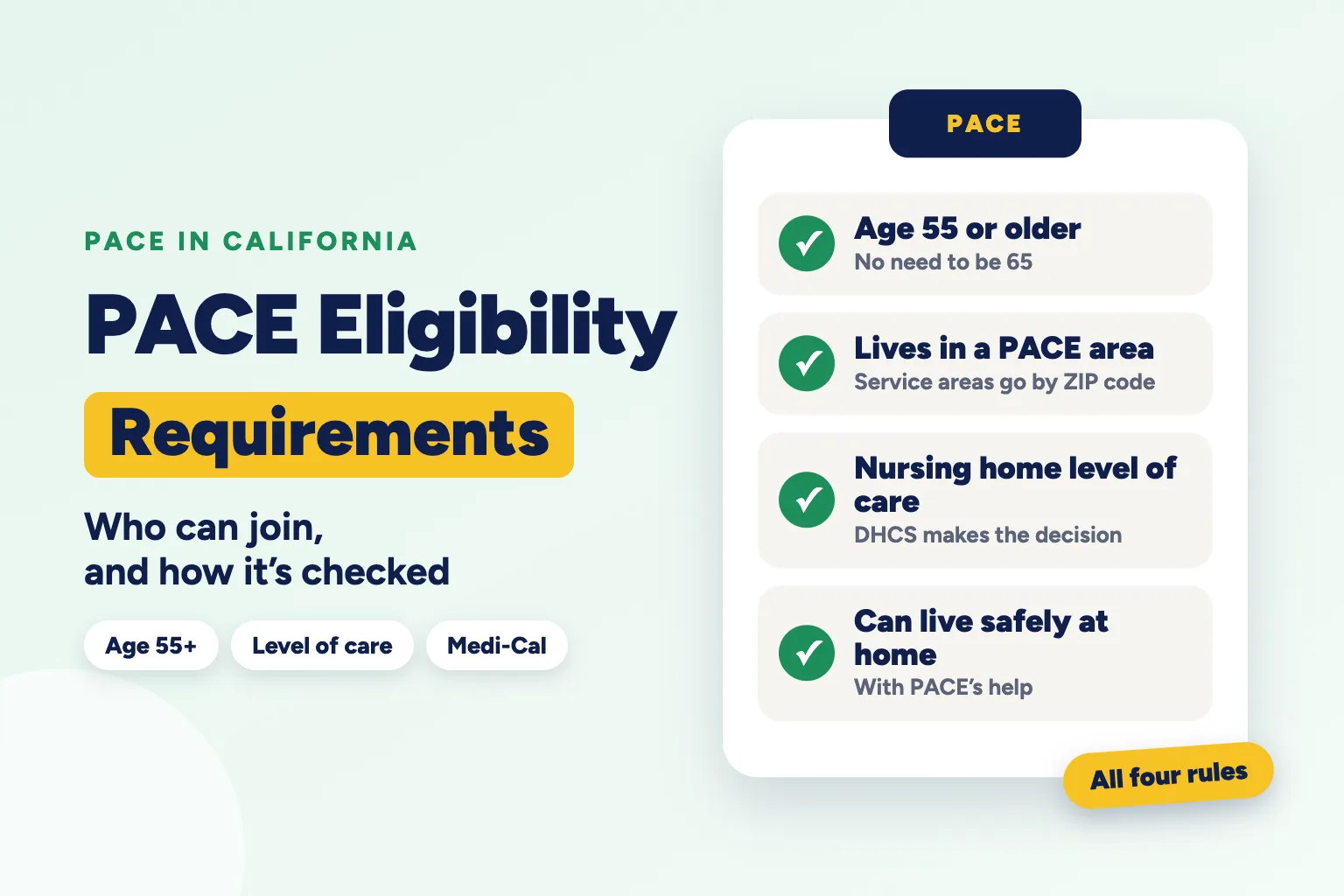
PACE eligibility requirements come down to four rules: you are 55 or older, you live in a PACE service area, the state certifies that you need a nursing home level of care, and you can live safely in the community with PACE’s help.
The PACE eligibility requirements are short, but each one has a rule behind it. PACE, the Program of All-Inclusive Care for the Elderly, is a Medicare and Medicaid program. In California, Medicaid is called Medi-Cal. PACE helps people who need a nursing home level of care keep living at home, with one care team that arranges their care.
This article explains who can join in 2026, how California checks your care needs, and what Medicare or Medi-Cal changes. For the full picture of the program, see our guide to PACE in California.
What are the PACE eligibility requirements?
There are four. Medicare.gov and the California Department of Health Care Services (DHCS) list the same ones. You must meet all four when you join:
- You are 55 or older. You don’t have to be 65, so some people join before they have Medicare.
- You live in a PACE service area. Each PACE organization serves certain ZIP codes, and PACE is not offered in every part of California.
- You need a nursing home level of care. DHCS decides this, not the PACE organization alone.
- You can live safely in the community with PACE’s help. This is checked at the time you join.
Medicare.gov also notes that PACE exists only in states that offer it under Medicaid. California is one of them.
| Requirement | Who checks it |
|---|---|
| Age 55 or older | PACE staff, during intake |
| Lives in a PACE service area | PACE staff, during intake |
| Nursing home level of care | DHCS makes the final decision |
| Can live safely in the community | PACE staff, using the state’s criteria |
How does the PACE level of care assessment work in California?
The PACE level of care assessment checks whether you need the level of care that Medi-Cal requires to cover nursing home care. In California, both the PACE team and DHCS assess you, and DHCS makes the level of care decision.
Who does the assessment?
Federal PACE rules say the state must assess every applicant for this level of care, including people who don’t have Medi-Cal. DHCS says a person must “be determined eligible at the nursing home level of care by the Department of Health Care Services.” The PACE organization’s care team, often called the interdisciplinary team, does its own assessments before DHCS decides.
What happens during intake?
Intake is the PACE word for the sign-up visits. Under federal rules, PACE staff visit you at home at least once, and you visit the PACE center at least once. During intake, staff must explain:
- How PACE works, using a copy of the enrollment agreement
- That the PACE organization becomes your only source of care
- Who provides care, including its list of contracted providers
- Any monthly premium, and any Medi-Cal amount you may owe
You also sign a release so the PACE organization can get your medical and financial records. The PACE team checks that it can care for you safely in the community.
Does the level of care get checked again?
Yes. Federal rules say the state must check at least once a year whether you still need a nursing home level of care. The state may waive this yearly check when no improvement is expected. If your health improves, you may still stay in PACE until the next yearly review, if you would likely need that level of care again within 6 months without PACE.
Can you join PACE without Medi-Cal or Medicare?
Yes. Federal rules say you may have Medicare Part A, Part B, Medicaid, any mix of them, or none. What you have changes what you pay, not whether you can join. The Centers for Medicare & Medicaid Services (CMS) says most people in PACE have both Medicare and Medicaid.
| Your coverage | Can you apply? | What it means for cost |
|---|---|---|
| Medicare and Medi-Cal | Yes | No monthly premium for PACE |
| Medi-Cal only | Yes | No monthly premium for PACE |
| Medicare only | Yes | A monthly premium for the long-term care part, plus a Part D premium |
| Neither | Yes | You pay the PACE premium yourself |
In every row, you still need to meet the four requirements. A PACE organization's agreement with the state may also add a few program-specific conditions.
A Medi-Cal share of cost may still apply. Our article on what PACE costs in California explains each case.
If you have Medicare
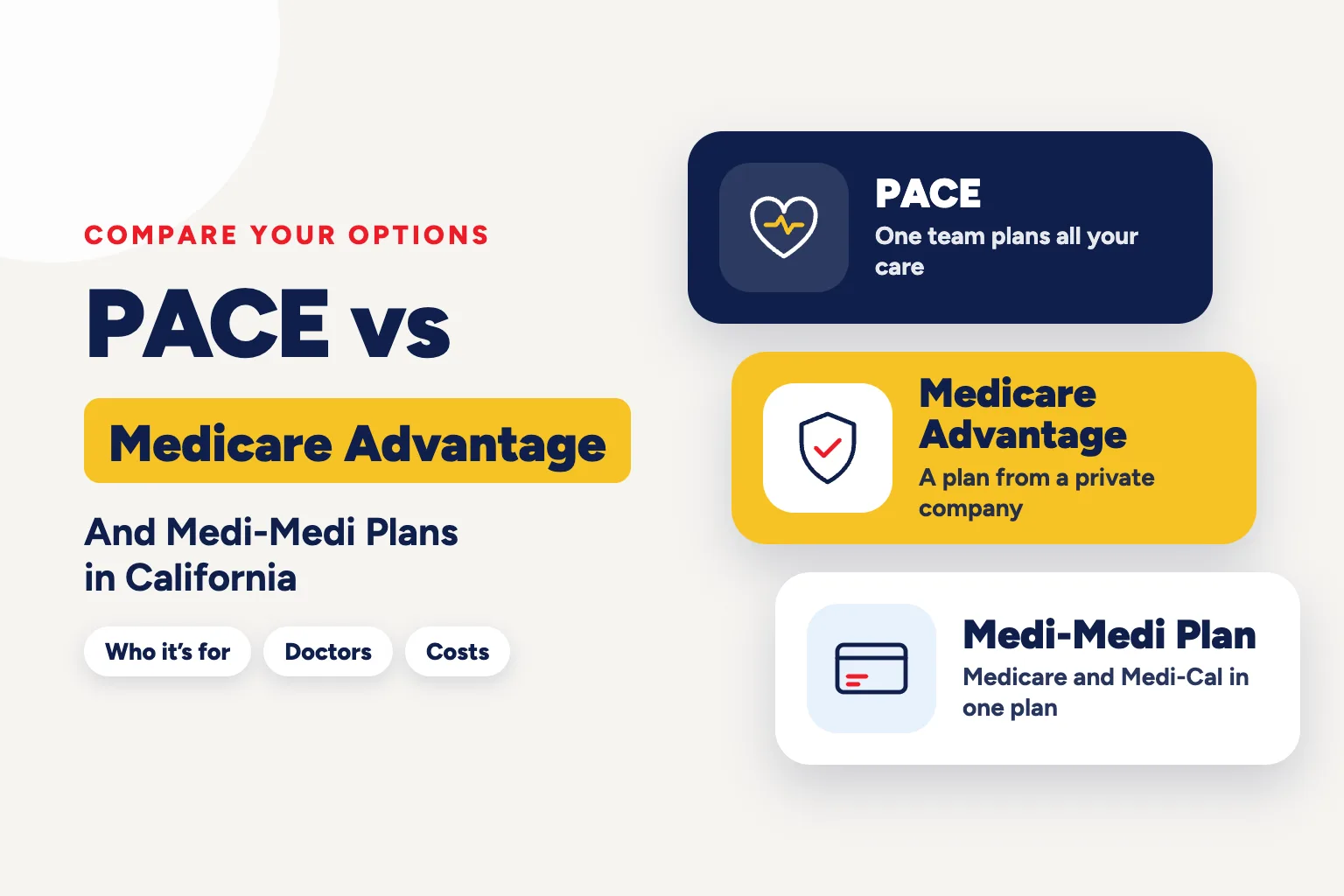
If you join PACE, you get your Part D drugs and other needed medicines from PACE. Medicare.gov warns that joining a separate Medicare drug plan while in PACE ends your PACE enrollment. Federal rules also say joining PACE ends any other Medicare or Medicaid prepaid plan, such as a Medicare Advantage plan.
If you have Medi-Cal only
People 55 to 64 often have Medi-Cal but not Medicare yet. They can apply for PACE too. When they become eligible for Medicare, federal rules say choosing Medicare coverage from anyone other than the PACE organization ends PACE enrollment.
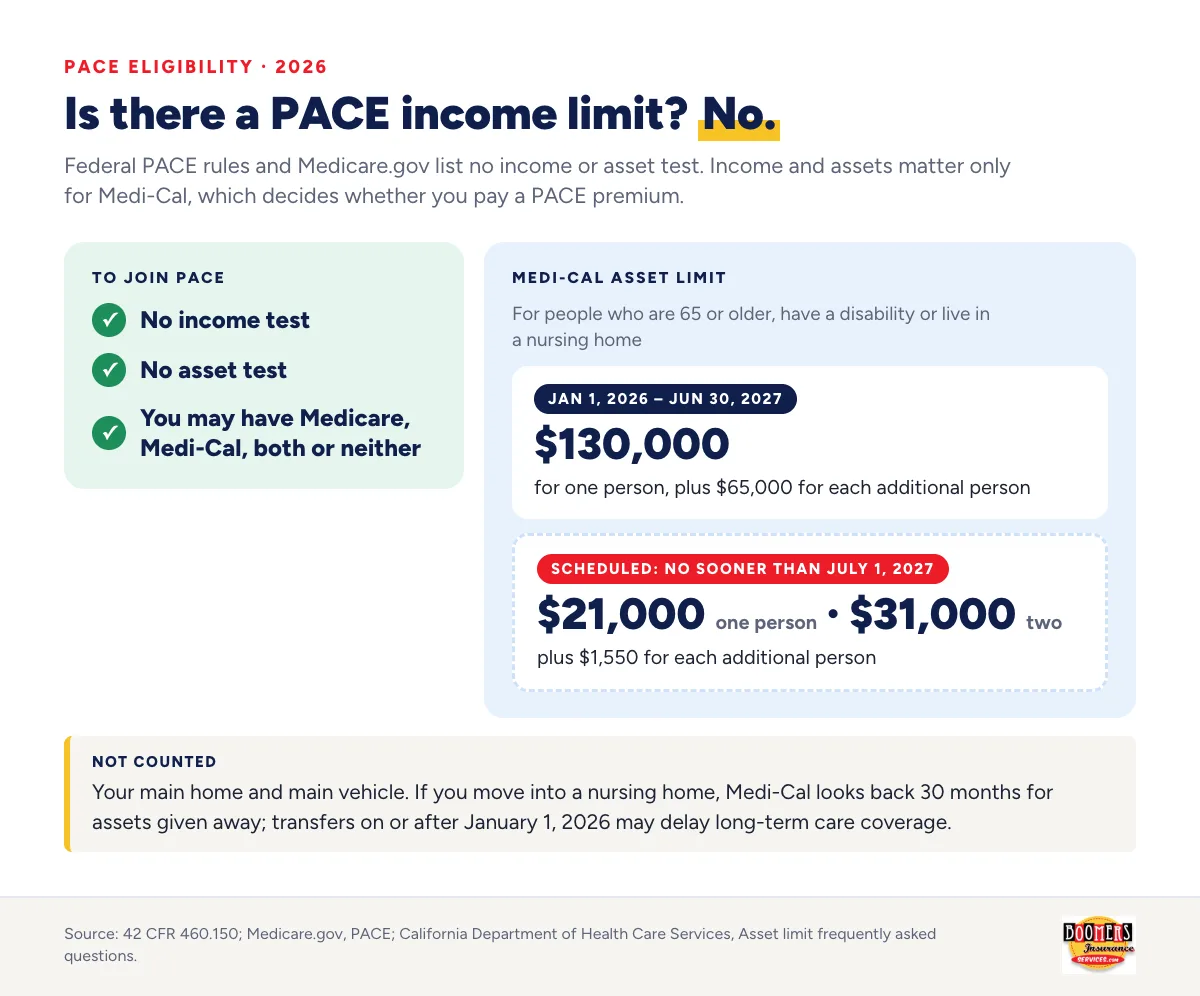
Is there a PACE income limit?
No. The federal PACE rules list no income or asset test, and Medicare.gov lists none. Income and assets matter only for Medi-Cal, which decides whether you pay a PACE premium.
Medi-Cal has its own income rules. Since January 1, 2026, it also has an asset limit for people who are 65 or older, have a disability or live in a nursing home:
- January 1, 2026 – June 30, 2027: $130,000 for one person, plus $65,000 for each additional person
- Scheduled change: the limit is scheduled to drop to $21,000 for one person and $31,000 for two no sooner than July 1, 2027, plus $1,550 for each additional person
Your main home and main vehicle are not counted. If you move into a nursing home, Medi-Cal looks back 30 months for assets given away; transfers on or after January 1, 2026 may delay long-term care coverage. See our Medi-Cal asset limit guide for the details, and ask your county office about the income rules.
What services does PACE include once you join?
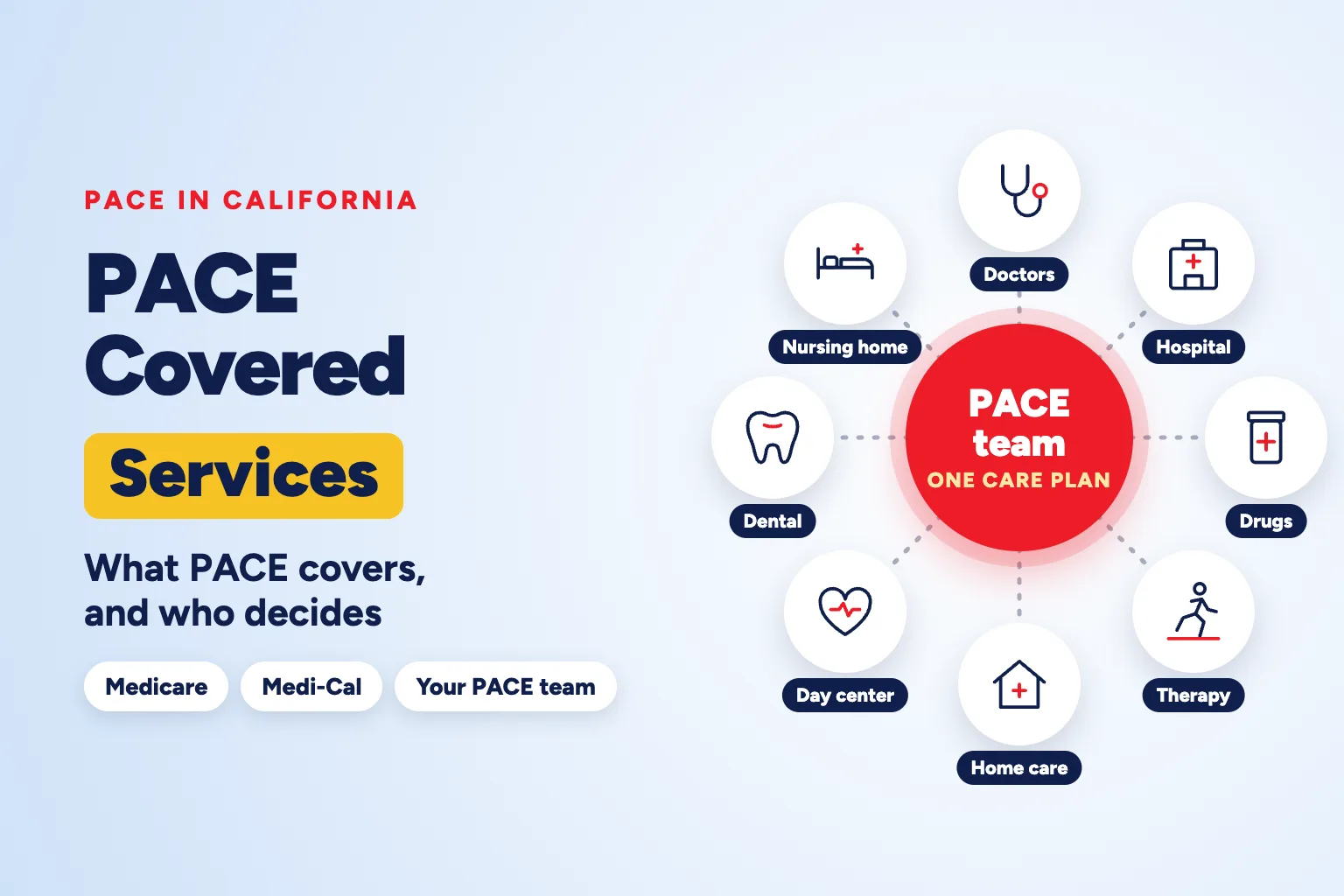
PACE covers all Medicare- and Medicaid-covered care, plus other care your PACE team decides you need. Medicare.gov lists services such as:
- Primary care, specialists, hospital care and emergency care
- Prescription drugs, lab work and X-rays
- Home care, personal care and adult day care at the PACE center, with meals
- Physical, occupational and speech therapy
- Nursing home care when medically necessary
- Transportation to the PACE center and to medical appointments
You get your care from the PACE organization and the providers it works with. Our PACE in California guide has more on the care team and the PACE center.
PACE or other options for care at home?
PACE is one of several ways to get help at home in California, and it isn’t the right fit for everyone. If you don’t meet the PACE eligibility requirements, or there is no PACE organization near you, other programs may help:
- In-Home Supportive Services (IHSS): help at home for Medi-Cal members, through your county IHSS office
- Multipurpose Senior Services Program (MSSP): for Medi-Cal members 60 or older who could qualify for nursing home care
- Medi-Medi Plans: Medicare plans for people with Medicare and full Medi-Cal. See our Medi-Medi plan article.
- A nursing home: Medicare pays only for short skilled stays. Our article on Medicare and long-term care explains the limits.
How to apply for PACE
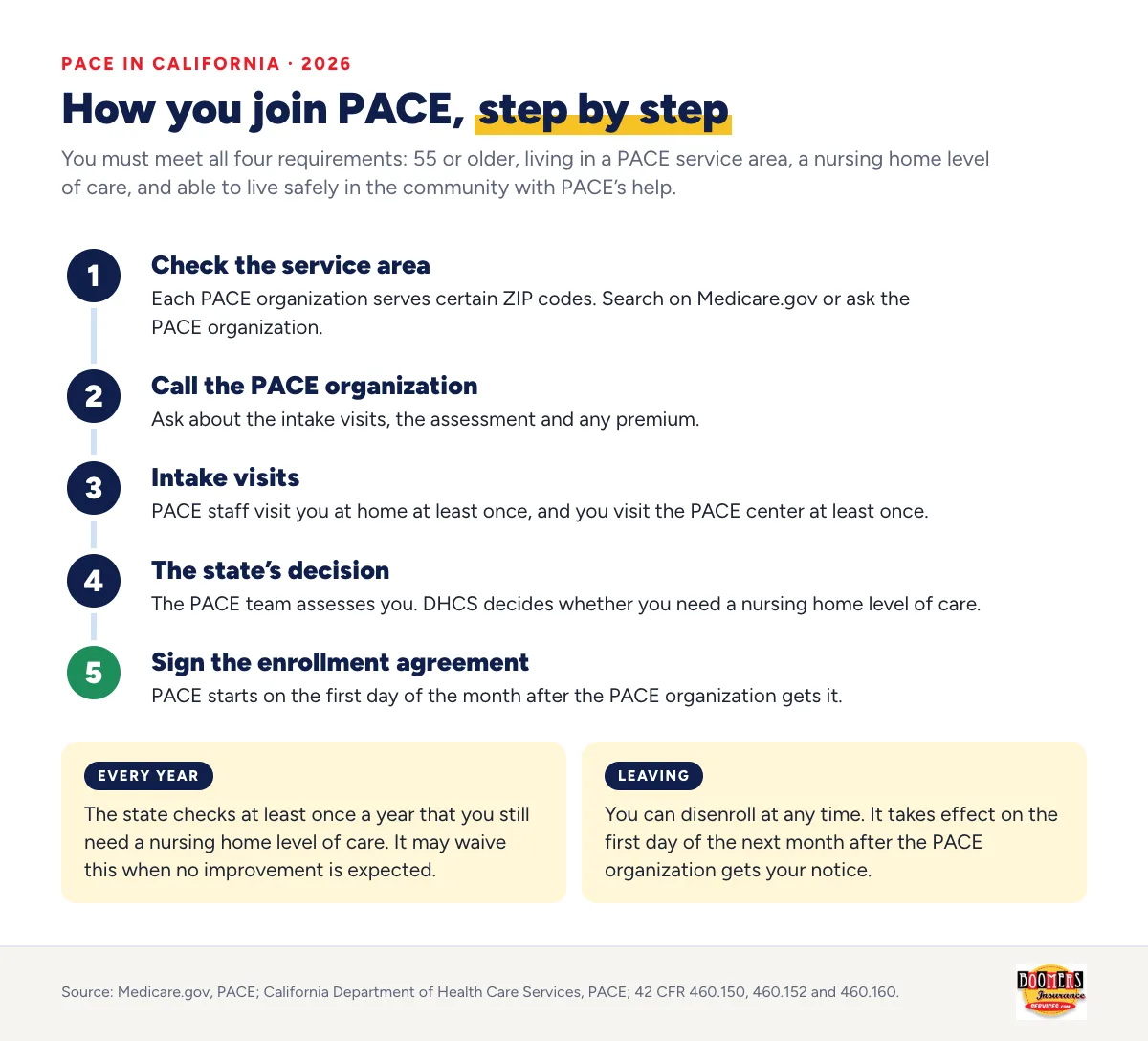
To apply, contact a PACE organization that serves your ZIP code. You can search on Medicare.gov or call your Medi-Cal office. Then follow these steps:
- Check the service area. Use the PACE search on Medicare.gov, or ask the PACE organization whether it serves your address.
- Call the PACE organization. Ask about intake visits, the assessment and any premium.
- Complete intake and the assessment. The PACE team assesses you, and DHCS decides on the level of care.
- Sign the enrollment agreement. PACE starts on the first day of the month after the PACE organization gets your signed agreement.
If you have Medicare, you can’t join or leave PACE at a Social Security office. You can disenroll at any time; leaving takes effect on the first day of the next month after the PACE organization gets your notice. For neutral help, call HICAP, California’s Health Insurance Counseling & Advocacy Program, at 1-800-434-0222.
Next steps
You don’t need to have every answer before you call. These steps help you check the PACE eligibility requirements for yourself or a family member:
- Look up whether a PACE organization serves your ZIP code.
- Write down the help needed each day, such as bathing, dressing, medicines or getting around, before the assessment.
- Check your coverage: Medicare, Medi-Cal, both or neither. It decides what you pay.
- Ask the PACE organization about premiums and any Medi-Cal amount you may owe.
- Call HICAP at 1-800-434-0222 if you want neutral help with Medicare questions.
Talk with a licensed Boomers agent
A licensed Boomers agent can go over the Medicare plans we represent in your area and check them against your doctors and prescriptions. We can also explain how PACE and Medi-Medi plans work. Boomers doesn’t decide PACE eligibility; the PACE organization and DHCS do.
Find a licensed agent near you · See upcoming Medicare events
Or call 1-800-815-1943 (TTY 711), Monday – Friday, 9 AM – 5 PM Pacific.
Frequently asked questions
Who qualifies for PACE?
You may qualify if you are 55 or older, live in a PACE service area, are certified by the state as needing a nursing home level of care, and can live safely in the community with PACE’s help. In California, DHCS makes the level of care decision.
Do I need Medicare to join PACE?
No. You may be able to join with Medicare, Medi-Cal, both or neither, if you meet the PACE requirements. If you have neither, you pay the PACE premium yourself.
Is there an age limit for PACE?
The only age rule is a minimum: you must be 55 or older. There is no upper age limit.
What happens if my health gets better while I’m in PACE?
The state checks your level of care at least once a year. If you no longer meet it, you may be able to stay until the next yearly review if you would likely need that care again within 6 months without PACE. Ask the PACE organization how this works for you.
Can I leave PACE after I join?
Yes. You can disenroll at any time, and it takes effect on the first day of the month after the PACE organization gets your notice. If you joined PACE when you first got Medicare at 65 and leave within the first year, you may have a Medigap trial right: the right to buy a Medigap policy without medical questions.
Sources
- PACE (Medicare.gov)
- Medicare & You 2027 handbook, page 77 (Medicare.gov)
- Program of All-Inclusive Care for the Elderly (California Department of Health Care Services)
- Programs of All-Inclusive Care for the Elderly (CMS.gov)
- 42 CFR 460.150, eligibility to enroll in a PACE program (eCFR)
- 42 CFR 460.152, enrollment process (eCFR)
- 42 CFR 460.160, continuation of enrollment (eCFR)
- Asset limit frequently asked questions (California Department of Health Care Services)
- Health Insurance Counseling & Advocacy Program (California Department of Aging)
Talk with a licensed Boomers agent
A licensed agent can go over the Medicare plans we represent in your area, check them against your doctors and prescriptions, and answer your questions. There is no cost to you and no obligation to enroll.
Monday – Friday, 9 AM – 5 PM PT