
PACE Program Cost in California: What You Pay in 2026
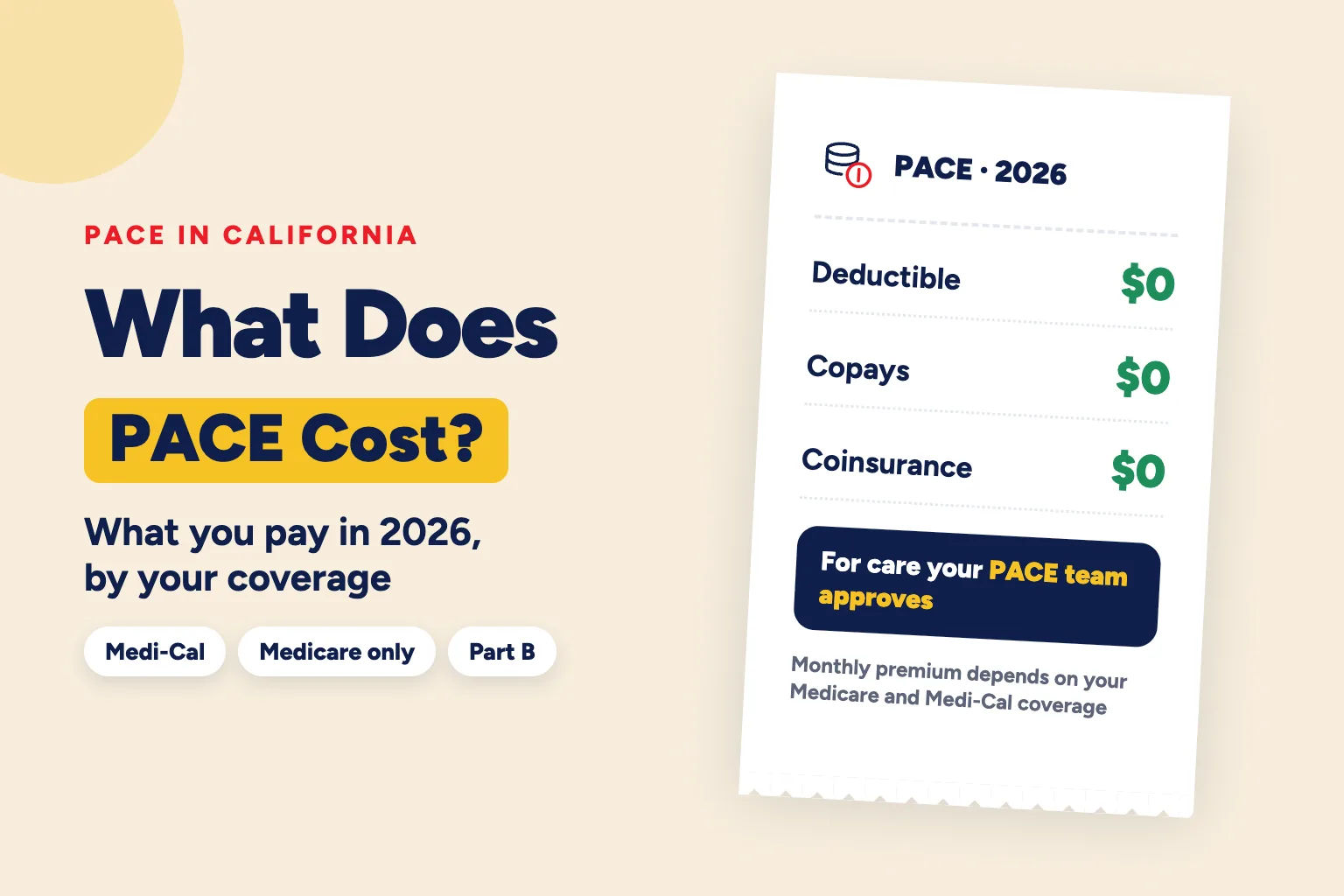
The PACE program cost depends on your coverage. With Medi-Cal, you won’t pay a monthly premium for PACE. With Medicare only, you pay a monthly premium for the long-term care part plus a Part D premium. With neither, you pay the PACE premium yourself.
The PACE program cost comes down to one question: do you have Medi-Cal, Medicare, both or neither? PACE, the Program of All-Inclusive Care for the Elderly, is a Medicare and Medicaid program. In California, Medicaid is called Medi-Cal. It serves people 55 or older who need a nursing home level of care and can live safely in the community with PACE’s help.
This article explains what you pay in 2026 in each case, what happens to your Part B premium, and the one cost trap to know about. For how the program works, see our guide to PACE in California.
How much does PACE cost?
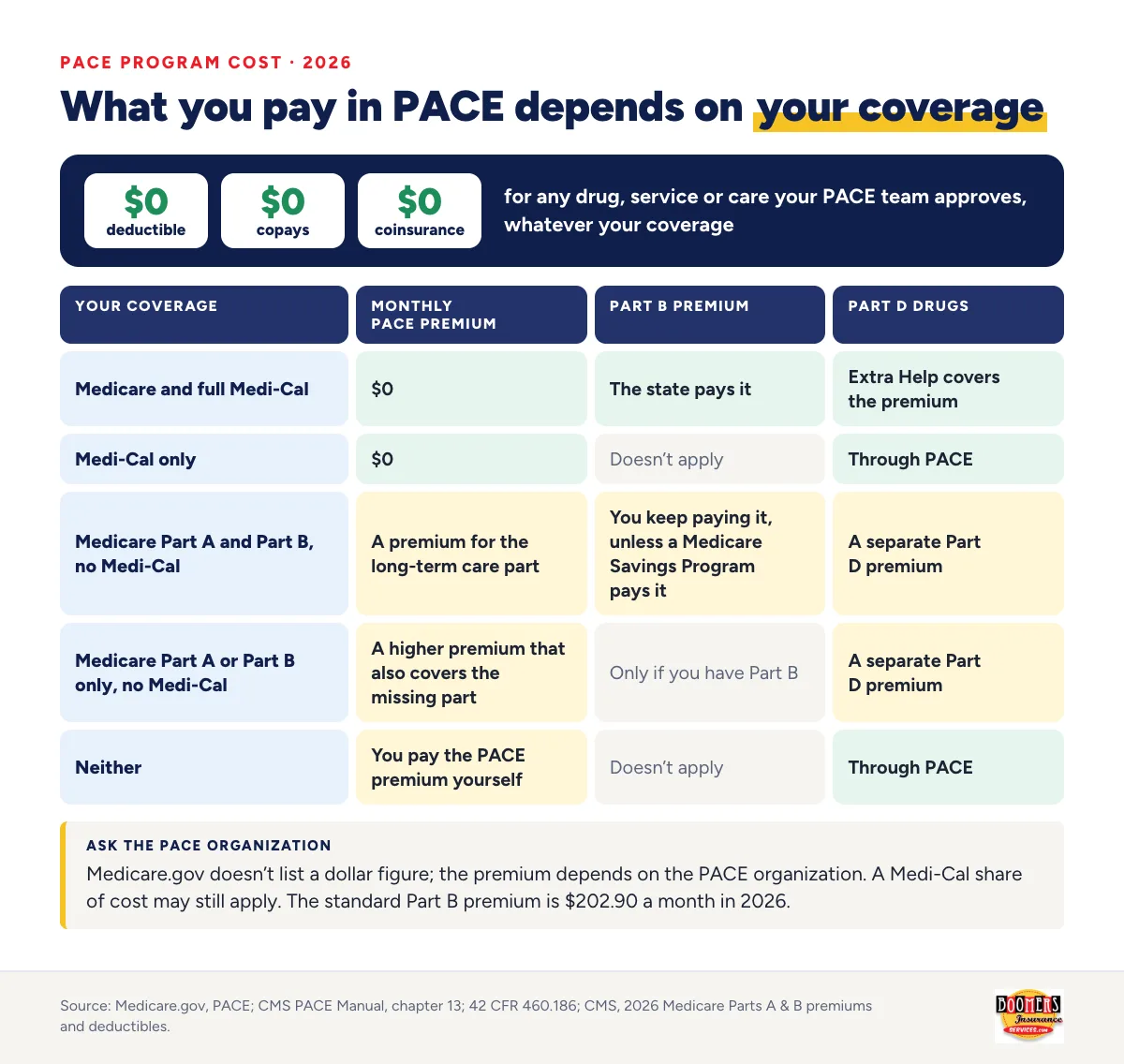
It depends on your coverage. Medicare.gov and federal rules set out who pays a monthly premium for PACE. Medicare.gov doesn’t list a dollar figure; the amount depends on the PACE organization, so ask it for the number:
| Your coverage | Monthly PACE premium | Part B premium | Part D drugs |
|---|---|---|---|
| Medicare and full Medi-Cal | None | The state pays it | Extra Help covers the premium |
| Medi-Cal only | None | Doesn’t apply | Through PACE |
| Medicare Part A and Part B, no Medi-Cal | A premium for the long-term care part | You keep paying it, unless a Medicare Savings Program pays it | A separate Part D premium |
| Medicare Part A or Part B only, no Medi-Cal | A higher premium that also covers the missing part | Only if you have Part B | A separate Part D premium |
| Neither | You pay the PACE premium yourself | Doesn’t apply | Through PACE |
In every case, there is no deductible, copayment or coinsurance for any drug, service or care your PACE team approves.
What does PACE cost with Medi-Cal?
With Medi-Cal, you don’t pay a monthly premium for PACE. Medicare.gov says that if you have Medicaid (Medi-Cal in California), you won’t pay a monthly premium for the PACE benefit. Federal rules say the same for people with Medi-Cal only.
A share of cost may still apply
Some people have Medi-Cal with a share of cost. That is an amount you pay, or agree to pay, toward medical bills each month before Medi-Cal pays. The Centers for Medicare & Medicaid Services (CMS) says a share of cost is not a PACE premium. A PACE organization can still collect it, along with any amount Medi-Cal says you owe from your income. Ask the PACE organization what you may owe each month.
Part B and Part D with Medi-Cal
If you have Medicare and full Medi-Cal, Medicare.gov says the state pays your Part B premium. You also get Extra Help automatically, and CMS says it covers the monthly Part D premium for these PACE members. Our article on Extra Help and the Medicare Savings Programs explains both.
What is the PACE premium for Medicare only?
If you have Medicare but not Medi-Cal, Medicare.gov says you pay two things each month:
- A monthly premium for the long-term care part of PACE
- A premium for Medicare Part D drugs
Federal rules set the long-term care premium equal to the amount Medi-Cal would pay the PACE organization for a member. If you have only Part A or only Part B, the premium also covers what Medicare would have paid for the missing part. That makes it higher.
The PACE organization must tell you its monthly premium during intake, before you sign up. The enrollment agreement you sign must also describe any premium and how you pay it.
Can Medi-Cal help with the premium later?
Possibly. Medi-Cal has income rules. Since January 1, 2026, it also has an asset limit for people who are 65 or older, have a disability or live in a nursing home: $130,000 for one person plus $65,000 for each additional person. It is scheduled to drop to $21,000 for one person and $31,000 for two no sooner than July 1, 2027, plus $1,550 for each additional person. Our Medi-Cal asset limit guide explains what counts. If you qualify for Medi-Cal, the PACE organization can’t charge you a premium, though a share of cost may still apply.
What happens to the Part B premium in PACE?
Joining PACE doesn’t end your Part B premium. CMS tells PACE organizations to remind members that, unless they also have Medicaid, they keep paying the Part B premium. CMS also says a PACE organization shouldn’t pay it for you.
The standard Part B premium is $202.90 a month in 2026. Some people with higher incomes pay more. If you pay a premium for Part A, that continues too. If you have full Medi-Cal, the state pays your Part B premium. A Medicare Savings Program can also pay it, if you qualify.
PACE private pay: what if you have neither?
If you don’t have Medicare or Medi-Cal, Medicare.gov says you can pay the PACE premium yourself. This is called private pay. CMS says a PACE organization may charge these members the Medicare and Medi-Cal amounts combined. If it does, the premium is higher than the Medicare-only premium. Ask the PACE organization for its figure.
People 55 to 64 often don’t have Medicare yet. If you’re close to 65, or could qualify for Medi-Cal, the cost may change soon. Ask HICAP, California’s Health Insurance Counseling & Advocacy Program, at 1-800-434-0222.
Which PACE services have no copays?
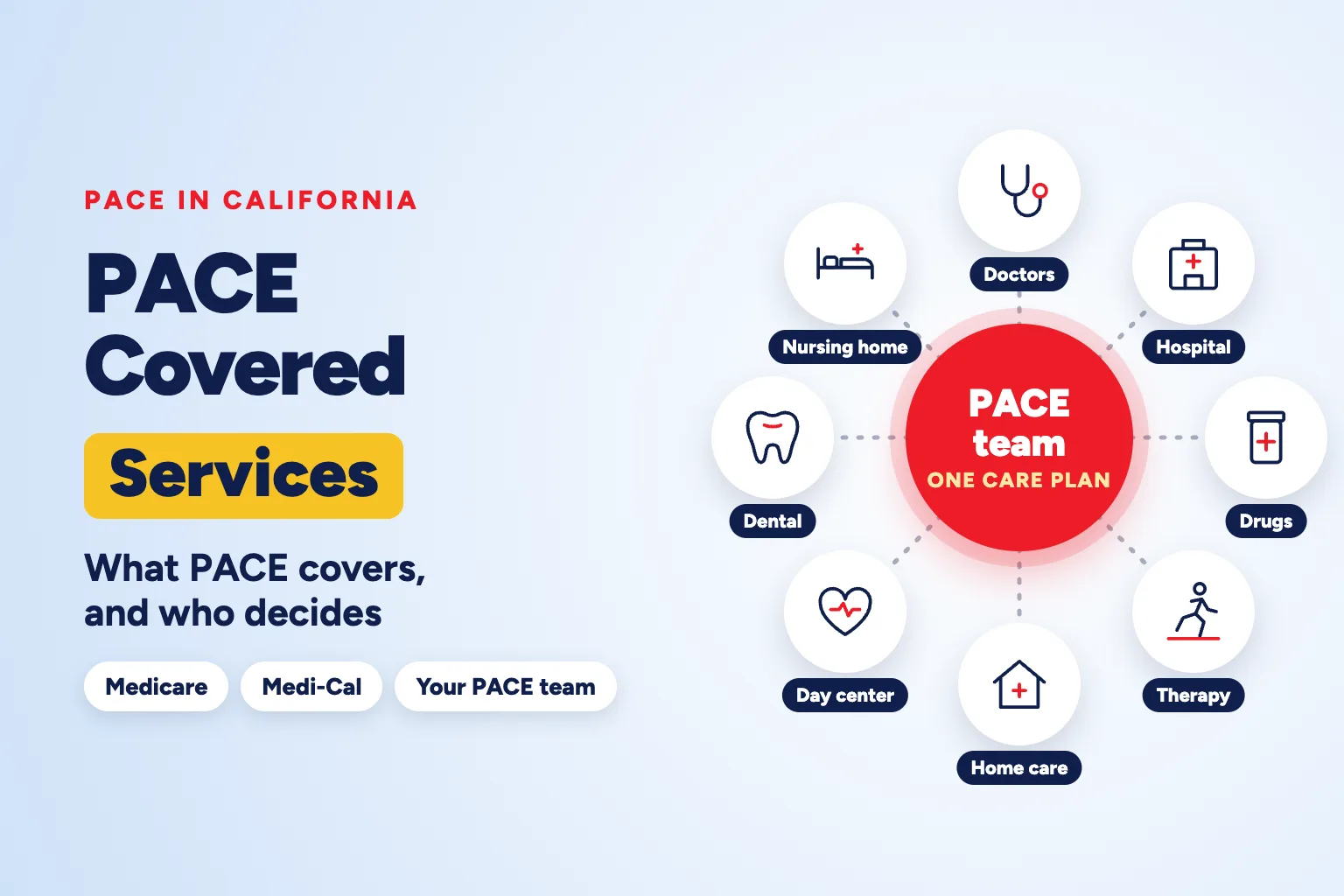
PACE covers all Medicare- and Medicaid-covered care, plus other care your PACE team decides you need. Federal rules say the usual Medicare and Medicaid deductibles, copayments and coinsurance don’t apply. Covered care includes:
- Primary care, specialists, hospital care and emergency care
- Prescription drugs, lab work and X-rays
- Home care, personal care and adult day care at the PACE center, with meals
- Physical, occupational and speech therapy
- Nursing home care when medically necessary
- Transportation to the PACE center and to appointments
What if you get care outside the PACE team?
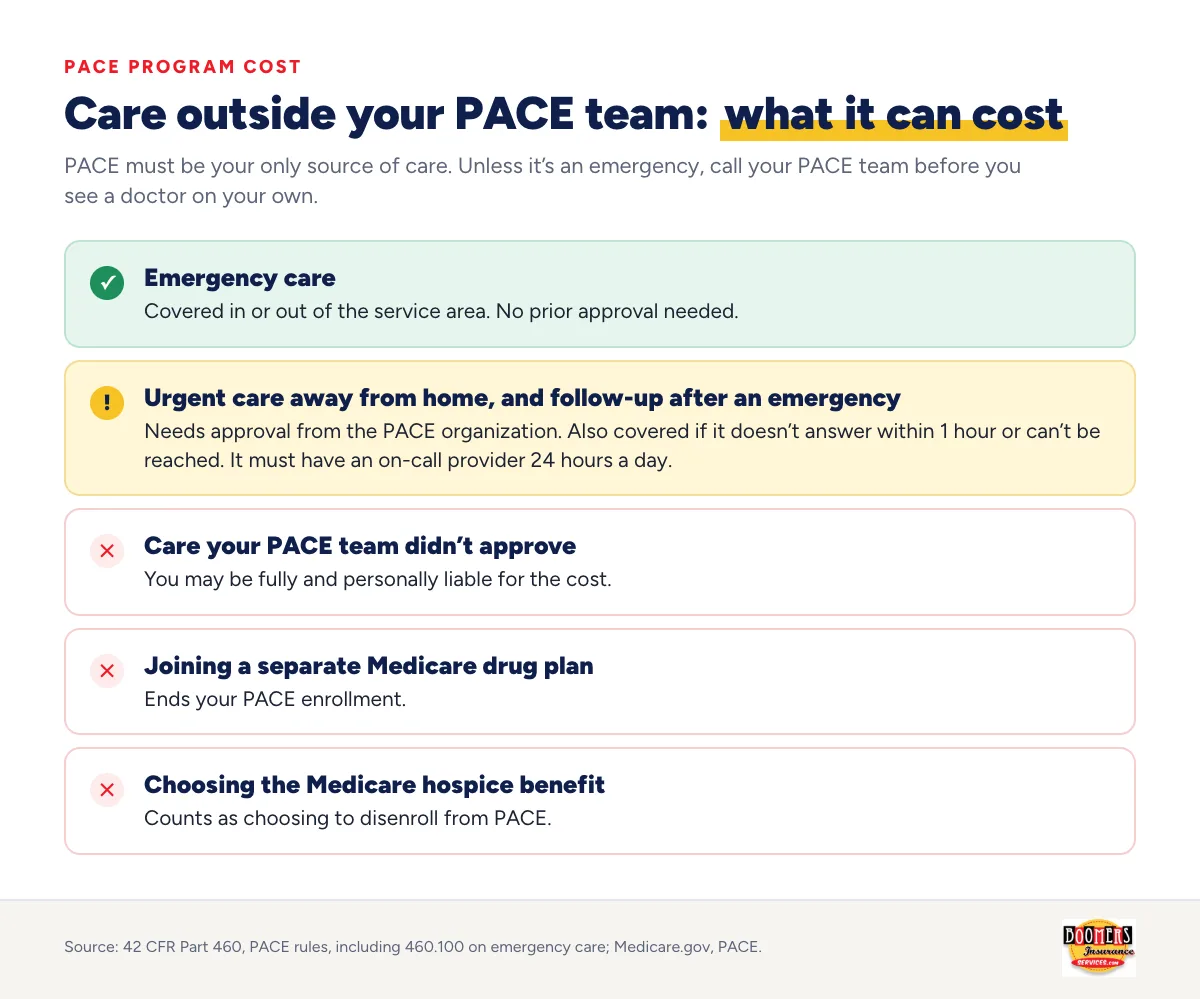
Here is the cost risk to understand before you join. PACE must be your only source of care. Federal rules say PACE members “may be fully and personally liable for the costs of unauthorized or out-of-PACE program agreement services.”
Emergencies work differently, and two other choices affect your PACE coverage:
- Emergency care doesn’t need prior approval, in or out of the service area.
- Urgent care away from home, and follow-up care after an emergency, need approval from the PACE organization. They are also covered if the PACE organization doesn't answer within 1 hour or can't be reached. It must have an on-call provider 24 hours a day.
- A separate Medicare drug plan ends your PACE enrollment, Medicare.gov says.
- Choosing the Medicare hospice benefit counts as choosing to disenroll from PACE, under federal rules.
Unless it’s an emergency, call your PACE team before you see a doctor on your own.
PACE cost compared with other options
What PACE costs next to other ways of paying for long-term care depends on your coverage. Original Medicare doesn’t pay for long-term custodial care, and it covers skilled nursing facility care only for a short time, up to 100 days per benefit period. Medi-Cal can pay for nursing home care for people who qualify.
Medi-Cal also has estate recovery. The California Department of Health Care Services (DHCS) must seek repayment from the estates of some members who have died. It applies only to care received at 55 or older. For deaths since 2017, it is limited to what goes through probate, and to nursing facility, home and community-based and related hospital and drug services. Ask DHCS how it applies to PACE. Our article on Medicare and long-term care compares the options.
How to find out your PACE program cost
To learn your own PACE program cost, contact a PACE organization that serves your ZIP code. You can search on Medicare.gov or call your Medi-Cal office. Then:
- Check your coverage: Medicare Part A, Part B, Medi-Cal, or none.
- Ask the PACE organization for its monthly premium and the Part D premium, if you have Medicare only.
- Ask about any Medi-Cal share of cost or other amount you may owe.
- Check whether you meet the rules to join. Our article on PACE eligibility requirements explains them.
Next steps
You don’t need to work out the PACE program cost alone. These steps help you get a clear figure before anyone signs up:
- Write down your current coverage and what you pay for it each month.
- Ask the PACE organization for its premium in writing during intake.
- Apply for Medi-Cal if you might qualify, through your county office.
- Ask how emergencies and care away from home work, so there are no surprise bills.
- Call HICAP at 1-800-434-0222 for neutral help with Medicare questions.
Talk with a licensed Boomers agent
A licensed Boomers agent can go over the Medicare plans we represent in your area and check them against your doctors and prescriptions. We can also explain how PACE and Medi-Medi plans work. Boomers doesn’t set PACE premiums or decide eligibility; the PACE organization and DHCS do.
Find a licensed agent near you · See upcoming Medicare events
Or call 1-800-815-1943 (TTY 711), Monday – Friday, 9 AM – 5 PM Pacific.
Frequently asked questions
Does Medi-Cal pay for PACE?
Yes, if you qualify for Medi-Cal and meet the PACE requirements. Medicare.gov says that if you have Medicaid (Medi-Cal in California), you won’t pay a monthly premium for the PACE benefit. A Medi-Cal share of cost may still apply.
Do I still pay the Part B premium in PACE?
Yes, unless you have full Medi-Cal or a Medicare Savings Program pays it. CMS says members without Medicaid keep paying their Part B premium. The standard amount is $202.90 a month in 2026. With full Medi-Cal, the state pays it.
Are there copays in PACE?
No. There is no deductible, copayment or coinsurance for any drug, service or care your PACE team approves. You may have to pay for care the team didn’t approve, except in an emergency.
Why doesn’t Medicare.gov list a price for PACE?
Federal rules tie the premium to what Medi-Cal and Medicare would pay the PACE organization, so it can differ from one organization to the next. Ask the PACE organization that serves your ZIP code for its figure during intake.
Sources
- PACE (Medicare.gov)
- Medicare & You 2027 handbook, page 77 (Medicare.gov)
- Medicaid (Medicare.gov)
- PACE Manual, Chapter 13: Payments to PACE Organizations (CMS.gov)
- 42 CFR 460.186, PACE premiums (eCFR)
- 42 CFR 460.82, marketing (eCFR)
- 42 CFR 460.100, emergency care (eCFR)
- 2026 Medicare Parts A & B premiums and deductibles (CMS.gov)
- Program of All-Inclusive Care for the Elderly (California Department of Health Care Services)
- Asset limit frequently asked questions (California Department of Health Care Services)
- Estate Recovery Program (California Department of Health Care Services)
Talk with a licensed Boomers agent
A licensed agent can go over the Medicare plans we represent in your area, check them against your doctors and prescriptions, and answer your questions. There is no cost to you and no obligation to enroll.
Monday – Friday, 9 AM – 5 PM PT